













Science at work 15 October 2026

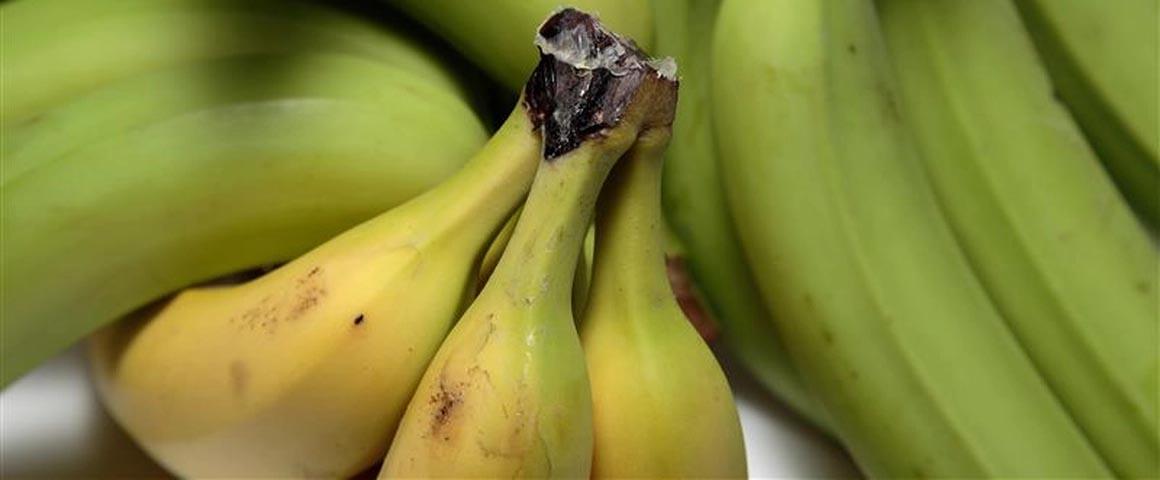
There will soon be banana varieties resistant to pathogens that satisfy consumer requirements © G. Brehinier, CIRAD
The banana sector in the French West Indies and other overseas regions, which faces a range of major challenges relating to reduced pesticide use, competitiveness, etc, is working to find innovative solutions for sustainable agroecological transition. Production is reliant on the Cavendish variety, which is very sensitive to emerging fungal diseases, primarily black Sigatoka, and is under threat.
It is increasingly difficult to control black Sigatoka, as a result of changing fungicide use regulations, and there is no treatment for TR4 fusarium wilt, a new threat to the sector. Growing new varieties resistant to these diseases looks like the most promising way of preserving banana growing in the French overseas regions.
The challenge set for a new partnership coordinated by CIRAD under the Ecophyto-PARSADA plan led by the French Ministry of Agriculture and Food Sovereignty aimed at rolling out alternatives following the reduction in pesticide use is to build an approach centred on creating new banana varieties, to satisfy producer requirements.
Concrete solutions for producers and other stakeholders in the sector are expected between now and 2029:
Several options are under study as part of the PARSADA programme. The bana+ partnership (CIRAD, Vitropic, INRAE, IT2) is marked out by its unique approach to controlling black Sigatoka. The project relies on combining two approaches, to offer three possible ways of creating new varieties: conventional breeding by crossing (creating new hybrids), genome editing (making the Cavendish variety more resistant) and a combination of the two (improving the quality of existing hybrids if necessary). The emphasis will be on pathogen resistance and quality.
The project primarily rests on a varietal creation and breeding platform in Guadeloupe and on infrastructures in Montpellier, which will include advanced phenotyping, genomics and genome editing tools.
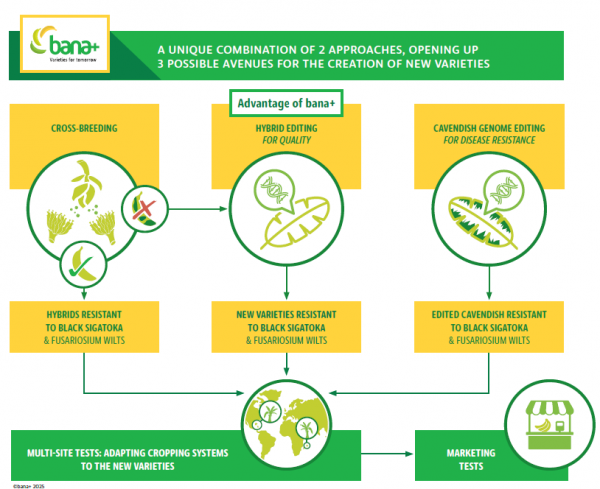
The three methods used by bana+
*PARSADA: Plan d’action stratégique pour l’anticipation du potentiel retrait européen des substances actives et le développement de techniques alternatives pour la protection des cultures (Strategic action plan to anticipate the potential EU ban on active ingredients and develop alternative crop protection techniques).
Science at work 15 October 2026
Science at work 14 September 2026
Science at work 7 July 2026