




















Science at work 15 October 2026


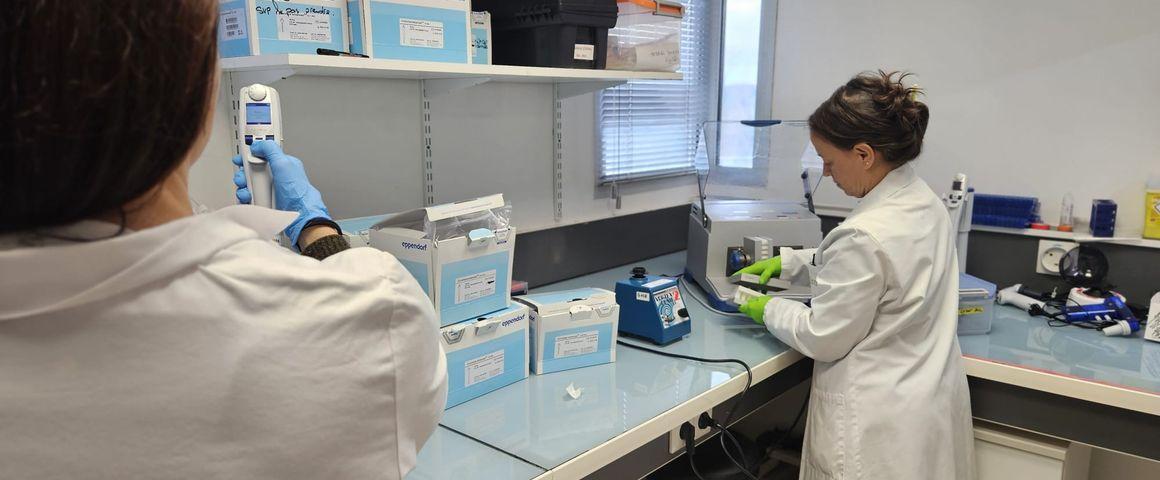
Diagnostic activities of CIRAD’s national reference laboratory. © C. Puech, CIRAD
Lumpy skin disease (LSD) was detected for the first time in mainland France on 29 June 2025, on a cattle farm in Savoie. CIRAD acted immediately, deploying all necessary resources as the national reference laboratory (LNR) to conduct emergency diagnostics. It was able to identify over 51 outbreaks between 27 June 2025 and 30 July 2025, the first cases to affect mainland France.
At that time, the LNR was the only laboratory with the diagnostic capacities for LSD, a disease that had never previously been detected in France. To enable rapid local diagnostics to be conducted in the areas affected, the LNR deployed LSD diagnostic capacities to the departmental analysis laboratories (LDAs) concerned, coordinated by the MAASA and the Directorate General for Food (DGAL). At the same time, the LNR offered technical assistance and expertise to the LDAs throughout the process. To date, five departmental analysis laboratories (Ain, Pyrénées-Orientales, Haute-Garonne, Pyrénées-Atlantiques, Savoie) have been granted temporary approval by the DGAL, following the recommendation of the LNR, and currently conduct LSD diagnostics throughout France.
On 15 December 2025, the MAASA set up a scientific consultation committee in the Occitanie region to assess proposals from professional agricultural representatives in the region regarding possible changes to the sanitary protocol implemented to control the disease. On 22 December 2025, the committee concluded that, based on the current scientific knowledge and the sanitary situation, the protocol in place in France since the emergence of LSD could not be altered. The committee also recommended an additional in-depth risk analysis to inform public decisions on “the feasibility of targeted culling in areas where immunity has developed”.
The MAASA then entrusted CIRAD with the task of coordinating a team of scientific and technical experts to produce this risk analysis.
This process is led and facilitated by Philippe Caufour, a national and international virologist specialising in LSD and head of the LNR for ruminant poxviruses, together with an epidemiologist at CIRAD.
The group is made up of 20 experts, including:
Through the establishment of the working group we are coordinating, this risk analysis is intended to assess the risk associated with targeted culling in comparison with the risk of culling all cattle in an infected herd within a vaccinated zone.
The expert group will specifically examine the risk of viral dissemination and the potential failure to manage the sanitary situation in such a context.
To achieve this outcome, expected by the end of June, the working group will concentrate on:
CIRAD’s research on LSD, conducted over many years, focuses primarily on developing tools to control the disease. Efforts to create new vaccines have been underway for the past 10 years, with the goal of bringing to market safer vaccines with DIVA properties (“Differentiating Infected from Vaccinated Animals”) and lower residual virulence.
The vaccines currently used against LSD are live attenuated vaccines, including the one used in France to control the disease. Although they are effective in reducing morbidity and viral transmission, they retain residual pathogenicity that can cause visible post-vaccination reactions (skin nodules, fever, reduced milk production). In some epidemiological contexts, these effects may complicate disease management, clinical monitoring and the acceptability of vaccination for farmers.
Current vaccine strains do not enable serological differentiation between vaccinated and infected animals, which limits the ability to monitor viral circulation accurately and may delay the lifting of trade restrictions.
Developing new, safer vaccines that incorporate DIVA properties and are paired with a companion test would make it possible to combine vaccination and differentiated serological monitoring, making it easier to control outbreaks, to accurately determine sanitary status, and to safeguard trade. Reducing, or even eliminating the residual virulence of current vaccines, and integrating DIVA properties, is thus a key scientific and strategic challenge for CIRAD.
Lumpy skin disease (LSD) is a major viral cattle disease endemic to Africa, Asia and the Middle East, caused by a virus. It is non-zoonotic, meaning it cannot be transmitted to humans. It is primarily transmitted by biting flies (stable flies, horseflies, etc.). The disease has significant impacts on animal health and welfare, and causes major economic losses due to reduced milk production, muscle atrophy, delayed growth, and skin lesions that make cattle hides unusable.
First identified in Zambia in 1929, LSD became endemic across Africa and later emerged in seven Balkan countries (Greece, Bulgaria, North Macedonia, Serbia, Kosovo, Albania, Montenegro) from 2015, where it was eliminated in 2017 thanks to mass vaccination campaigns. In 2023, it was reported for the first time in Libya, then in Algeria and Tunisia in 2024. Its emergence in Western Europe began in June 2025 in Italy (Sardinia and Lombardy), and a few days later the first outbreak was confirmed in mainland France, in Savoie, followed by Spain in October.
A total of 117 outbreaks have been detected in mainland France, with no further cases reported since 31 December 2025.
Find out more on the ESA international health monitoring platform and the WOAH website.
Science at work 15 October 2026

Science at work 14 September 2026

Science at work 7 July 2026