


















Science at work 15 October 2026

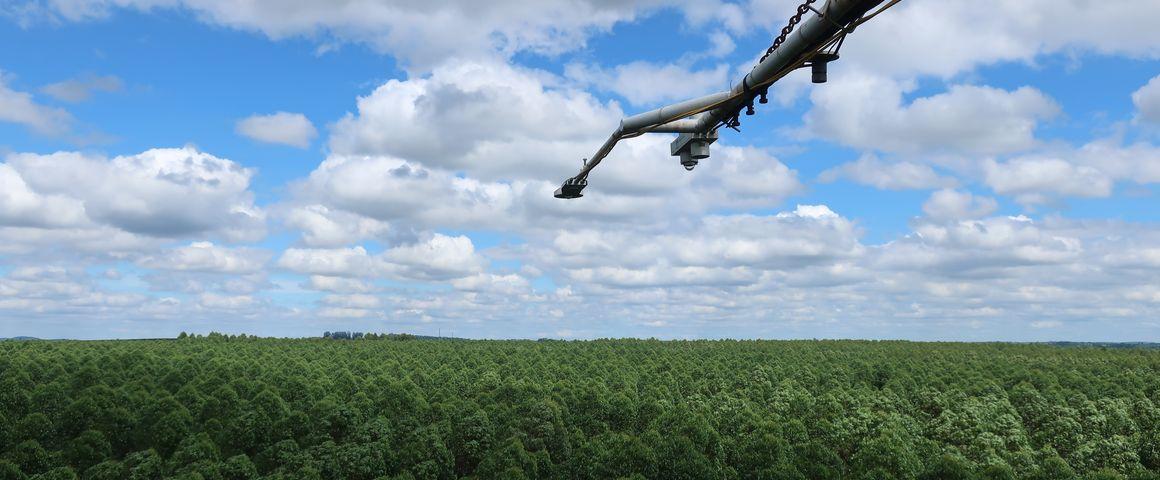
This flux tower has been measuring carbon sequestration continuously for 14 years. The measurement devices, installed between 5 and 7 metres above the trees, extend from 5 to 35 m high during a rotation © J. Guillemot, CIRAD
Eucalyptus plantations cover more than 20 million hectares worldwide and 8 million in Brazil, where they are developing rapidly in response to growing global demand for wood. However, little is known about carbon capture dynamics in such ecosystems, which are periodically clear-cut.
Under the Bonn Challenge, the international community committed to restore 350 million hectares of forest and land by 2030. Almost half that area currently comprises commercial plantations. Our work set out to assess their true carbon capture capacity.
The study shows that productivity and carbon capture in eucalyptus plantations are much greater than in natural forests: the study plot is capable of capturing up to 20 tonnes of carbon per hectare, per year. That is an exceptional figure, much higher than that of less than 6 tonnes for most tropical rainforests. One of the consequences is that after clear-cutting and replanting, plantations very rapidly become carbon sinks and compensate for the amount of carbon released at the time of cutting within two years.
However, these apparently encouraging values should be treated with caution: there is no guarantee of long-term carbon accumulation in eucalyptus plantations. In fact, according to our study, the long-term carbon balance is almost neutral. The quantity of carbon exported with the trunks following clear-cutting is comparable to that captured during a rotation, and there is therefore no guarantee of long-term carbon accumulation in commercial eucalyptus plantations, despite their very high productivity. These results, on a plot scale, are due to be supplemented in future with a life cycle assessment of the products made from the wood harvested—paper pulp, charcoal for steelmaking or chipboard—, which contribute to the bioeconomy.
These unprecedented results illustrate the importance of a scientific approach based on highly instrumented sites, which allow an understanding of the physiological mechanisms that determine bio-geochemical cycles in forests. Such data are vital for anticipating the effects of climate change on forests, as well as for guiding mitigation and adaptation strategies.
This study is the result of long-term scientific collaboration between CIRAD and IPEF (Instituto de Pesquisas e Estudos Florestais), which associates the main eucalyptus planting firms in Brazil and academic partners from the country, particularly the University of São Paulo/ESALQ. For 20 years now, CIRAD has been working with its partners in southern Brazil on advanced research into how planted forests function, and has thus made a crucial contribution to improving tropical silviculture.
Reference
Guillemot, J., le Maire, G., O. Campoe, C. et al. 2026. “Fast Net Carbon Balance Recovery After Clear-Cutting but Uncertain Long-Term Carbon Accumulation in Eucalyptus Plantations.” Global Change Biology 32, no. 4: e70881. https://doi.org/10.1111/gcb.70881.
Science at work 15 October 2026
Science at work 14 September 2026
Science at work 7 July 2026