



















Science at work 15 October 2026

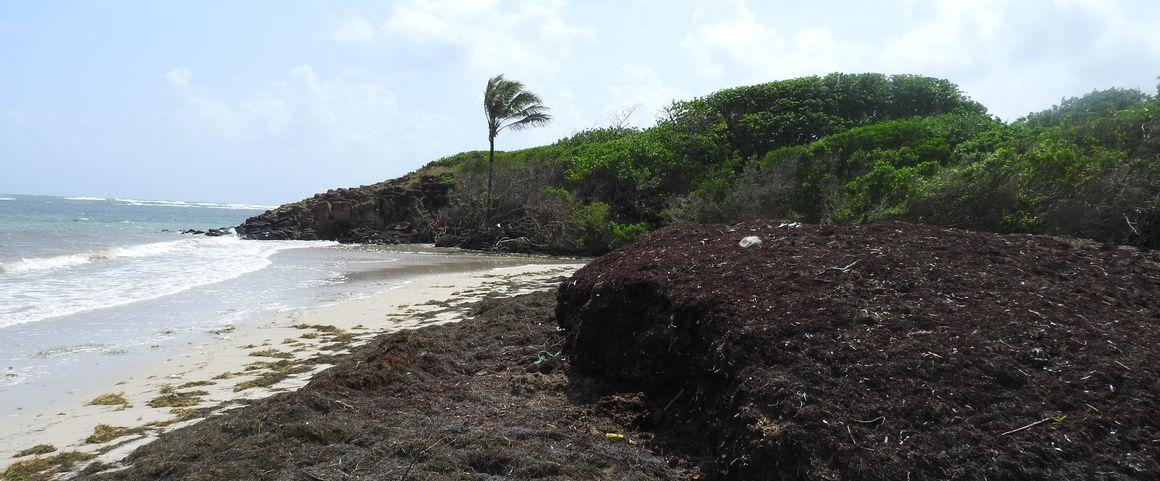
Rotting sargassum © J. Réminy, CIRAD
For almost 15 years, sargassum has been spreading across the Caribbean. Substantial research is under way, notably in the French West Indies and Mexico, but the issue has been somewhat overlooked in Cuba. The CARIBS project, on regional cooperation to manage sargassum and build capacity in the Caribbean, aims to:
Huge volumes of sargassum have arrived in several parts of Cuba, but the country does not have an effective monitoring or satellite surveillance system, or initiatives to make use of the biomass washed up on beaches. CIRAD is coordinating sargassum biomass use in Cuba and developing low-cost solutions, in view of the major energy crisis.
Our aim is to use sargassum as the main resource to produce biogas and briquettes to provide households and small firms in Cuba with a reliable, sustainable energy solution that meets their needs.
The residue generated by organic waste methanisation will subsequently be used to produce briquettes for use in place of charcoal.
This work is being done with longstanding partners in two provinces, in zones popular with tourists: Matanzas, on the south coast, and Ciego de Avila on the north coast of the country.
Taking an interdisciplinary approach, scientists are monitoring the technical component of the project (monitoring pollutants, particularly arsenic, etc), and the sociological component, via a study of appropriation of methanisation, on a small scale, by local communities faced by sargassum deposits. Their aim is to assess whether the solution satisfies families' needs and how, in practical terms, they take on board the new resources on offer.
The project is funded by the French Ministry of Europe and Foreign Affairs, overseen by the French Embassy in the Dominican Republic, and rolled out by the French Embassies in Cuba and Mexico. Scientific coordination is the responsibility of the Institut de recherche pour le développement (IRD) in Mexico, CIRAD in Cuba and the Instituto Tecnológico de Santo Domingo (INTEC) in the Dominican Republic.
Science at work 15 October 2026
Science at work 14 September 2026

Science at work 7 July 2026