





Science at work 7 July 2026
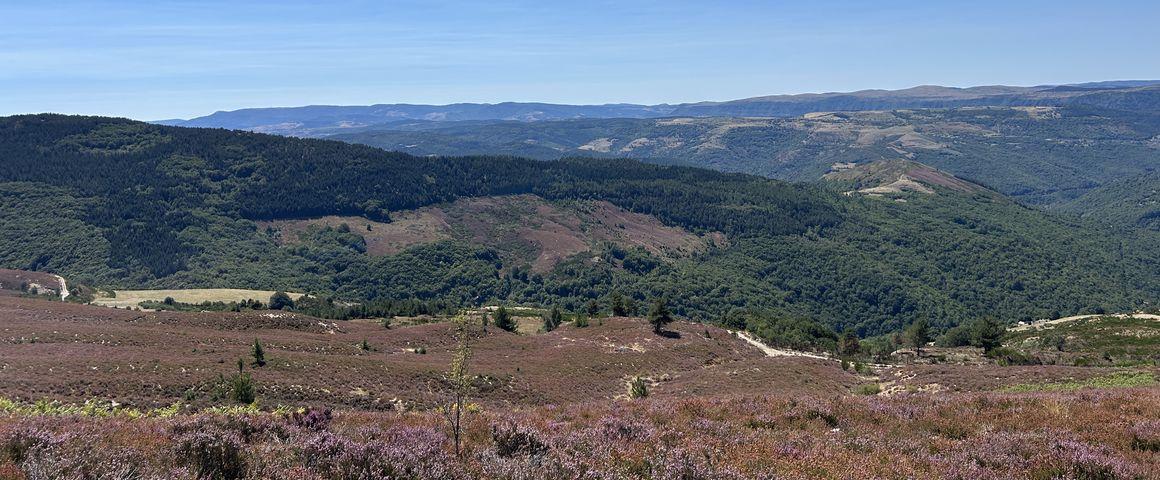
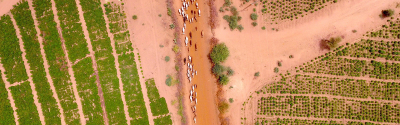
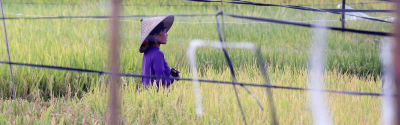
Illustration of the diversity of habitats observable in France and Europe (in this case the Cévennes National Park) on which Pl@ntBERT's capacities were assessed © P. Bonnet, CIRAD
The study was conducted as part of a thesis, with financial support from the EU GUARDEN and MAMBO projects, and paves the way for a better understanding of biodiversity and better preservation, thanks to artificial intelligence (AI). According to the researchers, while this work centred on understanding assemblages of plant species and mapping European natural habitats, the AI model developed during the study has numerous possible applications.
To build their model, the scientists based themselves on the BERT tool, a form of artificial intelligence that serves to understand text, which people use daily without even realising when doing Google searches. To make it work better on plants, the researchers trained it by feeding it with more than a million European vegetation records. This plant-specific language model, called Pl@ntBERT, is capable of deciphering the "syntax" of the phrases formed by cohabiting plant species, classified in order of abundance.
Just as a conventional language model is capable of finding a missing word in a sentence, Pl@ntBERT can predict the plant species likely to be found in an assemblage of species and thus supplement field records.
In practical terms, Pl@ntBERT facilitates vegetation inventories by suggesting species that are probably present but not recorded. The tool even goes further, by predicting coherent, previously unseen species assemblages.
The study also demonstrated Pl@ntBERT's capacity to classify types of habitats, out of the 250 recorded European natural habitats, very accurately and based on lists of species. Habitat maps are available to the public on the geo.plantnet.org website.
The EU Nature Restoration Law, adopted in 2024, relies on the notion of habitat to identify restoration strategies. This is why it is important to inventory habitats on a European scale, to be able to monitor their future evolution.
Differences between the expected species assemblages for a given type of habitat and those observed on the ground may therefore reveal ecosystem disruptions and prompt early, appropriate conservation actions.
Outside Europe, this type of approach offers considerable prospects for tropical regions whose exceptional biodiversity is still largely unknown and could be pinpointed better, notably in order to steer conservation and restoration efforts within these ecosystems, which are among the most vulnerable on the planet.
Predicting the species missing from an assemblage and mapping habitats are not the only things Pl@ntBERT can do! As the researchers stress, its use goes well beyond those two objectives, and they hope to see the scientific community take this open-access tool on board. The field of play is huge, for instance assessing dark diversity more effectively. This fashionable concept refers to the species that could live in a given habitat but are not there, for as yet unknown reasons. Pl@ntBERT could soon provide clues.
Leblanc, C., Bonnet, P., Servajean, M., Thuiller, W., Chytrý, M., Acic, S., Argagnon, O., Biurrun, I., Bonari, G., Bruelheide, H., Campos, J.A., Carni, A., Custerevska, R., De Sanctis, M., Dengler, J., Dziuba, T., Erenskjold Moeslund, J., Garbolino, E., Jandt, U., Jansen, F., Lenoir, J., Perez Haase, A., Pielech, R., Sibik, J., Stancic, Z., Uogintas, D., Wohlgemuth, T. & Joly, A. Learning the syntax of plant assemblages. Nat. Plants 11, 2026–2040 (2025). https://doi.org/10.1038/s41477-025-02105-7.
CIRAD is the French agricultural research and international cooperation organisation working for the sustainable development of tropical and Mediterranean regions.
It works with its partners to build knowledge and solutions for resilient farming systems in a more sustainable, inclusive world. It mobilises science, innovation and training in order to achieve the Sustainable Development Goals. Its expertise supports the entire range of stakeholders, from producers to public policymakers, to foster biodiversity protection, agroecological transitions, food system sustainability, health (of plants, animals and ecosystems), sustainable development of rural territories, and their resilience to climate change. CIRAD works in some fifty countries on every continent, thanks to the expertise of its 1750 staff members, including 1200 scientists, backed by a global network of some 200 partners. It also supports French science diplomacy operations.
INRIA, the French National Institute for Research in Digital Science and Technology, supports the State in its national digital research and innovation strategies as a Programme Agency. INRIA conducts over 300 research and innovation projects with its 3500 scientists, engineers, and support staff, in partnership with universities and the digital ecosystem (businesses, entrepreneurs, public stakeholders). Together, we explore key areas such as artificial intelligence, cybersecurity, quantum computing, cloud technology, the digital transformation of healthcare, digital twins, and digital technologies for defence. We build concrete solutions such as software, tech start-ups, partnerships with national businesses, and cutting-edge training programmes.
Our objective: scientific, technological, and industrial impact serving France's digital sovereignty.
Science at work 7 July 2026

Science at work 17 June 2026
Science at work 20 May 2026