







Just out 25 September 2026

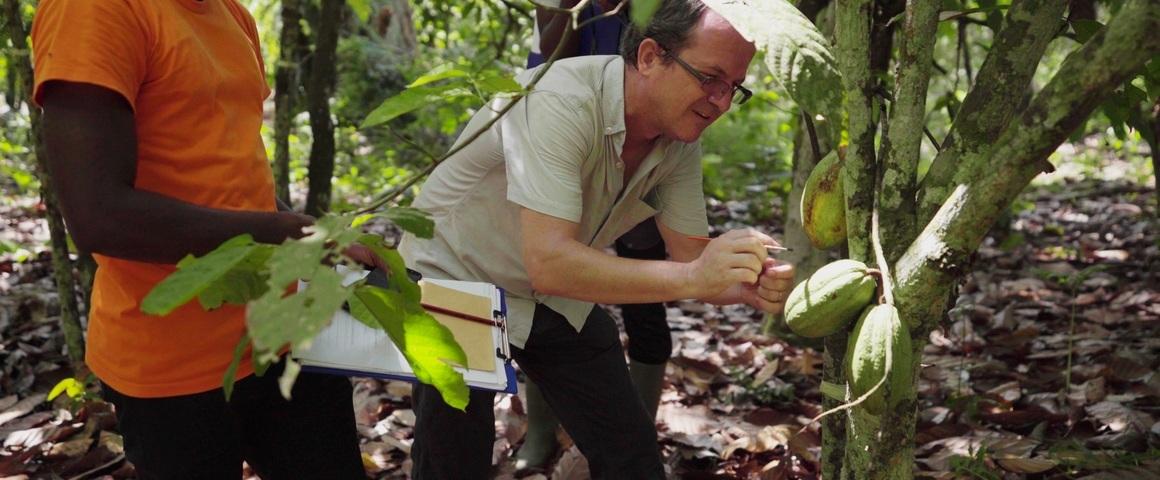
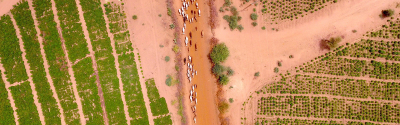
The Franco-Ivorian team based their work on a study of 150 Ivorian cocoa plantings, to assess the services provided by the trees in cocoa plantings © Imagéo/Cocoa4Future
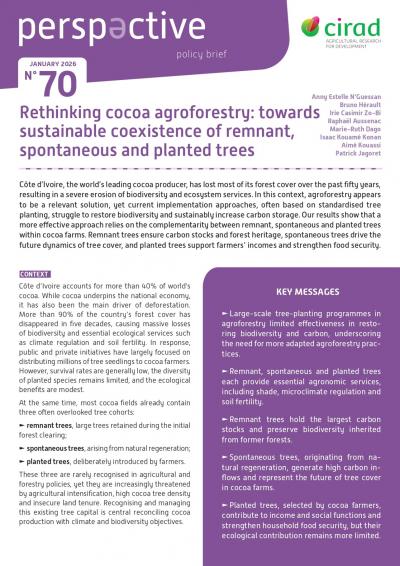
Ivory Coast, the world's leading cocoa producer, has lost more than 90% of its forest cover. To address this crisis and preserve cocoa tree productivity long term, public policy and private initiatives have largely encouraged agroforestry, notably in the form of large-scale planting programmes. However, such programmes are not sufficient to restore biodiversity or store carbon long term.
For the work described in this 70th Perspective, the Franco-Ivorian team based themselves on a study of 150 Ivorian cocoa plantings. The results are clear: the plantings already have a broad range of trees, which is often overlooked in current strategies. There are three main categories, in addition to cocoa trees:
Each type of tree plays a specific, complementary role. Remnant trees hold the largest carbon stocks and preserve the biodiversity inherited from former forests. Spontaneous trees, which are numerous and fast-growing, ensure the renewal of tree cover and future carbon flows. Planted trees, which are often fruit or utilitarian trees, contribute to the income, diet and wellbeing of farming households.
In addition to the ecological benefits, all these trees provide vital agronomic services for cocoa production: shade, microclimate regulation and improved soil fertility. However, their effective management is strongly dependent on the socioeconomic context, land tenure security, use of crop management sequences and farmers' botanical knowledge.
| Remnant trees | Spontaneous trees | Planted trees | |
|---|---|---|---|
| Agronomic services* | ++ | ++ | ++ |
| Biodiversity | ++ | + | - |
| Carbon inflows | ? | ++ | - |
| Timber production* | ++ | ++ | - |
| Crafts/artisanal uses* | + | ++ | - |
| carbon stock | ++ | + | - |
| Cultural functions | ++ | + | - |
| Traditional medicine | ++ | + | ++ |
| Social functions | + | + | ++ |
| Food security | - | + | ++ |
| Non-timber forest product trade | - | - | ++ |
The authors also call for a new type of agroforestry, founded not merely on planting trees but on recognising, protecting and valuing existing trees, supplemented by targeted planting. This type of approach would make it easier to meet cocoa production, climate and biodiversity objectives simultaneously.
The Cocoa4Future project (C4F) aims to develop sustainable cocoa systems that reconcile productivity, climate resilience and biodiversity preservation. It works in Ivory Coast and Ghana, in partnership with CIRAD, Félix Houphouët-Boigny University, INPHB and Nangui-Abrogoua University. Farmers and local farmers' organisations are heavily involved in its operations. C4F is funded by the EU DeSIRA initiative and the Agence française de développement.
Just out 25 September 2026
Just out 27 July 2026