









Just out 25 September 2026

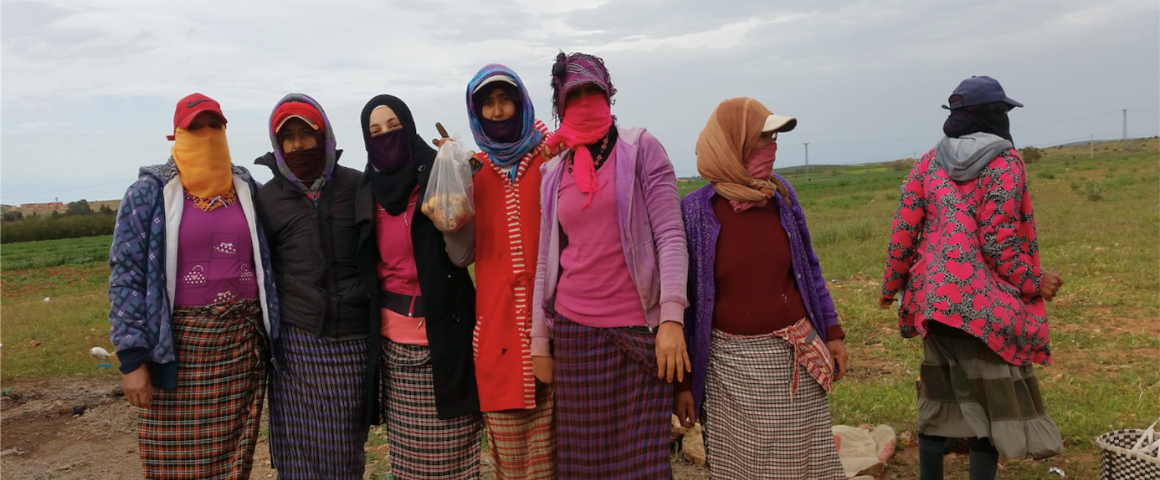
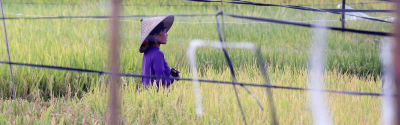
Women farmworkers at the end of the day in the Berkane region, Morocco © S. Salhi
In 2022, in Morocco, the agricultural sector accounted for more than 14% of GDP and almost 30% of jobs. As a result, the agricultural workforce now includes significantly more women. Those women play a central role in production systems and food value chains, including in international migration circuits, as for instance in the red berry value chains of southern Europe. More broadly, they play an active part in household budgets and in the agricultural economy.
These essential workers are responsible not just for their own survival but for that of their families, and make a substantial contribution to the rural economy. In the absence of other economic alternatives, these women have a brave, determined battle on their hands every day to cope with the hard working conditions in the fields. They are part of a permanent struggle for survival, dignity and socioeconomic independence.
However, women farmworkers' contributions to family budgets and the agricultural economy are rarely recognised. They only very rarely have formal contracts, and are often the victims of marginalisation, harassment, legal weakness and hidden exploitation. Their daily lives are marked by low pay, precariousness, poor social protection, risks in terms of health and accidents, and vulnerability in the event of pandemics such as Covid-19.
It is not until times of crisis (fatal accidents, Covid-19, etc) that the daily lives of women agricultural workers, on the fringes of society and policy, become more visible in the media and on social networks, and prompt a degree of indignation. However, that visibility is only sporadic and short-lived, and eventually dwindles and is forgotten.
Research has only rarely studied these women's living, working and migration conditions, despite growing interest on the part of certain associations.
Women agricultural workers are a vital part of the agricultural workforce in North Africa. However, very few public policies take any interest in them, and there has been little research on them until now.
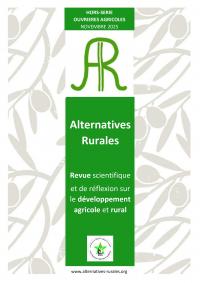
In this special issue of the journal Alternatives Rurales published in November 2025, researchers from Morocco, France and Tunisia look into this little-explored reality. They present an overall picture of the conditions for women agricultural workers in Morocco and the Mediterranean (Spain, Tunisia and France), providing greater knowledge of their daily life, the constraints they face, their adaptation strategies and their aspirations.
We do not have insurance! If we fall off a lorry, nobody worries about us. We are sometimes forced to work all day without food! If the boss doesn't like you, he won't even pay you for your day's work.
To help my children, I have to get the "lorry of death" and go to work in the fields. (…) It is really important to take steps to improve conditions for women agricultural workers. (…) farmers should also have to sign contracts with those workers, clearly specifying wage levels clearly specified.
The precariousness that applies to women farmworkers often extends to their children, particularly if those women are single parents or if their partners are irresponsible. Registering births and obtaining a livret de famille (family record book), both of which are essential in order to send children to school, are complex in those cases, and make their daily lives even harder.
This reality comes is very clear in the touching testimony of the daughter of a woman farmworker with five children in the Saïs region, Morocco, who died without having had her two youngest children legally recognised. The eldest, who is 19 years old, speaks bitterly of the authorities' reluctance to take action and considers they had turned a blind eye to their situation: "My mother had to die for her children to be recognised at last".
I don't recommend agricultural work to girls, as they will hear immoral words and be harassed, looked down on and seen as being easy. They could fall pregnant. Young girls are exposed to all sorts of aggressions.
The contributions in the issue are all based on detailed field studies. They include scientific articles, lecture notes and testimonies from women farmworkers, grassroots players and associations. These women workers and development players share their experiences and suggest ways of improving working conditions for women farmworkers. The various contributions provide concrete, detailed elements concerning:
These contributions serve to fuel the public policy debate and come up with suitable legal, social and economic instruments to improve their living and working conditions and guarantee their dignity. These studies have highlighted the importance of considering and recognising the work that women do in rural and periurban areas. They also stressed the need to rethink public policy, which pays little heed to the question of women workers. The intention is to advance towards more inclusive, appropriate systems that take account of every aspect of the conditions for women farmworkers: social, economic, legal and also organisational.
There are several suggestions for this, including:
The message from this special issue is that it is high time that women farmworkers in Morocco and Tunisia stopped being invisible in the eyes of public policy and social debate, by involving them in the changes that could possibly be made.

Just out 25 September 2026
Just out 27 July 2026