







Science at work 14 October 2026
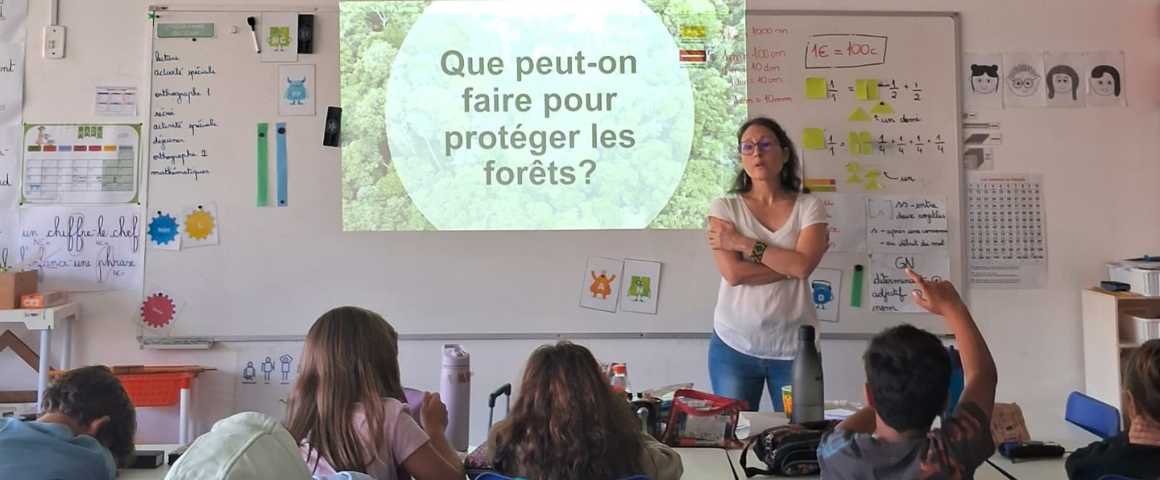
Educational activity at the Lycée français François Mitterrand, led by Géraldine Derroire, an ecologist at CIRAD © Enora Le Calvé, CIRAD
With its six forest biomes, Brazil is one of the world's most biodiversity-rich countries. The Amazon has almost 16 000 tree species, compared to between 130 and 140 in mainland France. The Cerrado, a large grassland area in Brazil, which is often less well-known than the Amazon, is home to more than 6000 plant species. It alone houses 30% of the biodiversity in Brazil, and almost 5% of the world's plant and animal species.
These ecosystems, which are delicately balanced, play a vital role in regulating climate, conserving soils and maintaining the zone's unique biodiversity. However, the pressure exerted by human activity, notably deforestation and forest degradation, and the risks linked to climate change continue to jeopardise these territories, increasing the threat of extinction for certain endemic species. There is therefore an urgent need to give young Brazilians in-depth knowledge of the species that make up their environment and heritage.
I hope that seven- to fourteen-year-olds will enjoy playing the game and at the same time learn about the main characteristics of the 36 tree species described on the cards. We have included a "use" characteristic to help young people understand that trees have also been widely used by humans since the start of history.
To introduce children to the wealth of biodiversity in Brazil, a Franco-Brazilian team coordinated by CIRAD hooked up with the French firm Bioviva to develop this 36-card educational game on the trees of Brazil. The trees chosen come from four of the country's six biomes: the Amazon forest, the Cerrado, the Atlantic forest and the Caatinga. Each card associates a photo of a tree with a bilingual description of its characteristics, in French and Portuguese. The species were chosen and the descriptions written based on the researchers' work.
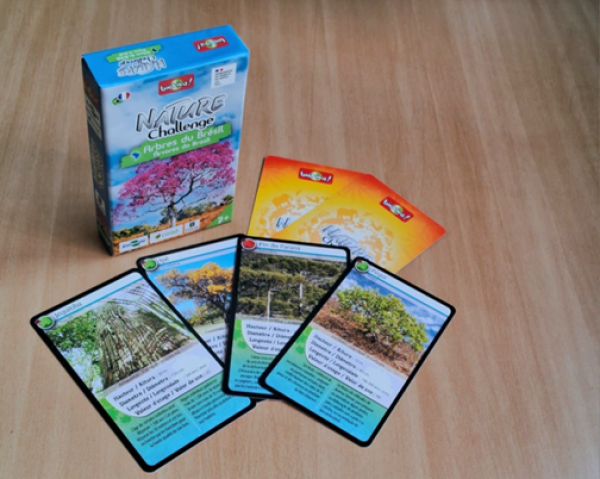
The "Arbres du Brésil" card game © Enora Le Calvé, CIRAD
Five thousand copies of the game were printed in France and shipped to Brazil with funding from CIRAD, the French Embassy in Brazil and the Team France fund for action in the Amazon on climate change and its impacts (FEFACCIOn). The game was officially presented on 17 November 2025 at COP 30, held in Belém, Pará state, in the EMBRAPA Agrizone area.
Raising children's and teenagers' awareness is vital for educating future generations about ecology and conservation, and for the health of the planet. This game, "Les Arbres du Brésil", is a teaching tool that supports that understanding and that gratitude for trees, their role and what they represent for the lives of both humans and other species, and for the balance of the Earth.
There is a teaching module along with the game. It was developed jointly by CIRAD and the Economic Service at the French Embassy in Brazil, and was initially presented to and tested with eight- and nine-year-olds at the Lycée français François-Mitterrand in Brasilia, and three classes at the city's Alliance Française. These initial experiments confirmed the game's potential as a tool for discovery, learning and discussion about the biodiversity in Brazil.
Distribution of the game to schools in Brazil was then supported by the FrancEcolab project, a competition organised by the Educational Cooperation Service at the French Embassy in Brazil to encourage young people to be curious about environmental issues and sustainable development. Three online training courses were offered to teachers in participating schools, to help them master the game and the educational activity. Game sets were also sent to each of the schools that signed up for the competition.
Thanks to funding from the FEFACCIOn project, a dozen or so in-person activities have been organised in schools in the states of Amazonas, Pará and Amapá. The "Arbres du Brésil " game proved particularly relevant in this last state, on the border with French Guiana, where French is taught in primary schools.
In combining discovery of biodiversity, issues relating to climate change and French language learning, the game is a versatile teaching tool. It familiarises pupils with the trees and ecosystems around them, while feeding their curiosity about the French language. It is a way of making a game serve as a real link between science, the environment, languages and cultures.
Science at work 14 October 2026
Science at work 7 October 2026
Science at work 23 September 2026