

Science at work 28 October 2026
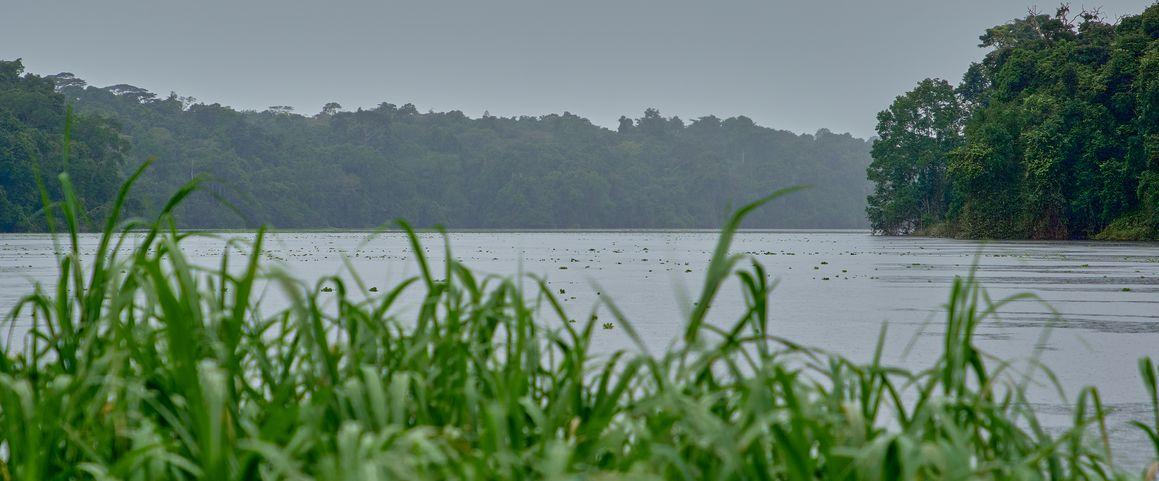
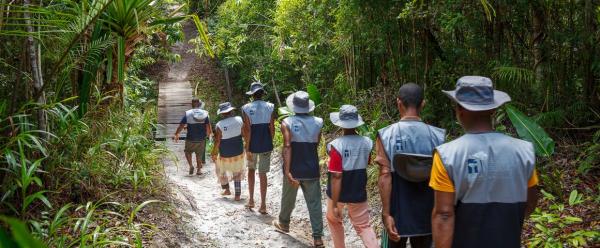
View from the Ipassa research station, in the heart of the Gabonese forest, one of the One Forest Vision initiative (OFVi) super-research sites © Jules Regombi, COMEN (Communication environnementale)
Tropical forests and wetlands play an essential role in carbon storage and biodiversity maintenance. Supporting their preservation calls for reliable data on their state, functioning and evolution. One Forest Vision intends to satisfy that need by compiling field data and developing the use of tools to improve forest ecosystem monitoring methods. The initiative is particularly relying on artificial intelligence to improve the identification of animal and plant species, and on remote sensing to produce more accurate maps of forest structures, carbon stocks, and their dynamics.
In addition to generating knowledge, OFVi is intended to facilitate access to scientific data and their processing and sharing. The approach should help build capacity in the partner countries and make the knowledge produced by research available to benefit their conservation efforts.
"The One Forest Vision initiative was built on historic scientific partnerships in the Congo Basin. That scientific cooperation is vital for understanding the complexity of tropical forest ecosystems and encompassing the social issues relating to climate change. The Congo Basin forest is a biodiversity and carbon reserve, and also a habitat and a supplier of goods and services for local and indigenous people. Preserving those ecosystems and their services raises issues that can only be addressed by means of the interdisciplinary, multicultural research enabled by international scientific cooperation in the form of OFVi." Vivien Rossi, CIRAD researcher and OFVi Congo correspondent.
The OFVi initiative concerns all forests worldwide, and is led by France. It has a budget of several million euros, granted in 2023 by the French Ministries of Higher Education and Research, and of Europe and Foreign Affairs to finance fundamental science and scientific cooperation respectively. Six French research organisations were behind the initiative: CIRAD, CEA, CNRS, INRAE, IRD and the National Natural History Museum (MNHN). It is coordinated by CIRAD, INRAE and IRD.
Building scientific capacity is a major component of the One Forest Vision initiative. It is currently supporting 15 PhD students—six from Congo, six from Gabon and three French—, who are conducting research on the forests and wetlands of the Congo Basin. Their work covers a range of topics: plant and animal biodiversity, forest dynamics, carbon storage, carbon fluxes, remote sensing, climate change, and ecosystem functioning and resilience. CIRAD's support of PhD students is helping to build research anchored in the realities of the Congo Basin and capable of shedding light on the issues surrounding forest conservation and sustainable management.
Maurice Bakala Nkaya is one of those junior researchers, and is looking into a crucial question: how can the forest species of the Congo Basin adapt to changes in their environment? "My work concerns the phenotypic plasticity of forest species, in other words their capacity to modify their physical characteristics in line with their environment", he explains. "In the forests of the Congo Basin, I am looking at how trees are adapting to the new light and water supply constraints induced by climate change. We are examining their responses on a morphological level, and also on a hyperspectral level, using a non-destructive technique that consists in analysing the light reflected by a sample on various wavelengths. We are also observing tissues, organs and cells under a microscope."
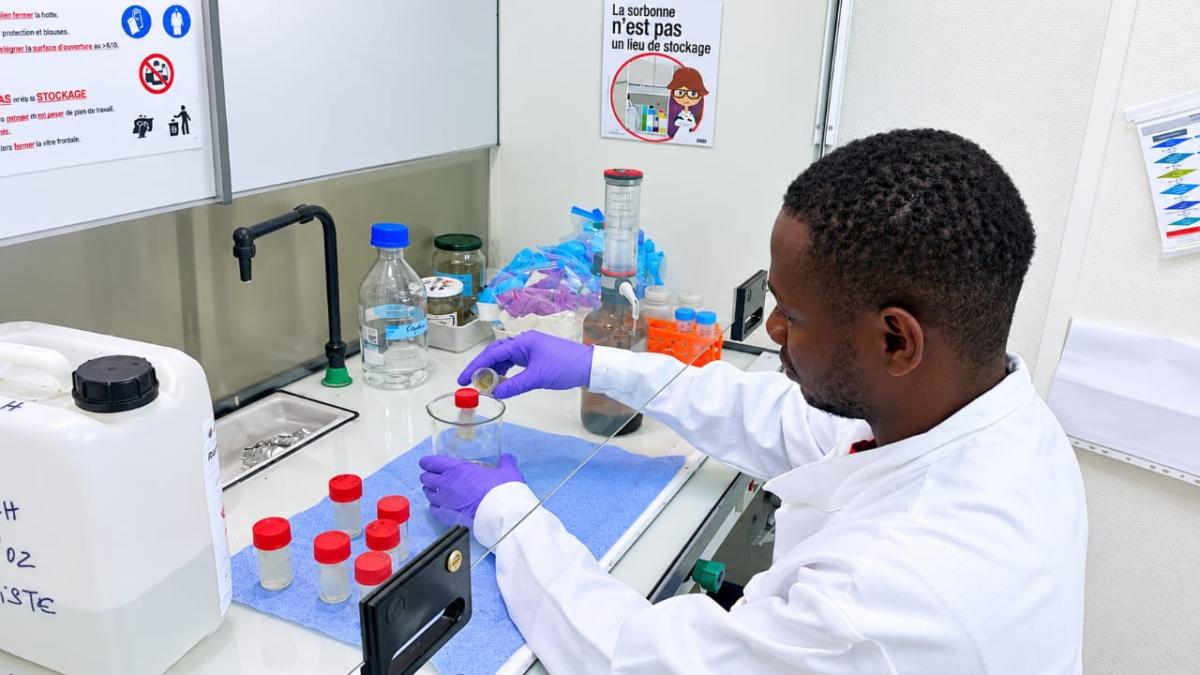
Maurice Bakala Nkaya doing histological analyses of Millettia laurentii (wenge) leaves subjected to water stress to determine the plant's histological behaviour © Maurice Bakala Nkaya, Marien NGOUABI University
To study their adaptation strategies, Maurice Bakala Nkaya is testing their development in a nursery, under different light and water conditions. He is observing the plants' reactions on several scales, from their growth and architecture to their cell structures. "The aim is to identify the most vulnerable species and understand the mechanisms that foster natural regeneration. This new knowledge could help to steer forest conservation and sustainable management strategies."
In Gabon, the co-existence of forest elephants and local people is a major challenge for conservation. The country is home to almost two thirds of the Congo Basin's forest elephants, but their presence near villages and agricultural zones means that they damage crops and sometimes kill humans. Despite the mitigation measures already taken, there is still conflict between those local communities and the elephants. This is the issue that Claude Evny Maganga Moussadji, a PhD student whose research concerns the socioecological factors that affect this co-existence. By combining ecology and social and human science, she is trying to understand how elephant density, their food resources and how local communities view their presence influence the conflict. She is using several methods: acoustic monitoring, genetic analyses and local population surveys. "My research will enable a clearer understanding of the factors that influence the dynamics of the conflict between humans and elephants, and make it possible to assess the efficacy of existing prevention measures", she says. "My work should eventually help improve resolution strategies by seeking to improve the co-existence of local communities and elephants."
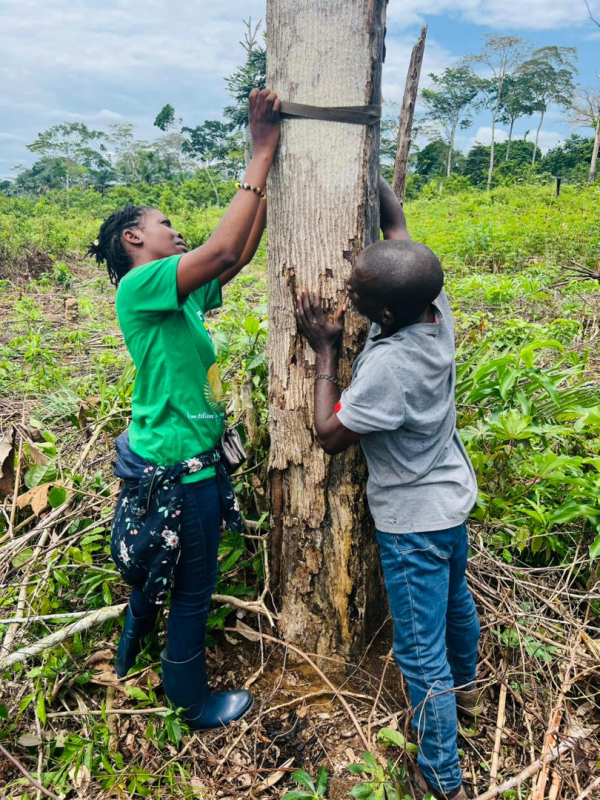
Claude Evny Maganga Moussadji installing camera traps alongside a field to assess the efficacy of mobile electric fences and monitor elephant movements around fields © Claude Evny Maganga Moussadji, Omar Bongo University
Three years after the One Forest Summit in Libreville in March 2023, One Forest Vision has published an initial report on its activities and research findings. In particular, it reports 30 partner organisations, five co-construction workshops, more than a dozen scientific missions to the Congo Basin, 14 training courses, 15 PhD students 17 scientific publications.
Science at work 28 October 2026
Science at work 14 October 2026
Science at work 7 October 2026