





Expert view 7 September 2026
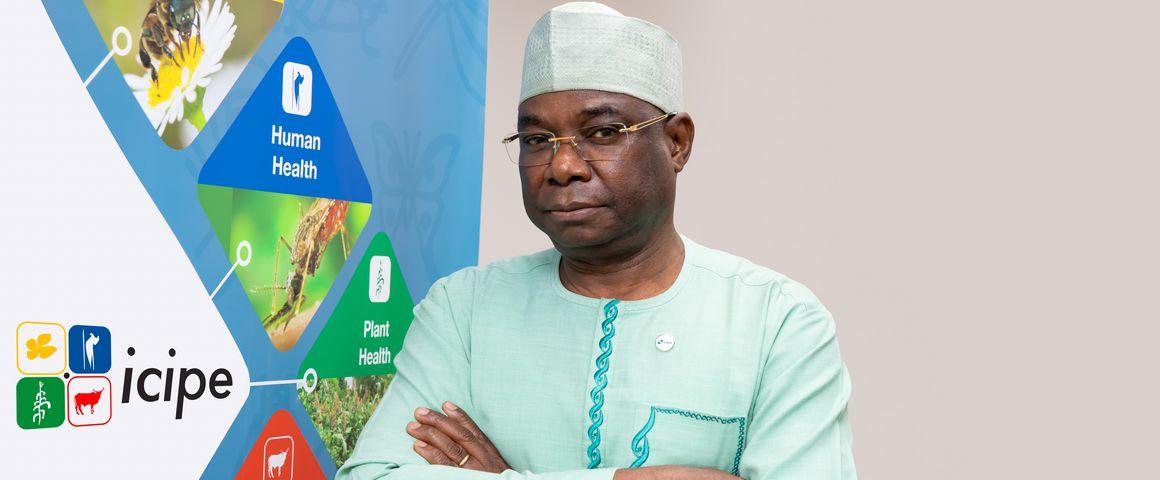
Dr Abdou Tenkouano, Director General, International Centre of Insect Physiology and Ecology (icipe) © icipe
Dr Abdou Tenkouano has been Director General of icipe since 2024. The international research organisation is based in Kenya, and specialises in entomology, the study of insects. Abdou Tenkouano trained as a geneticist, and has had a long career in agricultural research, mixing knowledge production and the dissemination of innovations. From varietal breeding, through biotechnology, to postharvest strategies, his research has helped to develop several crops across Africa, notably sorghum, millet, maize, cassava, yam, banana and plantain banana.
Dr Tenkouano comes from Burkina Faso, and has trained and worked in the US, Senegal, Tanzania, Ghana, Cameroon and Mali, and now in Kenya. He also teaches on behalf of Belgian and French research organisations and universities. This impressive international career also bears witness to the scientific reputation of icipe, a centre with operations in almost every country in Africa.
Abdou Tenkouano: Our partnership with CIRAD is unique. There are generally several CIRAD scientists working at icipe, who stay for several years. This makes exchanges between CIRAD teams and ours much easier. There are also a large number of student exchanges between Montpellier and Nairobi. This model also applies to IRD. It is an attractive model: we recently welcomed a number of other interested French research institutions, including INRAE, and universities in Belgium have also shown an interest.
Partnerships are a form of engineering. How do we build them? How can we make them work? The success of networks and collaborations often depends on what they are built on: when we lay the first stone, have we made sure that every participant is truly committed?
We asked ourselves these questions when we launched the new platform in partnership, TRACE. The platform's scientific ambition is to promote social ecosystem health in the African Great Rift valley, by means of agroecology, science-policy dialogue and regional cooperation. In research, there are generally two types of players: those who design technology, and those who transfer it to the field. They have very different skills, but they rely on each other. Building that continuum between the creation of solutions and their rollout in the field is what makes platforms in partnership so attractive.
A.T.: icipe's reputation is based on the quality of its research and that of the scientific supervision it provides to students. It was built on solid foundations. This is what is now enabling us to turn towards the development and dissemination of concrete innovations. We want our scientific work to make a difference at grassroots level.
The centre's new "Impact Delivery" department is focusing on what we call technology "scaling". This simply means studying how theoretical solutions thought up by scientists can be converted into practical solutions farmers can use. To this end, we are working not just with public institutions but with private players, since businesses have the capacity to pinpoint the parts of our research that will rapidly generate financial results.
The scientific ecosystem is highly competitive, both in terms of the quality of the knowledge produced and with respect to funding. Our donors demand useful research, capable of tackling concrete, urgent challenges. icipe's work has always been geared towards questions of general interest, particularly health issues, since the study of insects lies somewhere between human, animal, plant and ecosystem health. What has changed is the new clear determination to work even more closely with communities, and for communities.
A.T.: Agroecology sits at the interface between three of icipe's priority topics: plant health, environmental health and animal health. Agroecological practices therefore fit neatly into our research work. The "push-pull" method is one of the conventional biological techniques used to control crop pests, which may be insects or sometimes weeds.
First of all, "push-pull" consists in planting other plants that act as pest repellents between rows of the main crop in a plot (push). Then plants that attract those pests are planted around the edge of the plot (pull), to keep them away from the main crop.
This method is really good for farming systems including livestock, because the plants used to pull or push pests often provide fodder for animals. That fodder is generally rich and high quality, in other words a product that is both useful to livestock farmers and an alternative income source for crop farmers. In addition to integrating crop and livestock farming, some plants can also boost yields of the main crop, for instance by improving soil health.
"Push-pull" technologies are often more labour-intensive, but they also allow farms to become less reliant on pesticides. For instance, icipe has done a lot of work on striga, a weed that is very attractive but is very difficult to eradicate from fields and destroys maize crops. One of the "push-pull" systems we have tested with farmers is planting desmodium, a small herbaceous plant, between maize rows. This gets rid of the striga.
"Push-pull" is easy to adapt to situations in Africa, provided certain constraints are lifted, notably as regards seed production and access to seed. CIRAD's expertise in terms of seed could help to roll out the technology to other parts of Africa.
A.T.: I think there are two main lines to be followed in terms of scientific partnerships. The first is knowledge generation and skill sharing. icipe has high-tech equipment and brilliant scientists and students. However, we sometimes need expertise that we don't have. Scientific partnerships allow us to access that expertise. For instance, CIRAD has teams specialising in anticipation and foresight studies. At icipe, we are interested in working together to imagine possible futures and prepare for crises before they hit. Anticipation is much cheaper, it is effective, and it guides our research, the training we provide for students, and so on.
In return, obviously, icipe makes its own expertise available. For instance, we recently worked with IRD to identify an effective parasitoid against a maize pest in France. The parasitoid in question is found in Kenya and we know it well. Knowledge transfers are never unilateral, particularly when they concern the living world: there are still too many things that we don't understand and we need both research and cooperation.
The second line is transferring results to what we could call "users". The solutions imagined by research will remain theoretical unless they are tried and tested by the communities or private players who are going to put them into practice. We are therefore building partnerships with local players, who know what local farmers and others need. At the same time, as I said, the private sector has the capacity to detect which innovations will generate financial results. It is up to us as scientists to negotiate preferential access to some results, while keeping anything that can be classed as a common good both public and free.
A.T.: The summit will provide opportunities for scientific institutions across the continent, since it will be looking at the challenges the different countries share. We already know that the discussions will centre on the development of agricultural value chains, including innovation sharing with the private sector.
As long ago as 2010, agronomy was seen as a priority for collaboration between Africa and Europe. The summit, co-organised by Kenya and France, is likely to remind us of that commitment.
Over the period 2017-2023, the number of joint agricultural research projects between the two continents increased fivefold compared to 2010-2016. That upward trend is set to continue. Nevertheless, I would call on European countries to look into alternative funding possibilities. Some States are already providing ringfenced funding for shared scientific explorations by European and African institutions, in which the objectives are set after the event, in the field and in consultation with communities. We need donors to trust us in this way if we are to develop innovations that would not be possible otherwise.
Expert view 7 September 2026
Expert view 9 July 2026