











- Home
- Press area
- Press releases
- Banana and plantain roadmap
CIRAD presents its roadmap for the dessert and plantain banana value chain
Institutional news
22 October 2026
Banana is the world's second-placed food crop, a staple food for hundreds of millions of people and a source of income for many producers. However, banana value chains face major challenges: pests and diseases, dependence on synthetic pesticides, climate change, and economic and social fragility. To support agroecological transition, CIRAD has released a 2024-2034 roadmap for dessert and plantain bananas.
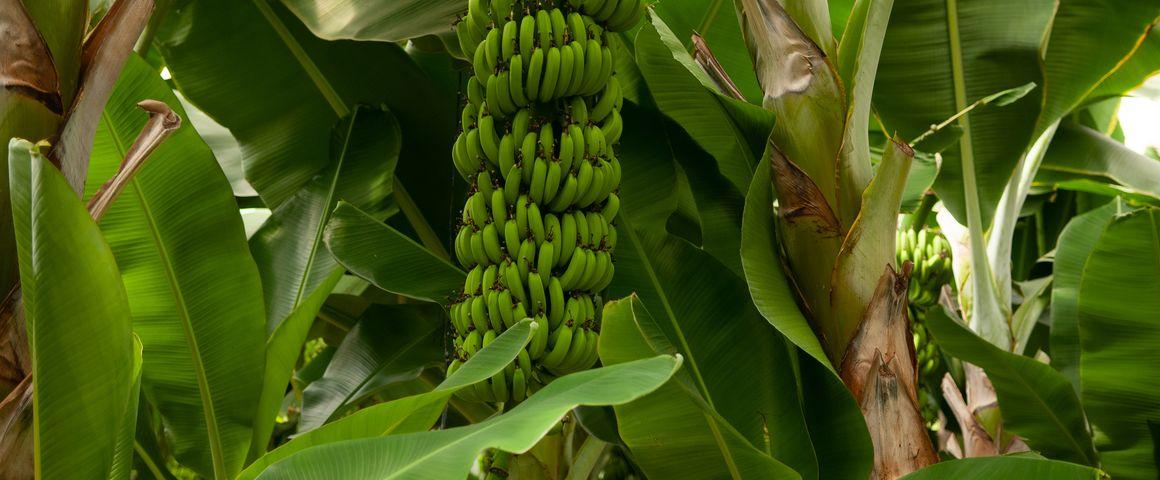
Banana plant in Morocco © Vitropic
Annual banana production worldwide totals some 160 million tonnes. Bananas are very popular on the global market, but are first and foremost a staple food for a large part of the world's population, for instance in West and central Africa, Asia and South America.
A necessary transition for plantain and dessert bananas, which face distinct challenges
Demand for "cooking" bananas (including plantain) is rising. There is an estimated 10 million-tonne annual shortfall in plantain banana output to cover current requirements. They are primarily produced by family farmers, who are having trouble satisfying the growing demand for their product.
As for "dessert" bananas, there have not been any profound changes since the 1960s. The chain faces very different challenges: the market is dominated by Cavendish varieties, of which some 93 million tonnes a year are produced, including more than 21 million tonnes for export. Organising the chain around a single varietal group has accentuated its vulnerability to disease, particularly black Sigatoka and fusarium wilt. Controlling these diseases means using large quantities of synthetic pesticides in some production zones, with potential consequences for the environment and the health of workers and neighbouring communities. Climate change is exacerbating those challenges.
CIRAD is working to invent the sustainable dessert and plantain banana chains of the future
To address these many issues, CIRAD presents its three main ambitions in the summary of its roadmap for the value chain:
1. Dessert banana agroecology 1.0: a major reduction in pesticide use within five to ten years
The banana sector, which has hitherto been dominated by the inevitable Cavendish variety, is now under threat from pests and diseases and therefore urgently needs to embark on an agroecological transition. To support the value chain, CIRAD is working on a combination of setting up innovative, alternative cropping systems and creating and breeding resistant varieties, in close collaboration with its Vitropic subsidiary.
Denis Loeillet
Agroeconomist and banana and plantain research coordinator, CIRAD
2. Dessert banana agroecology 2.0: aiming to go zero-pesticide
We know that over time, pathogen populations adapt, particularly in the case of black Sigatoka. More than ever before, for banana and for
other value chains, we need to reintroduce crop and species diversity, not just to control pests and diseases but to generate added value. CIRAD, notably via the Bana+ project, proposes creating new, multi-resistant varieties by combining the conventional hybridisation approach with biotechnology based on genome editing.
Jean Carlier
Plant pathologist and banana and plantain research coordinator, CIRAD
3. Ecological intensification of plantain growing in Africa
CIRAD is working on a range of levers to support ecological intensification of plantain banana growing in Africa: convincing policymakers, agricultural advisors and training staff and producers of the crop's potential; and training producers and agricultural advisors in agroecology to foster zero-pesticide production and develop agroecological practices by harnessing the crop's main advantages.
More than 150 plantain varieties are cultivated and consumed, with little-known agronomic characteristics, very diverse cropping systems that probably include biological regulation possibilities of benefit to plantain, and nutrition requirements that are little-known but lower than those of dessert bananas, etc.
Sylvain Dépigny
Agronomist, CIRAD
CIRAD distributed the roadmap at the Fruit Attraction Show in Madrid, Spain, in early October.
CIRAD and Vitropic: close collaboration for crop innovation
The roadmap is due to be rolled out in collaboration with Vitropic, a CIRAD subsidiary set up in 1986. Vitropic specialises in producing in vitro plantlets, primarily banana and other tropical plants. It is working with CIRAD to create banana varieties resistant to two major diseases (TR4 fusarium wilt and black Sigatoka), to adapt the plant to climate change and to maintain varietal diversity.
- 71% of the bananas produced worldwide are dessert bananas
- 50% of the bananas produced for the global market come from South America
- 3 kg of pesticides are used per hectare in the French West Indies, compared to more than 80 kg in some other countries
- 2 M family plantain banana producers in West and central Africa
- 50 M banana plantlets produced and distributed worldwide by Vitropic, a CIRAD subsidiary
- 70 scientists working on the value chain at CIRAD
See also
Institutional news 8 June 2026
Launch of the AIKO project: Artificial intelligence to process scientific literature

Institutional news 18 May 2026