


















Results & impact 21 September 2026


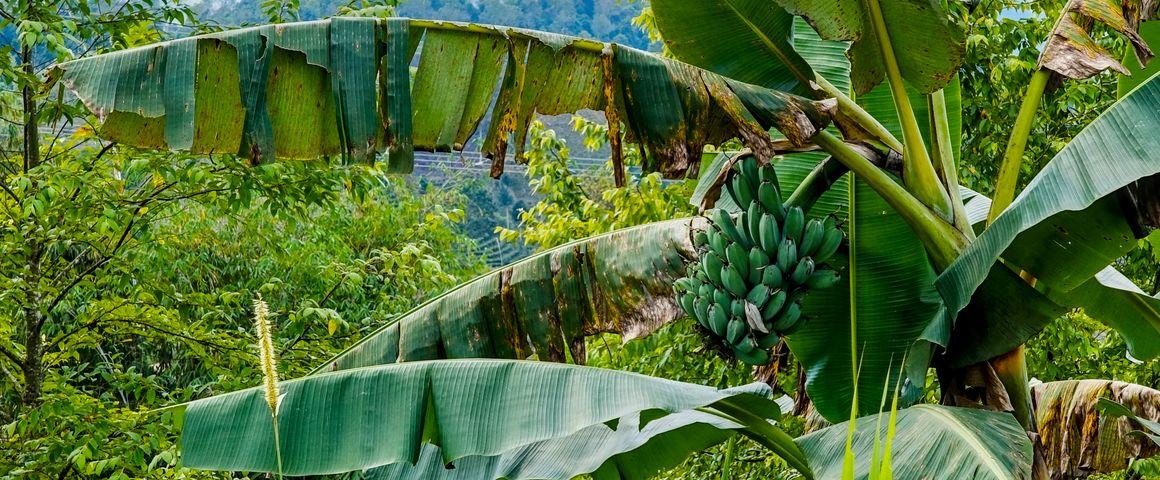
Klue Tiparot, a banana variety originating from Laos/Burma, photographed during surveys for the study. The contribution of Musa balbisiana is marked, and clearly visible to an expert eye. That of M. acuminata comes mainly from the local sub-species M. burmannica, and it takes molecular analysis to see its involvement. © M. Chabannes, CIRAD
Bananas are grown in every humid sub-tropical region, but only 20% of the harvest is intended for the global market. As a staple food in production zones, the major share of global production, which totals 150 million tonnes, is consumed by farmers or traded on local markets.
The bananas grown today, which are the fruit of breeding operations aimed at removing the seeds and boosting the amount of flesh, are sterile and therefore produced via vegetative propagation. They are genetically identical within a given variety. Very few dessert banana genotypes are grown on a large scale, including Cavendish, which dominates the global market. There are more varieties that are used on a local basis, for a wider range of purposes. However, that diversity remains limited, which hampers the crop's capacity to adapt to environmental change and makes it more vulnerable to phytosanitary risks (diseases, parasites, etc), which have increased dramatically as a result of increased global trade.
The development of new, resistant varieties is therefore essential. This requires in-depth knowledge of the available biodiversity, in order to explore how it could be used to make banana more resilient to climate change and diseases.
The work covered northern continental Southeast Asia, notably North Vietnam, northern Laos and southern China. The international research team collected representatives of cultivated and wild forms in the zone, to establish their genome profiles. Based on those profiles, they identified the various ancestral components, revealing the evolutionary processes that led to their creation.
The study revealed the novel and previously little-known degree of diversity among bananas in the zone.
One of the most surprising conclusions was that the related species Musa itinerans, which is endemic to the study zone, is found in several local varieties. That contribution to cultivated forms had never been documented before. The genome of the species, combined with that of traditional bananas, produces perfectly edible varieties. The species could therefore be used as a source of resistance to fusarium TR4, a disease that is threatening banana plantings worldwide.
The scientists also confirmed the contribution of Musa balbisiana and M. burmannica, the local sub-species of Musa acuminata, the major banana parent species. Until now, it had been thought that this sub-species played only a minor role in domesticated banana varieties. However, the team showed that it is found in widely disseminated local varieties. The sub-species, which is known for its various resistance characters, could therefore be used more widely.
In the light of climate change and growing biotic pressure (parasites, pests, etc), these local genetic resources are a precious resource for varietal breeding, and offer potential adaptation traits. Our research also highlighted the urgent need to preserve and promote wild and cultivated diversity, which is often under-represented in collections, despite the fact that that is where the parents of future banana varieties are found.
The history of bananas began in New Guinea, and the domestication route commonly described crosses the Malay peninsula, Java and Sumatra, steadily incorporating local endemic varieties along the way. The work published in PLoS ONE reveals an alternative introduction route from New Guinea via the Philippines, Taiwan and southern China.
Perrier X, Sachter-Smith G, Breton C, Rivallan R, Jacquemoud-Collet J-P, Dubois C, et al. (2026) Beyond domestication: The unexpected contribution of native Musa wild relatives to cultivated banana diversity in Mainland Southeast Asia. PLoS One 21(8): e0352247. https://doi.org/10.1371/journal.pone.0352247
Results & impact 21 September 2026
Results & impact 3 September 2026
Results & impact 29 June 2026