











Event 8 October 2026

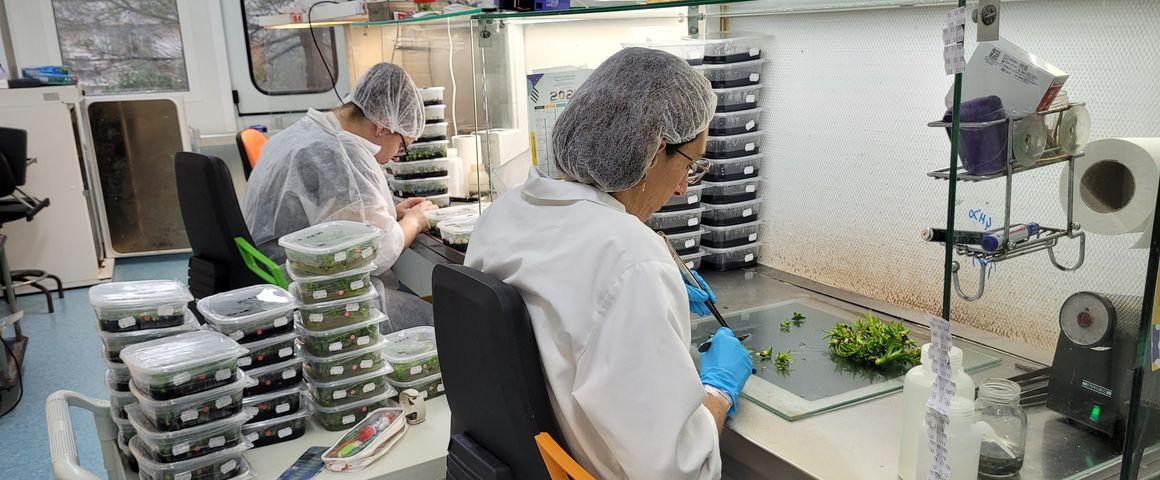
Propagating in vitro plantlets in Vitropic's laboratories © S. Della Mussia, CIRAD
In addition to celebrating a company, this anniversary tells a particular story: that of an innovation resulting from research done in Montpellier that has become an international economic activity, while remaining firmly anchored in its region of origin.
One in every three bananas (or thereabouts) sold and eaten in France comes from in vitro plantlets produced by Vitropic in Saint-Mathieu-de-Tréviers. While 60% of the 7 million in vitro plantlets the group produces each year are dessert bananas, it also produces cooking banana (plantain), pineapple, vanilla, sweet potato, sugarcane and coffee plantlets, among other tropical and ornamental species. Those plantlets are intended for farmers in numerous world regions. Some 95% of its output is exported, notably to Africa. This is one illustration of the international scope of an industrial activity based in the heart of Hérault département.
Vitropic offers varieties tailored to growing conditions and to the needs of value chains. Its activity also includes introducing and purifying new species, developing propagation protocols and producing plantlets that satisfy strict sanitary criteria.
Ordering from Vitropic guarantees certified, homogeneous, disease-free and traceable varieties.
The story of Vitropic is one of a small firm born in 1986, when the concepts of "start-ups" and "spin-offs" were less common than they are now. Its creation was a pioneering move to put public research to practical use, building a business based on scientific and technical expertise and ensuring that it benefits agricultural value chains in the global South.
Vitropic is majority-owned by CIRAD. Its activity tallies with CIRAD's scientific vocation to convert knowledge and know-how into concrete solutions, with and for producers and agricultural value chains. The plantlets that Vitropic produces contribute directly to crop sustainability: they have allowed a reduction in pesticide use in banana plantings worldwide, for instance.
While most of Vitropic's output is intended for export, its know-how is also proving useful closer to home. Bananas are being grown in Lansargues. In Baillargues, a project to grow sugarcane is under way, with a view to making rum. Sweet potatoes, carobs, vanilla and other crops of tropical origin are also potential development opportunities for the firm.
These initiatives pave the way for agricultural diversification prospects in Occitanie, and bear witness to the potential for plant propagation techniques to be used in new ways, in new situations.
Vitropic also provides local jobs. Most of its 22 employees live in or near Saint-Mathieu-de-Tréviers, five of whom have been with the firm from the outset.
"Five of us have been with Vitropic since the very start. We have produced tens of millions of plantlets, improved techniques, stood firm through the difficult times any firm faces, and trained the next generation", says Alexia Bourdoumi, a technician at Vitropic in charge of its laboratory, who was one of the pioneers in the Vitropic adventure in 1986.
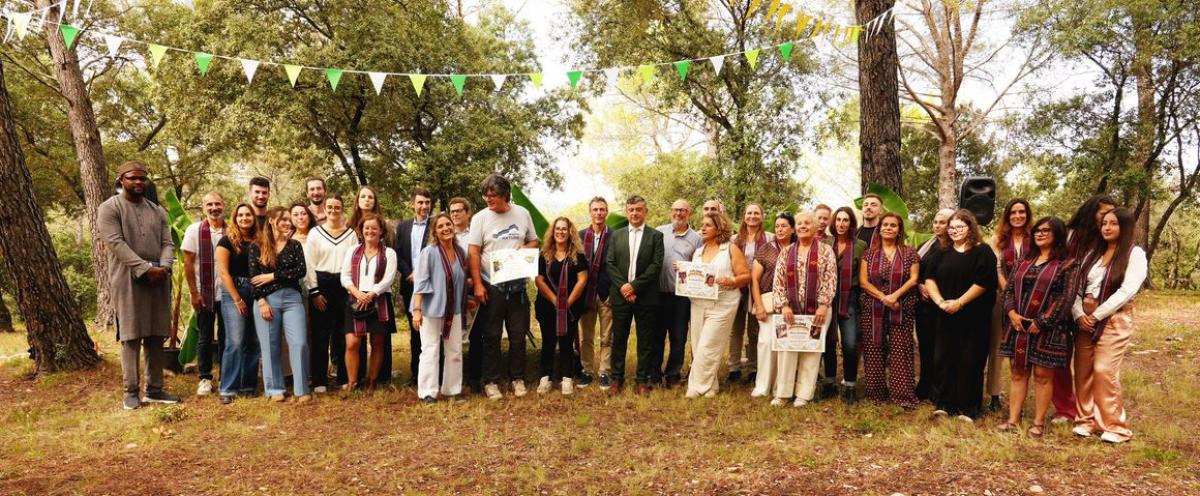
Alongside their historic partners, shareholders, customers from Africa and the West Indies, technical and scientific teams, representatives of the new Vitropic Africa subsidiary, the Acting CEO of CIRAD and the Mayor of Saint-Mathieu-de-Tréviers and Chair of the Pic Saint-Loup community of communes, Vitropic and CIRAD have celebrated their 40-year partnership on crop innovation. © M. Adell, CIRAD
To mark its 40th anniversary, Vitropic is moving on to a new stage. The prospects include new projects being conducted by CIRAD to create banana varieties more resistant to two major diseases (TR4 fusarium wilt and black Sigatoka), adapt to climate change and maintain varietal diversity.
The firm is continuing its global development, with the recent creation of "Vitropic Africa", a subsidiary set up in Ivory Coast in partnership with Compagnie fruitière, the largest banana producer in Africa. The aim is to develop dessert and plantain banana in vitro plantlets in a context of strong demand from local markets.
For Vitropic and CIRAD, this anniversary is a chance to thank their teams, everyone who built the firm, its customers and the partners involved in this adventure since 1986. It is also an opportunity to look to the future, which will extend and justify Vitropic's role: to use its expertise to develop new varieties, for sustainable value chains.
Since its founding in 1986, Vitropic has had close links with CIRAD's research activities. That scientific backing serves to bolster its expertise in in vitro culture, varietal breeding and plant sanitary quality. In return, the firm helps to apply and transfer innovations to agricultural value chains.
This complementarity provides both parties with development leverage: research fuels Vitropic's innovation capacity, while the firm's industrial experience and its relations with producers and markets help to build bridges between scientific knowledge and its applications.
This dynamic fits in CIRAD's strategy and that of its subsidiaries, with a determination to boost the impact of crop innovation, to benefit tropical and Mediterranean farming systems.
Vitropic specialises in producing in vitro plantlets and young plants, primarily banana and other tropical crops. It is based in Saint-Mathieu-de-Tréviers, near Montpellier, and it supports agricultural value chains by virtue of its expertise in in vitro culture, and its ability to adapt varieties and produce high sanitary quality planting material. www.vitropic.fr
CIRAD is the French agricultural research and international cooperation organisation working for the sustainable development of tropical and Mediterranean regions. It works with its partners to build knowledge and solutions for resilient farming systems in a more sustainable, inclusive world. It mobilises science, innovation and training in order to achieve the Sustainable Development Goals. Its expertise supports the entire range of stakeholders, from producers to public policymakers, to foster biodiversity protection, agroecological transitions, food system sustainability, health (of plants, animals and ecosystems), sustainable development of rural territories, and their resilience to climate change. CIRAD works in some fifty countries on every continent, thanks to the expertise of its 1750 staff members, including 1200 scientists, backed by a global network of some 200 partners. It also supports French science diplomacy operations.
CIRAD is a public establishment (EPIC) under the joint authority of the Ministry of Higher Education, Research and Space and the Ministry of Europe and Foreign Affairs.
Event 8 October 2026

Event 6 May 2026