

















Results & impact 21 October 2026



Tropical forest in Peru © C. Dangléant, CIRAD
The essentials
According to past work, tropical rainforests currently make up around a third of the global terrestrial carbon sink. Unfortunately, their sequestration capacity is falling, while global emissions continue to rise. The impacts of deforestation in the tropics are currently accurately quantified, but forest degradation is much less well documented. However, depending on the zone, degradation can cause aerial carbon losses equal to if not higher than the emissions generated by deforestation.
In response to climate change, fighting forest degradation is just as crucial as fighting deforestation.
If deforestation has been studied more than degradation, it might be because it is easier to define. Deforestation refers to the total loss of forest cover, while degradation is defined as a partial loss. The difference looks clear until it comes to defining the "loss" to be considered. "What some people see as forest management practices, others will see as degradation", Bruno Hérault explains. "Defining what we mean by forest degradation is currently a real challenge, on both a local and an international level. Labelling a forest "degraded" has concrete impacts, for instance in economic terms when it comes to applying for payments for ecosystem services."
To distinguish better between degradation and deforestation, the scientists involved in the analysis looked at the "direct factors" in forest cover loss. Total deforestation is due to human deforestation activities, while forest degradation may be due to human factors, but also to ecological or climate aspects. The study therefore looked at selective logging, fires, droughts, uprooting by the wind, and the "edge effect". "The edge effect is a disruption seen on forest fringes, for instance after deforestation or a fire", Bruno Hérault points out. "Trees that were previously surrounded by vegetation find themselves exposed to the wind, to drier soils, and to a whole load of other phenomena that make them more vulnerable. This edge effect may be seen in trees up to a kilometre away from the new forest edge."
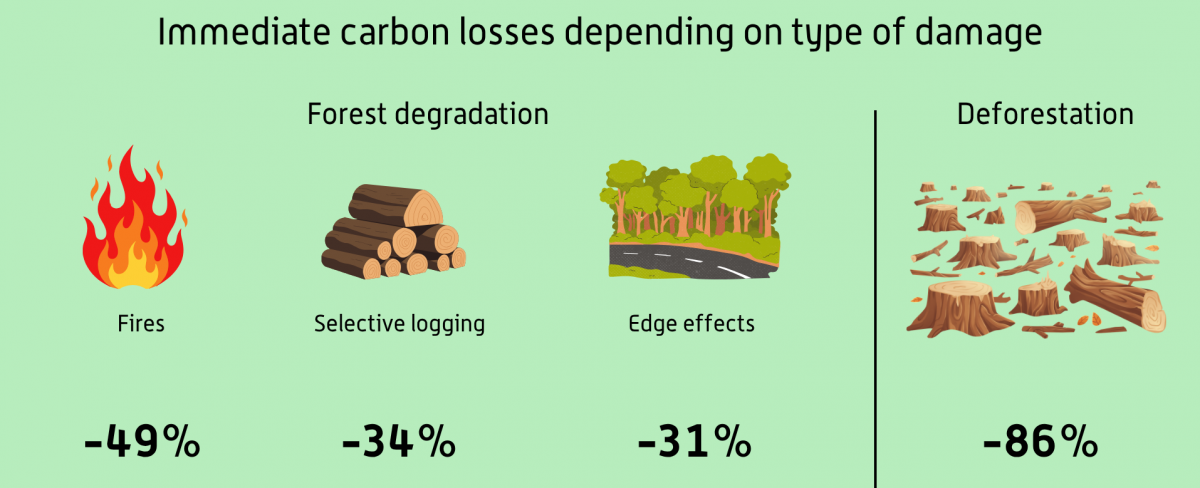
According to the forest degradation data compiled by the international team of scientists, fires cause the greatest carbon losses: on average, almost half the aerial carbon stock disappears immediately. Droughts have little effect, causing around 5% losses. Edge effects and logging, on the other hand, have significant effects (minus 31 and 34 % respectively).
"These are averages", says Bruno Hérault, "but it is important to understand that there may be several types of disruption at once. For instance, degraded forest edges that suffer additional disruption, such as fires or logging, suffer 56% losses of their carbon stocks on average. For edge effects alone, the figure is closer to 24%." The same pattern is seen for forest fires. In the event of repeated fires, the scientists noted 62% carbon losses.
It is no surprise that degraded forests regenerate faster than secondary forest, in other words those that have suffered total deforestation. Carbon stocks are therefore reconstituted better after degradation, albeit to a very varied extent. Dr Bienvenu Amani, researcher at Nangui Abrogoua University (Ivory Coast), specialises in forest regeneration after disruption. He has been working with CIRAD for a long time, and was a co-author of the meta-analysis: "within twenty years of disruption, a regenerated forest recovers between 41 and 117% of its initial carbon stock, compared to just 1 to 74% for a secondary forest. That shows that conserving forest structure improves forest regeneration capacity".
Dr Amani's work, including several studies that formed part of the meta-analysis, goes further: regrowth is faster if trees are kept in degraded landscapes on the edges of forests. Those so-called "remnant" or "residual" trees preserve soil fertility, temper microclimates and act as a source of seeds for forest regeneration.
Land use before its abandonment and forest regrowth also substantially influences carbon storage recovery. "In West Africa, several field studies have shown that regeneration is slower after a rice crop than after a yam crop", Dr Amani reveals. "In the Brazilian Amazon, the aerial carbon storage gain is 38% higher in forests on former cultivated soils than on former grazing land."
Understanding the factors that accelerate or slow disrupted forest regeneration, and thus aerial carbon stock regeneration in the tropics, will help steer field operations.
In the publication, the scientists set out average carbon losses and gains depending on continent. While their data are a major step forward, the authors have one reservation: two thirds of the studies were in the Americas, and a large proportion focused on the Amazon alone.
"Asian and African forests are under-represented in the research work", Bruno Hérault regrets. "However, the available data are particularly interesting. For instance, African forests seem to resist extreme drought better than Amazonian forests. We need to look further into these aspects to see why."
"According to the IPCC, the highest young secondary forest recovery rates are observed in Africa", Dr Bienvenu Amani adds. "Similarly, in the data gathered, carbon losses as a result of selective logging were lower in Africa than in Asia or the Americas."

Forest in Senegal © R. Belmin, CIRAD
The studies compiled used different carbon accounting methods: satellite or remote sensing data, flux towers, field surveys, etc. Within the same region, the data for a given disruption factor may vary hugely: "If we take selective logging in Asia as an example, immediate carbon losses range from 13 to 75%", says Bruno Hérault. "Hence the importance of basing analyses on local data."
Nevertheless, field sampling is not always possible. The progress made in terms of spatial and temporal satellite data resolution goes some way towards solving the issues. As far as the scientists are concerned, this range of sources is vital, and above all, it must be possible to gather data over several years.
"This is not just a scientific issue, but a climate policy one", Bruno Hérault feels. "Carbon loss and gain factors directly fuel national greenhouse gas inventories, and those inventories allow countries to apply for carbon credits, for instance."
The team considers that their average carbon loss estimates could directly fuel the IPCC emission factor database. And as such, the lack of data for Africa could put it at a disadvantage: the IPCC's default indicators are based on existing data, in other words mainly those for Amazonian forests. If African forests prove to resist selective logging and drought better, national inventories for the continent may be over-estimating their own carbon emissions.
Viola Heinrich et al. 2026. A meta-analysis of carbon losses and gains from tropical moist forest degradation and regeneration. Sci. Adv.
Results & impact 21 October 2026

Results & impact 18 September 2026
Results & impact 16 September 2026