







Call to action 3 August 2026


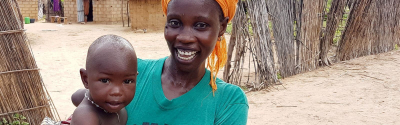
Millet field in an agroforestry system, Bambey region, Senegal © C. Dangléant, CIRAD
Farming, food and forestry systems contribute to climate change, but are also significantly exposed to its effects.
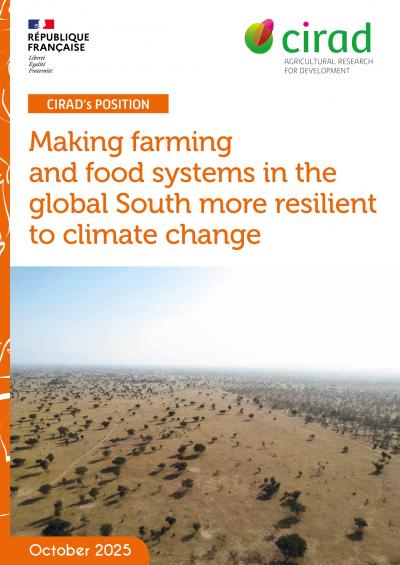
"Agriculture and food systems are both victims of and major contributors to climate change, but are also a vital part of the solution", says CIRAD agroecologist and Climate Change Officer Vincent Blanfort.
As the international community prepares for the upcoming United Nations Climate Conference (COP30), due to begin in Brazil on 10 November, CIRAD is publishing a position paper on the need to transform our farming and food systems in response to the climate emergency.
The paper, entitled Making farming and food systems in the global South more resilient to climate change, is based on the conclusions of a collective work coordinated by CIRAD scientists and their partners, with almost 150 authors from several fields.
CIRAD scientists have pinpointed three main levers for accelerating the transition:
Family farming accounts for almost 90% of farms worldwide, producing 75% of the world's food. Although they take various forms, they have considerable advantages (biodiversity, anchoring in territories, grassroots know-how) that make them living labs for agroecology.
"In switching to agroecology, family farms offer potential for climate change adaptation and mitigation, while boosting global food security and ecological stability", says Marie Hrabanski, a CIRAD researcher specializing in public climate policy.
Despite agriculture's recognized potential for fighting global warming, the sector receives just 2% of overall global climate funding. CIRAD is calling for mass reorientation of investment towards sustainable farming and family farms.
Lastly, the paper calls for stronger interfaces between science and policy, which are essential for converting scientific knowledge into concrete action. It recommends assessing the carbon impact of agriculture better, harmonizing measurement methods, and compiling shared databases for researchers, policymakers and agricultural players.
"Better measurements mean more effective action. No agricultural climate policy can be rolled out effectively without reliable assessment tools", says CIRAD ecologist and "4 per 1000" initiative officer Julien Demenois.
This position paper is based on the collective work Climate Impacts and Challenges in Agriculture, Forests and Food Systems: Perspectives on the Global South, coordinated by Vincent Blanfort, Julien Demenois and Marie Hrabanski and published by Springer.
Call to action 3 August 2026
Call to action 23 May 2026
Call to action 30 March 2026