Agroecology: in Guadeloupe, producers are using animals to control weeds
Science at work6 November 2025
Why not use animals to keep weeds down? Why not indeed: it would cut herbicide use, and also avoid the need for mechanical weeding, which is of costly and laborious. In Guadeloupe, sheep have been introduced into banana plantings to test the efficacy of the method. Find out the results of this innovative approach on the part of researchers and farmers, who are working together on the French territory's agroecological transition.
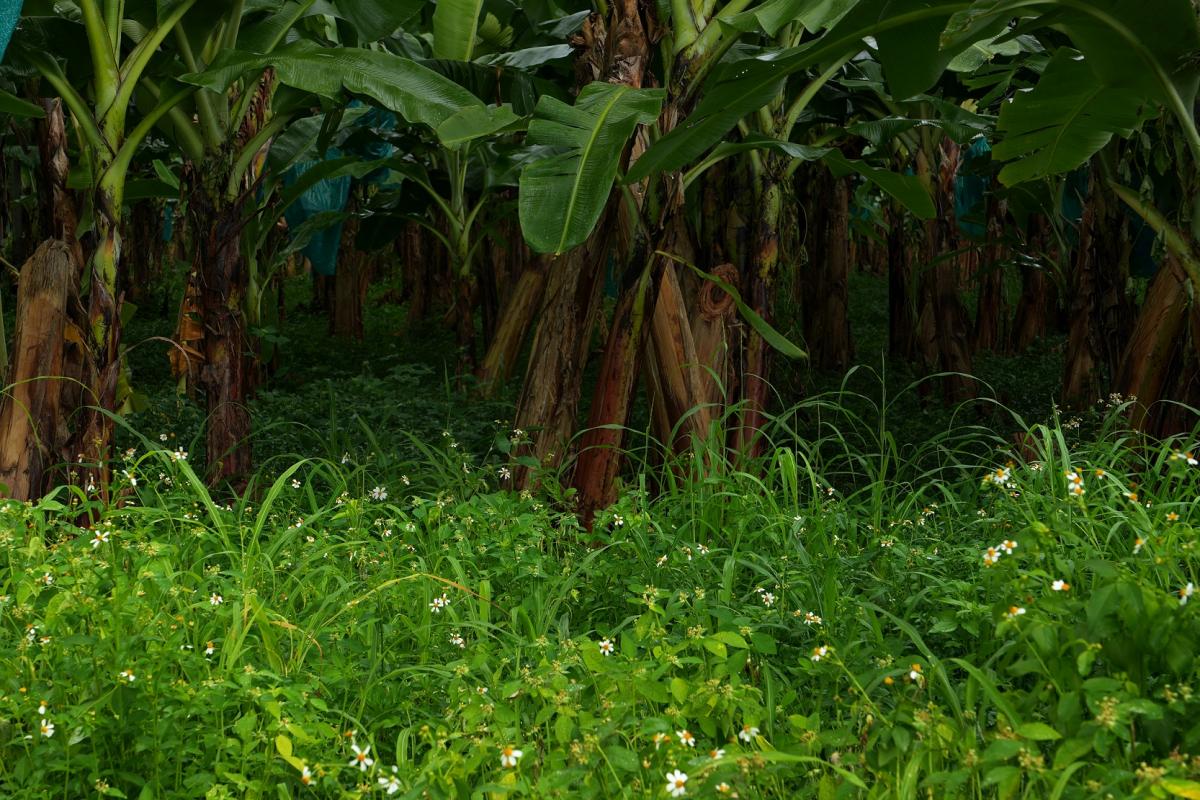
Despite major efforts to cut pesticide use, herbicides are still widely used in banana plantings in the French West Indies. This is a common issue across the tropics, where weeds grow quickly all year round.
In 2022, CIRAD began tests in banana plantings, using so-called "service" animals to keep weeds down.
The term "service animals" was borrowed from the practice of using "service plants" on farms. Service plants are intercropped with the main crop, and are chosen to provide certain services, such as protecting the soil against erosion or improving its structure, or regulating pest population levels. "We already had service plants to reduce weed growth in banana plantings, but they weren't doing enough as the weeds grew so fast", says CIRAD agricultural engineer Steewy Lakhia. "So we wondered whether we could use service animals to eat weeds."
Sheep apparently control weeds well, but their performance is tempered by the constraints of introducing animals on farms. The practice calls for fences, stables, training and daily monitoring, and also means decontaminating land exposed to chlordecone in this part of the "banana crescent". The initial proof of concept has been followed by applied research, by the Institut technique tropical (IT2) in Guadeloupe.
An innovation resulting from the Territoires durables (sustainable territories) project
The Territoires durables project is aimed at facilitating the agroecological transition in Guadeloupe, Martinique and Réunion. The transition targets three scales: plot, farm and watershed. The project is funded by the Ministry of Overseas France and led by CIRAD.
In Guadeloupe, efforts are focused on weed growth in banana plantings. In the face of sustainability issues, and also the need to respect sanitary regulations, banana producers are keen to find alternatives to herbicides.
Sheep in banana plantings: an opportunity that requires producers to reorganise
In the first tests, with five sheep per half-hectare, the animals ate just over half of the weeds between the banana plants. For the farmers, this meant a reduction in herbicide use, and also in mechanical and hand weeding operations, which are laborious, costly and time-consuming.
Sheep can therefore be considered to perform well as service animals, but there are drawbacks. "We observed two main constraints", Steewy Lakhia says. "The first was attacks by stray dogs, which meant installing electric fens. The other was linked to the parasites and diseases the animals are likely to catch. In other words, even small flocks mean providing producers with training and support, if they are not used to keeping livestock."
First of all, providing support means fine-tuning the process, and IT2 and zootechnicians from INRAE are currently doing tests in several banana plantings. Lucas Archimède, an agricultural engineer with IT2, explains: "we are monitoring the animals on farms, looking at several indicators. The first is obviously the change in biomass between banana plants: are service animals more effective than mechanical weeding? We are also studying animal weight gain and health, and setting up a chlordecone decontamination system before taking the sheep to slaughter".
Yes, the animals are intended to be eaten afterwards. During their experiments, the zootechnicians observed that sheep in banana plantings gained enough weight. Both they and the producers involved saw the opportunity this offers: selling meat serves to diversify income sources, or could partly be used to recoup the initial investment required.
For Lucas Archimède, what remains to be seen is how to calibrate the practice: "how many sheep should we use per hectare? How long should they be left to graze? We are currently testing sheep in banana plantings, but several sugarcane plantations are also interested. What service animal should we choose in that case?".
Since the shock discovery of chlordecone pollution and its consequences, the banana value chain has made undeniable efforts to reduce pesticide use. In terms of fungus control, for instance, it has developed preventive techniques such as de-leafing, and curative techniques using mineral oils. This drive to cut pesticide use across the board (fungicides, insecticides, herbicides, etc) is also helping the sector to anticipate the reduction in products authorised by the European Union for use in agriculture.
French bananas, which are grown in the French West Indies, are the fruits of a long history, fraught with difficulties, that CIRAD has supported over the years. Forty years that have revolutionized banana growing and seen biodiversity return to banana plantations.
In a context in which the means of production are costly, producers are keen to innovate, even if the results are not immediately cost-effective. As a farmer from Capesterre Belle-Eau puts it: "sheep are not very effective on my farm: they have a tendency to get over the fence, for instance. But I think that in the end, this is just a technical issue or a matter of scale".
IT2 is currently supporting the producer. "Banana producers often do not have the "knack" of rearing livestock", Lucas Archimède explains. "A lot of them have never kept animals, and they realise during experiments how much work is involved. Introducing sheep is a major change, and producers either become mixed crop-livestock farmers or bring in outside livestock farmers to care for the animals."
A need for applied research and close collaboration with producers
Whatever happens with this innovation in future, the process will have demonstrated the importance of doing applied research with producers. This was the initial stance taken by the Territoires Durables project, and IT2 has taken over by conducting tests on farms. "The current context is pushing the sector to adopt innovative practices, notably agroecology", Lucas Archimède stresses. "As a technical organization, we must be capable of transferring those practices to farmers. This means listening to them, and obviously testing innovations on the ground, if possible on their farms."
CIRAD agronomist Nadine Andrieu shares that observation: "ensuring that innovations are adopted necessarily means building those innovations hand-in-hand with future users. For example, this is how we can pinpoint how farmers' work will have to be reorganised as a result of new practices".
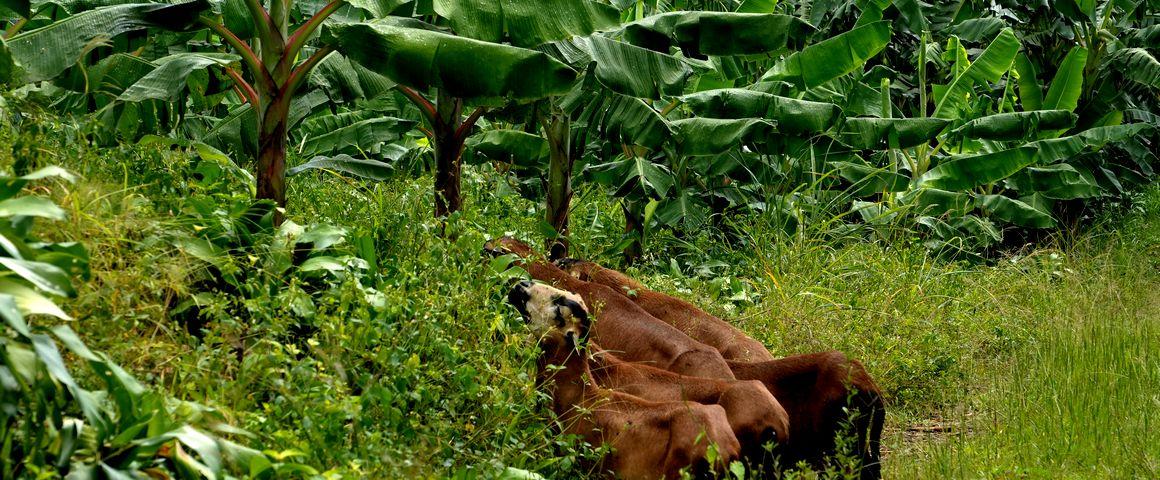
Research on service animals, in banana plantings and elsewhere, is still in its infancy. Steewy Lakhia is now looking to introduce cattle into banana plots left fallow. This is not a new practice in Guadeloupe, but the researcher hopes to document it, to identify ways of improving it and rolling it out ion a larger scale. IT2, for its part, is beginning tests on sugarcane plantations, and is due to choose the service animal to use, between sheep, geese and ducks. Meanwhile, Alexandre Buffon Technical College in Baie-Mahault now includes service animals in its vocational training programme.