












- Home
- Worldwide
- Our regional offices
- West Africa - Forest and Humid Savannah
- Actualités : Afrique de l’Ouest – Forêt et savane humide
- sustainable cocoa farming
Tree selection and forest cover management for agroforestry at the heart of sustainable cocoa farming
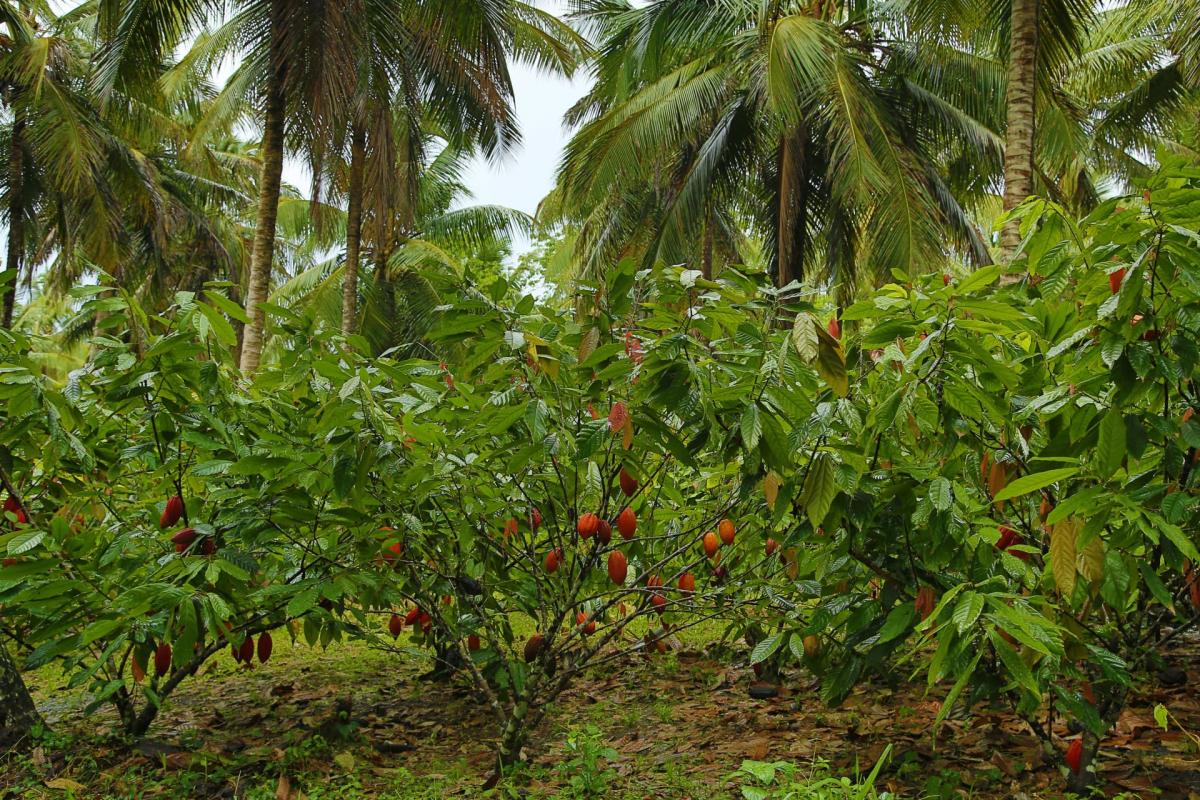
Cocoa cultivation © Cirad
Distinguishing the origin of trees: ecological and productive issues
Within cocoa plantations, trees originate from three sources: planted trees, remnant trees, and spontaneous trees. The majority of trees in the studied systems come from original forest formations (remnant trees) or spontaneous natural regeneration, and play a major ecological role. Remnant trees, thanks to their size and age, concentrate the largest carbon stocks, create shade and a microclimate, maintain soil fertility, and preserve biodiversity inherited from the vanished forests. Spontaneous trees generate high inward carbon sequestration fluxes due to their rapid growth and represent the future of tree cover in cocoa plantations. Planted trees, often fruit trees or exotic species, generally contribute less to biodiversity and carbon storage than remaining and spontaneous trees, but they strengthen food security and cocoa farmers' incomes.
Considering farmers' preferences: economic issues and constraints
Trees are economically important and can represent up to 70% of farmers' income related to timber production, fruit, handicrafts, and other tangible and intangible uses. Among them, avocado, kola, and bitter kola are the most commercially traded. However, producers' lack of botanical knowledge and constraints on market access limit the commercialization of agroforestry products.
Taking climate change into account
Climate change triggers different responses in trees, depending on whether it stimulates or slows their growth and natural regeneration. Of the 25 species studied, 13 appear to benefit from expected climate changes. However, in all cases, soil carbon stocks would decrease under the influence of rising temperatures.
Species with strong growth and good regeneration are the priority candidates for future systems, and effective management of root and aboveground competition will facilitate coexistence between species with different strategies. Conversely, species with poor regeneration pose a risk to the long-term sustainability of tree cover.
Consider agroforestry cocoa plantations as a source of supply for the timber industry
In cocoa plantations, current timber resources come mainly from remnant trees, which today constitute about 70% of the resource. Eventually, these trees will be gradually replaced by spontaneous trees, which will then form nearly 80% of the future timber stock.
The growth trajectory of trees varies depending on the species. For example, the minimum harvestable diameter can be reached between 24 and 93 years of age, depending on the species. Spontaneous trees perform better than planted trees: they grow on average 10% faster per year and reach a volume 41% greater at the same age. However, their production potential remains suboptimal without appropriate forest management.
Promoting tree diversity in agroforestry cocoa plantations
The diversity of tree species in cocoa plantations varies from 1 to 72 different species. Remnant and spontaneous trees exhibit a higher diversity (median of 9) than planted trees (median of 4). This diversity stems primarily from remnant and spontaneous trees, with planted trees contributing to it in addition.
Optimizing the choice of shade trees in cocoa plantations
Cocoa tree productivity decreases as tree cover increases, but this decline only becomes significant above 30%, a value that can be used as a benchmark. The best performance is observed when the associated trees have sparse or deciduous foliage. Optimal shade management requires technical support for growers on appropriate silvicultural practices.
Managing the regeneration and growth of tree cover
The combination of tree density and size (trunk cross-section at 1.3 meters) allows for accurate prediction of vegetation cover and shade. A canopy diagram combining these two parameters has been developed as an assessment tool to aid in the development of management strategies for achieving and maintaining a desired canopy cover level, based on a dynamic view of forest species growth. The same canopy cover level can thus be achieved with a high density of underdeveloped trees, and then through progressive thinning as the trees mature. This tool is already being used in a pilot Assisted Natural Regeneration (ANR) project in the Indénié-Djuablin region, in collaboration with the RISOME and funded by Barry Callebaut.
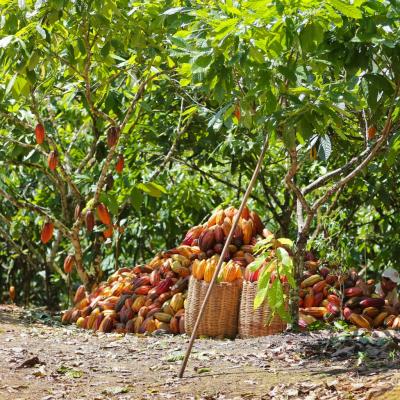
Cocoa harvest © Cirad
Recommandations for the design of agroforestry systems for cocoa farming
These results from the COCOA4FUTURE project lead to the following recommandations :
Prioritize and value spontaneous trees in cocoa plantations:
- Emphasize Assisted Natural Regeneration (ANR) in ecosystem service restoration programs within cocoa plantations.
- Promote species resilient to future climates, the spontaneous self-adaptation of the forest canopy, and an evolution of species composition based on their actual performance through observation, testing, and successive adjustments.
- Support the process by training farmers to identify and manage these young trees, as well as in silvicultural practices for optimal long-term canopy management.
Preserving remnant trees and residual forests:
- Recognize the essential ecological and agronomic services they provide, particularly as a source of propagules and for maintaining biodiversity and soil fertility.
- Protect dense-wooded species as pillars of the ecosystem, even if their growth is slowed.
- Also protect species with lower regeneration rates to prevent their gradual disappearance due to climate change.
Introduce targeted tree planting:
- Plant only as a supplement to natural regeneration to improve biodiversity or meet the specific needs of farmers.
- Respect farmers' choices based on their needs: food security, income, social functions, etc.
- Also improve market access for agroforestry products, especially for products with high economic potential and the production (timber and fruit) of fast-growing species that will benefit from the future climate.
- Strengthen the training of producers on tree species and their uses, and encourage the diversification of tree species to strengthen the economic and ecological resilience of households.
Promote policies that support agroforestry.
- Supplement density-based guidelines with target tree cover ranges adapted to production and conservation objectives, and to the necessary management of evolving forest cover. A value of 30% could be considered by default.
- Develop knowledge through research by identifying optimal cover levels according to producers' objectives (cocoa, timber, ecosystem services).