













Industrial and field analysis equipment - Natural resources and territories


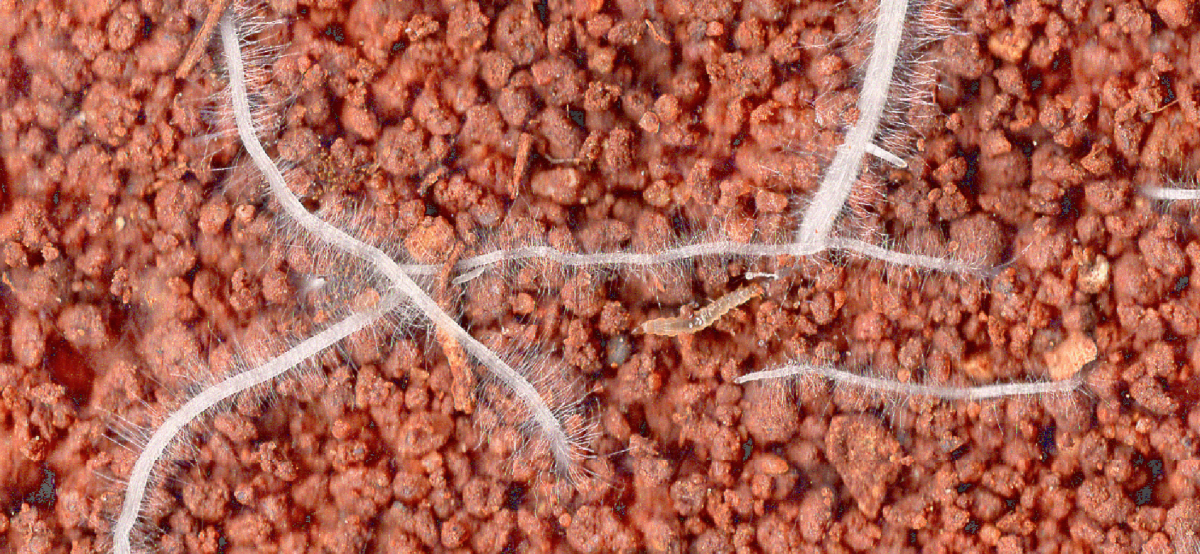
A symphile (invertebrate) after eating a root ©Christophe Jourdan, CIRAD. Photo taken with Scanorhize®
What with climate change, pressure on resources and environmental constraints, farming systems must change rapidly to become more sustainable, while maintaining yields. Understanding what goes on underground – in the crucial zone in which plant root systems interact with soil organisms and nutrients – is crucial for optimizing cropping strategies.
However, until now, observing root system dynamics meant resorting to destructive, labour-intensive techniques that were in some cases one-offs and thus did not allow real-time monitoring. Scanorhize® is an innovative, autonomous device combining a buried image sensor, artificial intelligence and connectivity. Thanks to its deep learning algorithms, Scanorhize® automatically identifies objects of interest, such as roots, mycorrhizal fungi and soil organisms, and characterizes the metrics of the interactions between those elements.
It is a relatively unintrusive continuous observation technology, capable of observing the life of the soil, including deep down. It therefore serves to visualize the efficacy of different practices (fertilization, irrigation, effect of biostimulants on root systems and soil fauna biodiversity) or the effects of climate change (long droughts or heavy rains), and to adapt or modify crop management sequences for the following year. Did you know, for instance, that ants play a role in soil aeration because of the tunnels they mine, and above all in root development and that of mycelial hyphae of soil mycorrhizal fungi?
Scanorhize® converts invisible underground data into reliable indicators for adjusting practices: varietal choices, irrigation calendar, input dosage, early detection of root diseases before symptoms appear on aerial parts, etc. It is a real decision support tool, with immediate applications for precision agriculture, varietal breeding, seed R&D and environmental studies relating to soil biodiversity. This innovation paves the way for more efficient, resilient, ecofriendly agriculture.
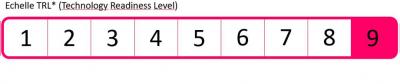
TLR9 - Technology Readiness Level
The Scanorhize® innovation developed by UMR Eco&Sols was fine-tuned by SATT AxLR and is currently the object of an ambitious transfer to a deeptech start-up, HUMEOS, launched in Montpellier in June 2025.
In a given zone, depending on local specificities and soil and climate conditions, a plant will not develop in the same way from one farm to another, or even from one plot to another. While producers' experience helps them decide whether a soil drains rainfall sufficiently, we can only guess how roots will react and capture soil moisture or inputs, depending on when farmers choose to apply them, or how soil organisms affect root growth. Everything you ever wanted to know about your crops is now available thanks to Scanorhize®, which allows you to scan the soil.
The tool could also benefit the seed sector, since it helps show users how to use seeds. The information given to producers is based on generic frameworks, but does not allow for all the specificities relating to how clayey or sandy a soil is, or whether it receives high or low sunlight levels. Scanorhize® makes it possible to generate data that help to give producers more precise advice and ensure successful crops.
Most solutions extol their effect on plants, but little attention is paid to the effect of molecules that enter the soil following their use. However, farmers need to be able to determine the efficacy and sustainability of a solution. It is important to know the positive or negative effects of such products on root life span, branching potential, fauna diversity, etc in the short and long term. Scanorhize® provides a solution for such assessments, and you can also use plant imaging (PHIV) to determine the effects on a whole-planet scale. All these methods provide a visual and scientific representation that may reassure producers and help them make decisions.
More than twenty projects have already benefited from Scanorhize®. "We estimate that more than a quarter of terrestrial biodiversity lives under our feet, but this wealth is still largely unknown. The soil is known as the 'third biotic frontier'. Understanding that biodiversity is essential to understand better how this complex ecosystem functions and to exploit the many services it can provide, particularly in farming systems", Emma Belaud, a PhD student with CIRAD, explains.
The agricultural training sector is also keen to include knowledge of the soil to boost the expertise of future agronomists, with the same idea that soils and their role in farming system performance are still too little known.
The sensor will be available in early 2026, following the current pre-industrialization phase. It will be sold by the start-up launched by HUMEOS, depending on requirements:
For more information about the device, contact the HUMEOS start-up!
Scanorhize® is a trademark registered by CIRAD.
Siegwart L, Saimpha G, Bertrand I, Hedde M, Jourdan C (2025) Optical scanner-based image analysis for assessing in situ barley root decomposition kinetics at different soil depths. Annals of Botany, Under revision.
Belaud, E., Jourdan, C., Capowiez, Y., & Hedde, M. (2025) Hearing and Seeing Through the Soils: A Review of New Sensing Technologies to Monitor Soil Invertebrate Activity. Under revision. Available at SSRN 5179879.
Belaud, E., Jourdan, C., Barry-Etienne, D., Marsden, C., Robin, A., Taschen, E., & Hedde, M. (2024). In situ soil imaging, a tool for monitoring the hourly to monthly temporal dynamics of soil biota. Biology and Fertility of Soils, 60(8), 1055-1071. https://doi.org/10.1007/s00374-024-01851-8.
Pruvost E, Tulet H, Delort E, Shokouh GS, Montesinos P, Magnier B, Jourdan C, Belaud E, and Hedde M. (2022). Invertebrates Detection with YOLOv5: Towards Study of Soil Organisms Using Deep Learning. 10th European Workshop on Visual Information Processing (EUVIP), 2022, pp. 1-6, https://doi.org/10.1109/EUVIP53989.2022.9922675.
Industrial and field analysis equipment - Natural resources and territories
Analysis-diagnosis service - Sustainable agriculture - Food and agrifood technology - Natural resources and territories - Animal production and health
Analysis-diagnosis service - Natural resources and territories