




















Software and digital applications - Territory management solution - Natural resources and territories


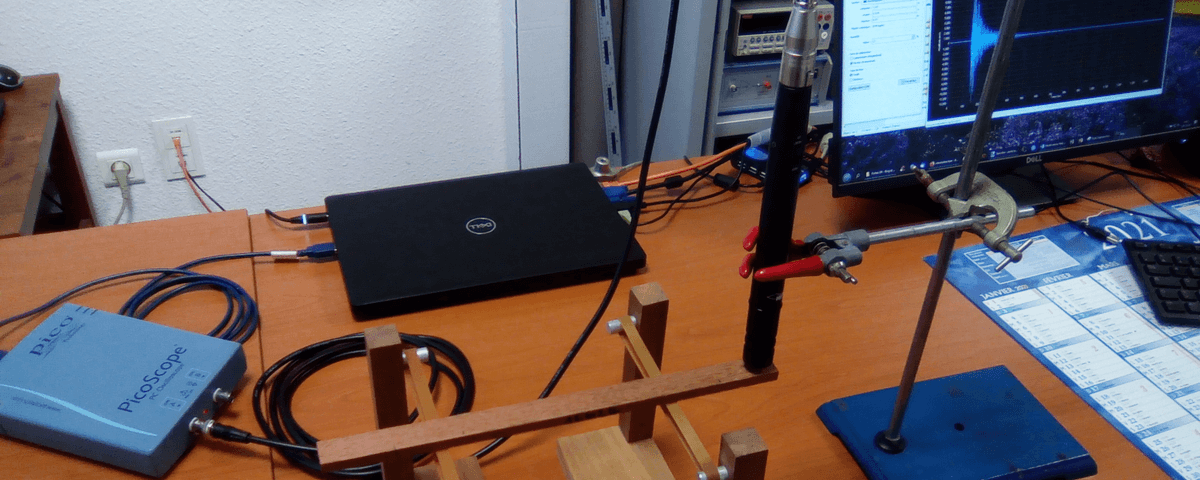
Device for non-destructive testing of the mechanical quality of wood by vibration method © Loïc Brancheriau, CIRAD
BING® analyses the vibrations emitted by a piece of wood after impact, enabling rapid assessment of wood quality and potential degradation. The BING® system is portable and can be used outdoors. It is a valuable quality control tool throughout the entire life cycle of a wooden component. It also contributes to a sound hazard analysis and critical control point approach (HACCP).
TLR9 - Technology Readiness Level
Discover the system’s key advantages :
The system enables :
BING® enhances your expertise in order to :
The current system, combined with our expertise, enables the development of customised applications tailored to your specific needs.
Training modules are available on request, and our expert team can either provide maintenance services or train your staff in system maintenance.
Paradis, Sébastien & Brancheriau, Loïc & Baillères, Henri (2017). Bing: Beam Identification by Non destructive Grading. 10.18167/62696e67.
Loïc Brancheriau et Henri Baillères (2002) " Natural vibration analysis of wooden beams: a theoretical review ", Wood Science and Technology, Springer – Verlag (Ed), Vol. 36, N°4, pp. 347-365
Loïc Brancheriau, Henri Baillères et Christian Sales (2006) "Acoustic resonance of xylophone bars: experimental and analytic approaches of frequency shift phenomenon during the tuning operation of xylophone bars", Wood Science and Technology, Vol. 40, N°2, pp. 94-106.
Loïc Brancheriau (2006) "Influence of cross section dimensions on the Timoshenko’s shear factor – Application to wooden beams in free-free flexural vibration", Annals of Forest Science, Vol. 63, N°3, pp. 319-321.
Loïc Brancheriau, Henri Baillères, Pierre Détienne, Joseph Gril et Richard Kronland (2006) "Key signal and wood anatomy parameters related to the acoustic quality of wood for xylophone-type percussion instruments", Journal of Wood Science (Japan Wood Research Society), Vol. 52, N°3, pp. 270 - 273.
Mitsuko Aramaki, Henri Baillères, Loic Brancheriau, Richard Kronland-Martinet, Solvi Ystad (2007) "Sound quality assessment of wood for xylophone bars", Journal of the Acoustical Society of America, Vol. 121, N°4, pp. 2407–2420.
Traoré B., Brancheriau L., Perré P., Stevanovic T., Diouf P. (2010) “Acoustic quality of vène wood (Pterocarpus erinaceus Poir) for xylophone instruments manufacture in Mali”, Annals of Forest Science, 67(8): 815-821.
Brancheriau L., Kouchade C., Brémaud I. (2010) “Internal friction measurement of tropical species by various acoustic methods”, Journal of Wood Science, 56(5):371–379.
Brancheriau L. (2014) "An alternative solution for the determination of elastic parameters in free-free flexural vibration of a Timoshenko beam", Wood Science and Technology, 48(6):1269-1279.
Barré J.-B., Bourrier F., Brancheriau L., Bertrand D., Rey F. (2018) "Effects of fungal decay on elasticity and damping of small-diameter silver fir logs assessed by the vibrational resonant method", Wood Science and Technology, 52(2):403-420.
Software and digital applications - Territory management solution - Natural resources and territories
Industrial and field analysis equipment - Natural resources and territories

Industrial and field analysis equipment - Analysis-diagnosis service - Sustainable agriculture