



Science at work 15 October 2026

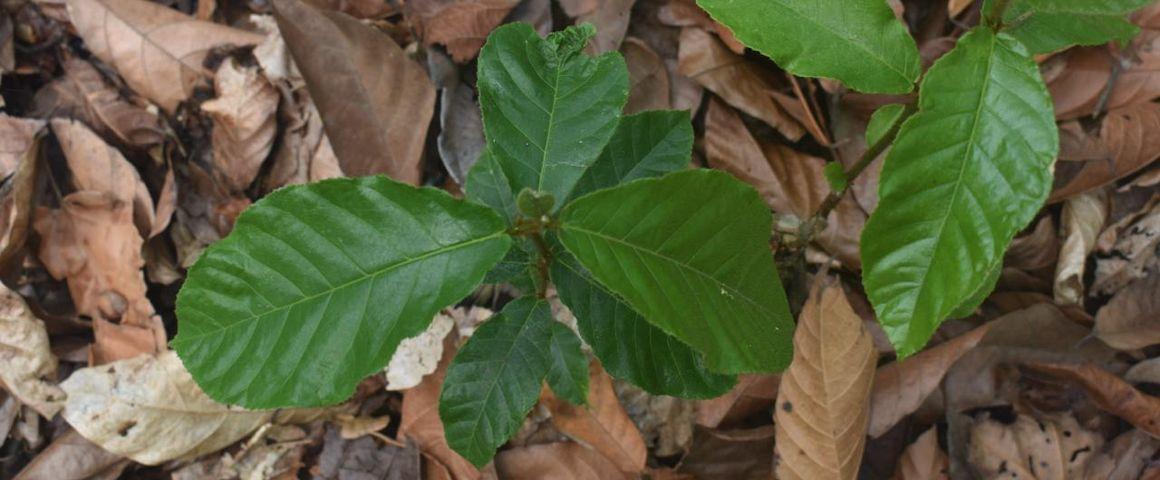
Ako (Antiaris toxicaria), primarily used to produce wood for veneers or plywood © I. K. Konan, CIRAD
Cocoa plantings in Ivory Coast are home to at least 1.05 billion young wild trees. Field inventories have recorded 272 species. This is the main finding of a study in the South of the country by scientists from CIRAD and Félix Houphouët-Boigny University. Those young trees, which have mainly grown from seeds brought by animals and the wind, are an as yet little-known natural resource that could become a major lever for forest restoration in the country.
Ivory Coast has seen substantial shrinkage of its forest cover (from around 16 million hectares in the early 20th century to under 3 million hectares today), notably as a result of agricultural expansion. Reforestation programmes aimed at restoring degraded areas often rely on producing plants in the nursery before planting them out in the field.
The results of this study suggest that such approaches could be supplemented by making use of young trees already growing wild in cocoa plantings. Across the country's 3.7 million hectares of cocoa plantings, there is an estimated stock of at least 1.05 billion individual trees. That estimate is based on a deliberately cautious assumed density; the actual figure could therefore be significantly higher.
These results suggest we should take greater account of the natural regeneration potential that exists in agricultural landscapes. The question is no longer just "how many should we plant?", but "what is growing there already?".
The study showed that plantings in which producers have kept more adult trees show more abundant, diverse natural regeneration.
This work revealed significant as yet little-documented plant diversity within the natural regrowth, and demonstrated the merits of taking greater account of those young trees when managing cocoa plantings.
Natural regeneration does not systematically replace restoration plantings. Planting is still appropriate, primarily in young, simplified plots, notably on land that was not previously forest, where there is a limited stock of young trees. However, preserving adult trees and fostering wild regrowth could become a prime strategy for agroforest transition.
These results tally with the country's policy for forest preservation, rehabilitation and extension (PPREF, 2018) and its implementation strategy (SPREF 2019-2030), which aim to increase national forest cover to at least 20%. The SPREF makes agroforestry the priority option in agricultural production systems and plans to reconstitute forests by means of reforestation and exclosure. Assisted natural regeneration, which consists in identifying, protecting and supporting young wild trees, is an economical additional way of achieving these aims in cocoa plantings.
To quantify regeneration, the scientists studied 145 cocoa plantings across 15 sites in southern Ivory Coast. In all, 725 plots were inventoried. Young wild trees less than 10 centimetres in diameter were recorded and identified, including seedlings just a few centimetres tall.
Bayesian statistical models were then used to assess the relations between the characteristics of the cocoa plantings and the abundance or diversity of natural regeneration.
Konan I.K., N’Guessan A.E., Dago M.R., Kouassi A., N’Dja J.K., Traoré S., Hérault B. (2026). Cocoa agro-ecosystems are not ecological dead ends: evidence of substantial tree regeneration potential. Restoration Ecology. https://doi.org/10.1111/rec.70583
This work fits into CIRAD's research into natural forest regeneration in Ivory Coast, notably as part of the Cocoa4Future project. It was conducted in partnership with Félix Houphouët-Boigny University in Abidjan, through its botany laboratory, the Institut National Polytechnique Félix Houphouët-Boigny (INP-HB) and the Ministry of Water and Forests.
Science at work 15 October 2026
Science at work 14 September 2026
Science at work 7 July 2026