

















Science at work 7 July 2026


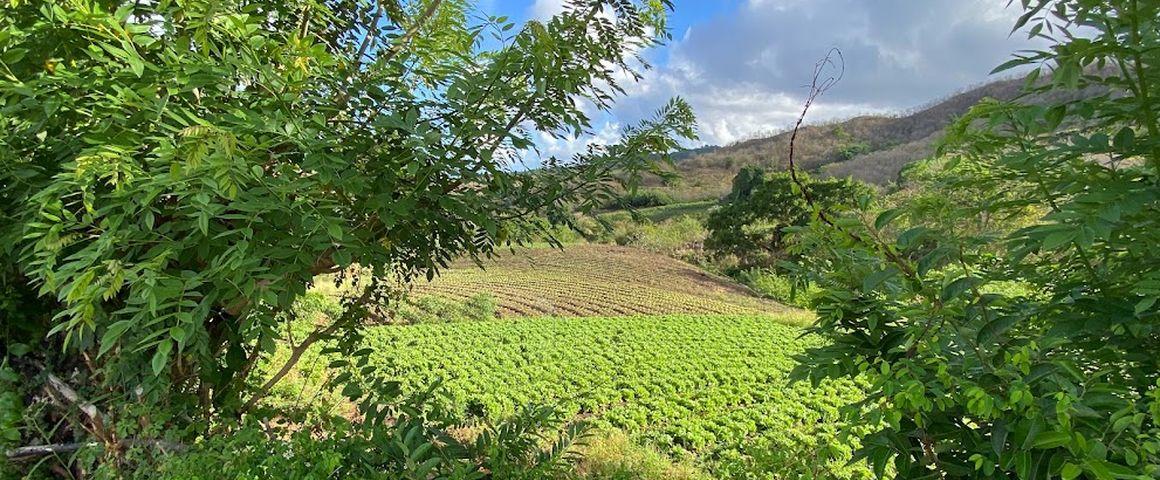
Lettuce production in irrigated plots © L. Parrot, CIRAD
The project, led by CIRAD in partnership with INRAE, the Directorate for Food, Agriculture and Forestry (DAAF), the Chamber of Agriculture, the Institut Technique Tropical (IT2), the University of the French Antilles and the TANOU BIO association, has shown that there is no silver bullet for reducing phytosanitary product use. The solution hinges on combining farming practices suited to local conditions with technical support, suitable work organisation and economic conditions that allow producers to embark on the transition.
In Martinique, local fruit and vegetable production covers only around 40% of the population's requirements, while 90% of the calories consumed are imported. At the same time, surveys conducted as part of the project have shown that consumers have high expectations of local products, and pay close attention to how they are produced and their cost.
Vegetable value chains in Martinique and Guadeloupe use smaller volumes of phytosanitary products than the national average. In Martinique, sales of such ducts, all value chains combined, fell by 9.4% in 2022. Glyphosate remains the most widely sold active ingredient.
Surveys of more than 400 market gardeners also revealed a wide variety of situations. Almost half of farmers with several activities declared that they did not use any synthetic phytosanitary products. The proportion was 23% for farmers mainly producing for their own consumption and 19% for large farms.
On more than half the farms studied, producers now combine a range of agricultural practices, notably combining agroecological practices and phytosanitary product use.
These results bear witness to an important reality: transition does not necessarily mean opposing agroecological practices and phytosanitary products, but rather changing production systems gradually by opting, whenever possible, for preventive strategies and combinations of practices suited to local constraints.
The PUMAT project has shown that there are several ways of reducing synthetic phytosanitary product use. The levers pinpointed notably include mulching, crop rotation and preventive measures, which act in advance on the conditions that favour pest and disease development.
Provided they are suitable for the crops and pests and disease concerned, certain alternative solutions, notably products of natural origin or biocontrol solutions, can also support transition.
The challenge is building combinations of practices that limit pest and disease pressure and reduce phytosanitary product use, without leading to excessive increases in work times or production costs.
The results of the PUMAT project confirm that making market gardening less dependent on phytosanitary products should be conceived across production systems, value chains and policy frameworks. Its work has identified combinations of practices to be tailored to local conditions, and highlighted the importance of work, training, shared information, outlets and collective action.
In addition to technical solutions, the project has also revealed the determining effect of economic conditions on whether farmers are able to change their practices.
The vast majority of farmers surveyed declared very low incomes from agriculture: 95% declared a monthly income from farming of less than € 1500, with 71 % declaring less than € 1000.
In this context, changes in farming practices will not be sustainable unless they are compatible with farmers' economic and organisational capacity.
Reducing phytosanitary product use therefore means securing the transition for producers, by triggering several levers at once: technical support, access to suitable equipment, training, outlets, payment for products and agroecological practices, and collective value chain organisation.
The results of ECOPHYTO PUMAT therefore show that reducing phytosanitary product use is both a technical and an economic and collective challenge.
Producers need solutions tailored to the realities of market gardening in the West Indies, and also conditions that allow them to risk changing their practices.
The agroecological transition cannot be left to farmers alone. It means mobilising all the stakeholders in value chains—producers, technical support services, research players, professional organisations, distributors, processors, the authorities and consumers—to create the conditions for a sustainable change in production systems and fairer added value distribution within value chains.
References
ECOPHYTO PUMAT final report, CIRAD and partners
Luis, C., Aubert, M. et Parrot, L. (2026). "Quelle agroécologie dans les systèmes de production maraîchère ? Analyse typologique des exploitations agricoles aux Antilles françaises". Cahiers Agricultures, 35, 14. DOI : 10.1051/cagri/2026013.
Science at work 7 July 2026

Science at work 17 June 2026
Science at work 20 May 2026