

















Science at work 14 September 2026


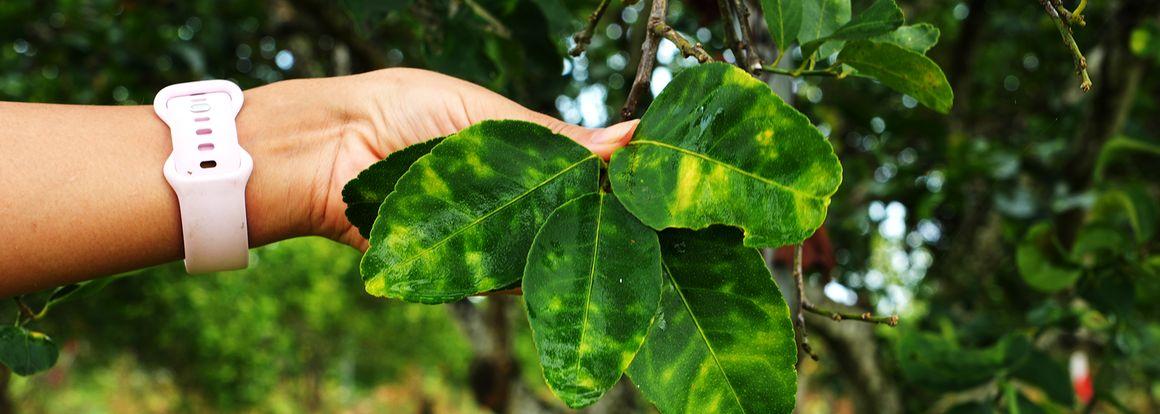
Citrus greening (HLB) symptoms on citrus leaves. HLB affects plantations in the Americas and the Caribbean, and is a threat to the entire Mediterranean. To address the risk, CIRAD recommends agronomic, biotechnological, social and communication action © B. Hufnagel, CIRAD
Horticulture is industrialised in developed countries, but practised by family farms,in low-income tropical countries. Those producers essentiallu supply local markets. Horticulture plays a major role in terms of local incomes, territorial development, jobs and food and nutrition security, for both rural and urban population groups.
The sector is particularly dependent on water supplies, which are increasingly scarce as a result of climate change. Pests and diseases such as citrus greening (HLB) jeopardise production systems and farm profitability. The still too frequent use of large volumes of synthetic pesticides is a threat to soil fertility and contaminates end products. Producers must also cope with economic losses due to the perishability of their products, and face growing competition from ultra-processed products.
To address these many issues, CIRAD presents its five main ambitions in the summary of its roadmap for the value chain:
Water is a vital resource that we can’t create and that we must increasingly learn to share. CIRAD is working on agro-technical questions, as regards finding and distributing water, storing it, and developing varieties and practices that consume less water. At the same time, our human and social science work looks at organisation, community structuring, and water governance on different scales.
CIRAD is working on reducing synthetic pesticide use in horticulture, to protect the health of producers, consumers and the environment. Several approaches are being promoted, such as anti-insect netting and pest- and disease-resistant varieties. The aim is to combine genetics and agronomy through good practice.
Horticultural products have high nutritional value and are vital for health. Consumers are looking for sufficient choice, quality, and transparency as regards production methods, at a reasonable price, while producers need to produce more and better, while earning a decent living.s
In addition to food, horticulture provides a wide range of social, economic, environmental and cultural services, such as waste recycling and mitigating warming in urban environments, but also contributes to pollution. That multi-functionality is still relatively undocumented, whereas it could be put to good use to manage the value chain more sustainably.
Digital technology is increasingly present, and offers new opportunities for the sector. However, players in tropical and Mediterranean countries may not benefit. CIRAD is helping them switch to digital, to allow them to take such tools on board while safeguarding their right to choose and their independence.
Lastly, product quality is a transverse issue, at the crossroads between the five ambitions.
Quality has several facets: economic, since horticultural product quality and freshness are what makes their market value, sanitary, since those products may contain pesticide residues and pathogens, and nutritional, since the sector covers a vital share of people’s nutrition requirements.
Science at work 14 September 2026

Science at work 7 July 2026

Science at work 17 June 2026