










Science at work 14 September 2026

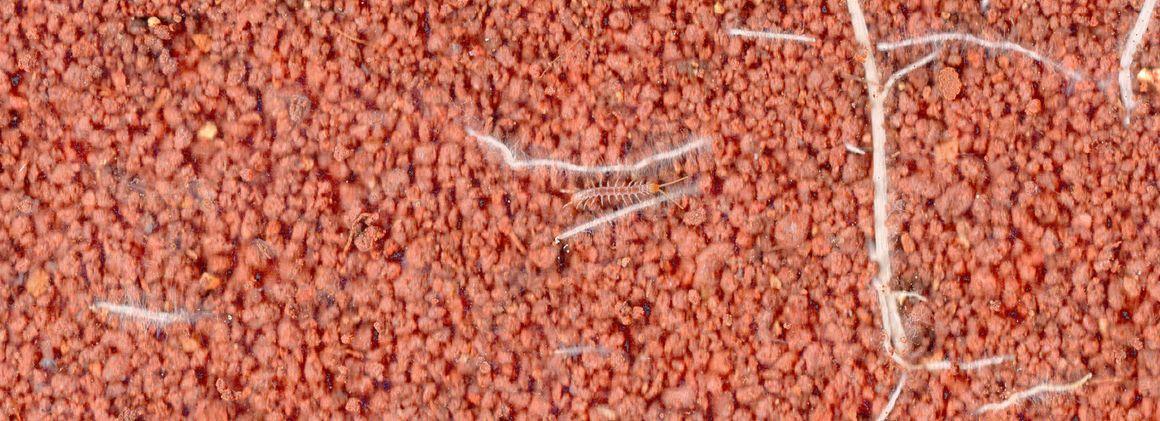
Close-up of an image taken at a depth of 20 cm with the Scanorhize® tool, showing a predatory myriapod (Lithobiomorpha) hunting for prey near growing wheat roots at the Mauguio agroforestry site © C. Jourdan, CIRAD
The Scanorhize® solution comprises one or more energy self-sufficient connected optical scanners, which are buried in order to observe biological activity deep down in the soil, without disturbing it. The images recorded are sent to a client server platform, where they are analysed and stored. This serves to continuously visualize root growth, mortality and decomposition, along with fungus growth and interactions with plants and the soil fauna. With this technology, it is therefore possible to assess the efficacy of farming practices (fertilization, irrigation, effects of biostimulants on rt systems and soil fauna biodiversity) or the effects of climate change (heavy rains or long droughts) on soils, to adapt practises and farm better.
What with climate change, pressure on resources and environmental constraints, farming systems must change rapidly to become more sustainable, while maintaining yields. Understanding what goes on underground is crucial for optimizing cropping strategies, and Scanorhize® is therefore a real decision support tool to help adapt practices: varietal choices, irrigation calendars, input doses, early root disease detection before symptoms appear on aerial parts, root litter dynamics, carbon capture in soils, and so on.
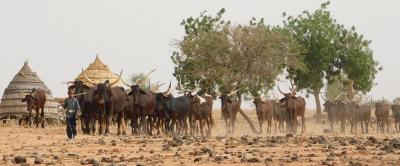
The first prototypes are currently being rolled out across Senegal to characterize underground interactions between Faidherbia albida and millet and groundnut crops in rotation systems, and in India, where teak tree roots are being monitored as far down as the water table, 10 m below the soil surface, observing root alteration processes and survival.
The Scanorhize® innovation, the result of seven years of work by the Eco&Sols research unit led by Christophe Jourdan, was supported by the Cirad’Innov® in-house incubator, fine-tuned by SATT AxLR, and is currently the object of an ambitious transfer to a deeptech start-up, HUMEOS, launched in Montpellier in August 2025. CIRAD's continuing support for the start-up via its researcher Christophe Jourdan is being supported by its new spin-off process. The sensor's design and technical development have been pursued and consolidated thanks to Philippe Gallet's expertise, notably in terms of equipment and software.
The sensor will be available in early 2026, following the current pre-industrialization phase.
SICLE.e is working to develop a silicon-based leather tanning method. Silicon is an inexhaustible, non-toxic resource that provides a sustainable alternative to conventional processes, notable chrome-based tanning. This new tanning method does not produce any toxic waste, can produce white leathers (paving the way for new shades) and allows for new functionalities (showerproof or fluorescent leather, etc).
The SICLE.e chair, funded by the French Agence nationale de la recherche (ANR), is the fruit of collective work by several partners: the Centre Technique du Cuir (CTC), the Institut des biomolécules Max Mousseron (IBMM), the Institut Charles Gerhardt de Montpellier (ICGM), and CIRAD's BioWooEB research unit.
The project set out to steer the French luxury leather sector towards clean, innovative, sustainable production systems that fit into a circular economy. Replacing chrome with silicon was the first major step forward achieved by past partnerships between teams from the CTC, IBMM and ICGM. There are plans for optimization operations as part of the industrial chair.
Alongside these operations, the BioWooEB research unit and the ICGM have long worked together in the field of carbon products such as biochars and activated charcoals. They will be in charge of studying how waste leather could be used for high-added-value purposes, by developing new biosourced products linked to the environment. The BioWooEB research unit will focus on developing silicon-rich biochars for agricultural use, and assessing their agronomic performance and carbon capture potential. Philippe Gallet and Alfredo Napoli are the main two researchers involved in these studies.
The two awards were made by the Montpellier University Innovation Platform, of which CIRAD is a founding member.
Science at work 14 September 2026
Science at work 7 July 2026

Science at work 17 June 2026