

Science at work 14 October 2026
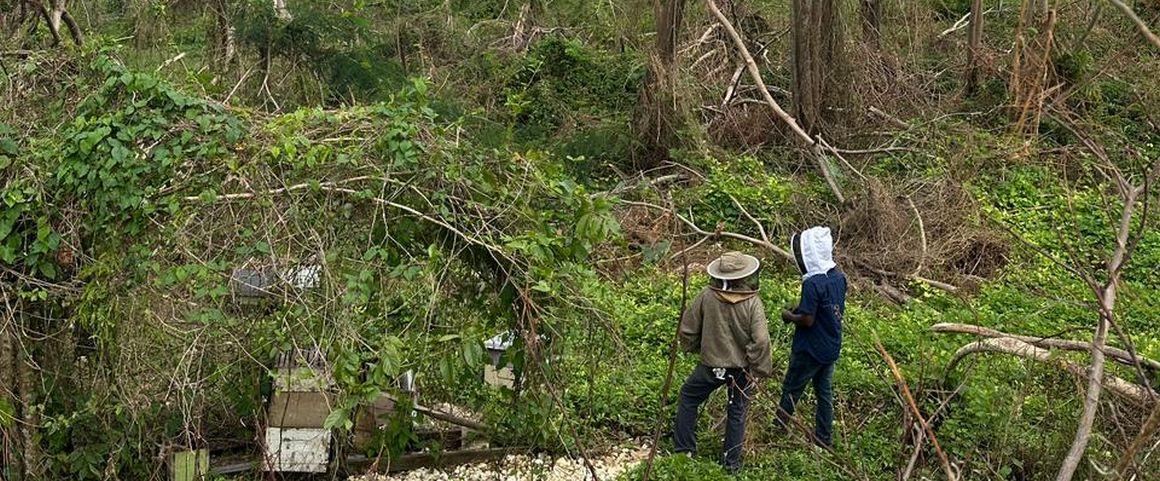
Honey farm in Jamaica hit by Hurricane Melissa © Joey Brown
As of 11 December 2025, the United Nations put the number of people affected by Hurricane Melissa in the Caribbean at almost six million. The storm hit not just Jamaica but Haiti, Cuba and the Dominican Republic, causing more than 90 deaths across the region. In addition to the urgent humanitarian crisis, the agricultural sector also suffered substantial damage.
Preliminary estimates for Jamaica put losses in the agricultural and fisheries sector at more than 184 million US dollars. Some 40% of laying hens were lost, along with 25% of the island's fishing fleet. The livestock sector was also hard hit, losing 1.25 million animals (small ruminants, cattle and poultry birds). Dealing with animal carcasses was a major priority, in view of the risks of water and environmental contamination and health repercussions. Rises in the number of cases of infectious diseases are often seen after environmental disasters, and Paul Cadogan, a veterinarian from Kingston, and Pamela Lawson, Managing Director at the JSPCA (Jamaica Society for the Prevention of Cruelty to Animals), point out that as of today, "there is an epidemic of leptospirosis in Jamaica, along with widespread gastro-intestinal symptoms affecting both domestic animals and humans".
Patricia D. Bedford is the Chair of CANDO, which she coordinates from Barbados: "CANDO is a multidisciplinary, multicultural Caribbean group specialising in managing the agro-environmental risks associated with natural disasters. The group is ideally placed to act immediately following a disaster.
CANDO has members on the ground, who provide first-hand information on the consequences of the disaster. This means we can provide an immediate response, to safeguard food security, livelihoods, the environment, tourism and the links between humans and animals, while preserving animal health and welfare.
CANDO provides technical information and emotional support, and acts as a link between regional and international organisations, veterinary services and local animal protection NGOs, nonprofits, and charities. Our members are all volunteers, and mostly based in the Caribbean. They have a range of skills, and work constantly to help affected countries protect the future of their livestock sectors".
Following the hurricane, CANDO members in Jamaica set up a "Melissa intervention group" comprising players from the animal health, production and welfare sectors. They include veterinarians from the public, private and industrial sectors, the JSPCA, officers in charge of livestock and wildlife, and disaster experts, including a direct liaison officer with the Office of Disaster Preparedness and Emergency Management (ODPEM).
Paul Cadogan and Sarah Wilkinson-Eytle are the two CANDO representatives for Jamaica: "Our group has been able to share information, list priority requirements and make it easier to manage the problems that arose when deciding on and rolling out the steps needed in the different sectors relating to animals. We are in direct communication with the Ministry of Agriculture, Fisheries and Mining in Jamaica, which has allowed us to add animals' requirements to the overall national list of requirements. This has enabled us to explain our constraints before accepting emergency supplies from overseas. The group has also facilitated communication with the government regarding the disposal of carcasses, following a webinar we organised on the issue".
CANDO compiles lists of priority requirements to facilitate coordination of the various players involved in disaster response operations, with the emphasis on agro-environmental issues. Five days before Melissa hit, the group had already prepared an online file with all the relevant information, approved by the Jamaican authorities. Following the hurricane, the information was supplemented and updated, again with the approval of the authorities.
Jennifer Pradel, a veterinary epidemiologist at CIRAD, and Patricia Bedford, a public veterinary health consultant and Chair of CANDO, were behind CANDO. "We monitor extreme phenomena throughout the cyclone season. We trigger the group once a warning is issued, and if the country concerned requests CANDO's assistance. We gather information on the situation and priority requirements through official channels, and then pass it on via our network. This is really useful for NGOS, veterinary associations, and any other professionals keen to help, to guarantee that any action taken is appropriate. We provide support throughout the risk reduction cycle, based on the One Health approach. It is currently CIRAD that is maintaining the CANDO collaborative platform."
This sharing and networking mechanism may look simple, but it is far from commonplace. It takes time and human resources to monitor rapidly-changing situations, while contending with often limited means of communication and under very high pressure on the ground. However, once it is well established, this type of operation can work for different types of problems (volcanic eruptions, hurricanes, cross-border diseases, and so on), since CANDO takes a multi-risk approach. The risks of introducing plant pests and diseases are now also taken into account in import procedures, thanks to its collaboration with the Caribbean Plant Health Directors (CPHD) forum.
Every member has the same level of information and can see who else is involved. CANDO then facilitates contact between the various players and with the country concerned.
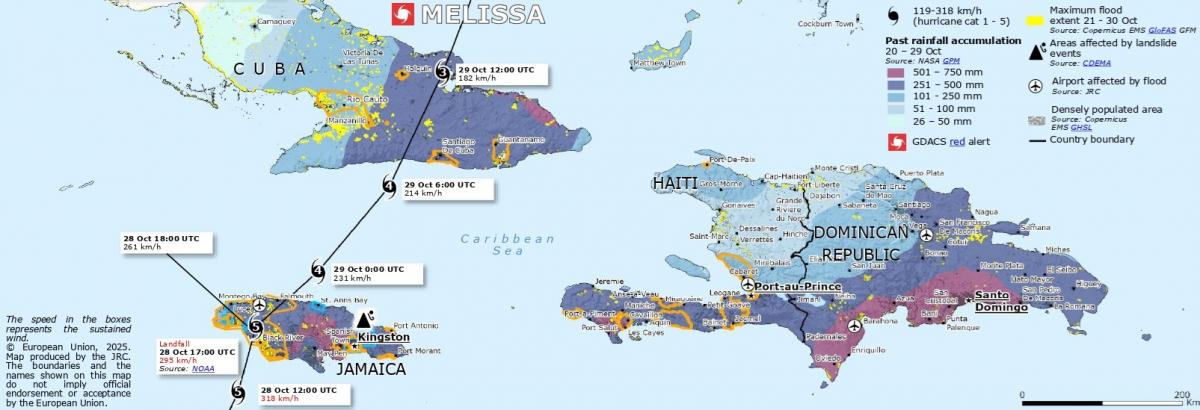
Map showing the path of Hurricane Melissa over Jamaica and Cuba – 30 October 2025. Source: Reliefweb and DG ECHO
Once a specific requirement is pinpointed, the network facilitates the search for relevant skills. With Melissa, as is often the case after natural disasters, managing animal carcasses has been a major issue. CANDO quickly found an expert in this type of operation via its network of members, including CENSA, a member of the WOAH Emergency Veterinary Network (EmVetNet). The expert provided online training and advised animal health players remotely.
CANDO is also working with a number of NGOs on the ground, such as IFAW (International Foundation of Animal Welfare), with which it linked up via its Jamaican members, and this has paved the way for new collaborations.
For Shannon Walajtys, Director of IFAW's Disaster Response Program, "the importance of saving animals in the event of natural disasters is obvious once we look at the many mutually beneficial links between animals and people worldwide. This dynamic relationship varies from one place and one culture to another. Independently of their value or usefulness to humans, animals are inextricably linked to the health and welfare of the other animals, habitats and ecosystems on Earth".
CANDO also looked for psychological expertise to help professionals working with animals. As Jennifer Pradel explains, "unlike humanitarian aid staff, veterinarians and others working in animal welfare do not receive any psychological training or support during events of this type. However, they are on the frontline and see at first hand the distress caused to both animals and their owners or farmers. Even now, the fact that the animal sector is not truly a part of national disaster risk reduction platforms makes management much more complicated, and this is very difficult for our partners to deal with: they sometimes take years to get over it".
Since Melissa, CANDO has been able to put animal health professionals in Jamaica in touch with the mental health and psychosocial programme rolled out by the Ministry of Health and Wellness via PAHO (Pan American Health Organization), which is also a CaribVET partner.
Other types of cooperation have been put in place with CIRAD's support, in this case for crop production. The town council in Le Lamentin, Martinique, has taken part in relaunching market gardening on the East coast of Cuba since the hurricane (Le Lamentin has been twinned with Santiago, in Cuba, for almost 30 years). CIRAD can count on the town's support in terms of providing planting material each time there is a disaster in the Caribbean, which is proof if proof were needed of the strength of the solidarity network in the region.
Biodiversity hotspots are often associated with the emergence of new pathogens. The Caribbean, which covers territories with contrasting ecological and socioeconomic situations, is a prime example. Science can help improve disease monitoring and control by combining fundamental research and more operational applications. Such integrative approaches involve not just scientists but policymakers, managers and monitoring players. This is what the CaribVET regional network does.
CaribVET was set up in 2006 and legally founded in 2020. Its members include official representatives from 34 countries and territories, along with scientific and academic institutions and organisations. CANDO is an offshoot of CaribVET, which initially focused on animal health but which has broadened its scope over the years to encompass plant and environmental health issues, following a One Health and multi-risk approach. In degraded situations, importing feed and fodder for animals, for instance, risks introducing crop pests and diseases or exotic plants that may prove to be a threat to plant biodiversity. These blind spots can be avoided by listening to plant health specialists, ecologists, or risk management and logistics experts, in addition to official and private-sector veterinarians.
Science at work 14 October 2026
Science at work 7 October 2026
Science at work 30 September 2026