










Science at work 14 October 2026
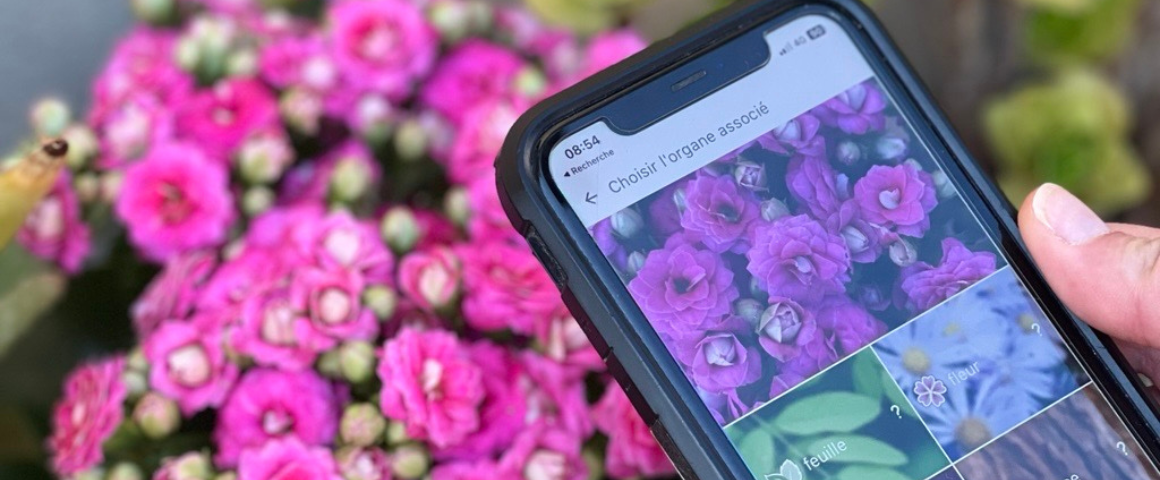
Observation of Kalanchoë © N. Kaden, CIRAD
Identifying a plant pathogen or pest typically requires specialist expertise, particularly in plant pathology or entomology. Such knowledge is rarely available to all agricultural sector stakeholders, and even less so to non-academic audiences. Although plant disease diagnostic tools are available, they have so far come up against two limitations. First, they are often designed for highly controlled laboratory conditions and are therefore not readily accessible. Second, they generally focus on just one crop or region at a time.
Using a dataset and an image recognition service, two tools built on recent developments in artificial intelligence, this knowledge can now be made widely accessible. The work carried out means farmers, technicians and researchers can use their smartphones to photograph a diseased plant or signs of pest damage, upload the image to a dedicated Pl@ntNet space, and subsequently obtain an initial diagnosis without the need for specialised equipment. Whether in tropical or temperate regions, this service is now open for public testing through the Pl@ntNet platform.
Led by the Pl@ntNet consortium and funded by PEPR Agroécologie et Numérique (Agroecology and Digital Technology Priority Research Programme and Infrastructure) as part of the Pl@ntAgroEco project, these work areas form complementary elements of a single approach. According to Pierre Bonnet, a botanist at CIRAD and coordinator of Pl@ntNet, “our goal is to make in-the-field plant pathogen identification directly accessible to everyone”.
Where most existing works focus on a single crop or a specific geographical area, this new method aims to achieve the widest possible coverage in terms of crops, areas and pathogens. To achieve this, the dataset developed as part of this work compiles images from highly varied acquisition conditions, covering both temperate and tropical crops.
“There is a real need to develop databases, especially for tropical plants”, says Pierre Bonnet. “When it comes to images, we must keep in mind that only a small fraction of terrestrial plants have ever been photographed in the wild. And the available data show that most plants that have never been photographed grow in tropical regions”.
The second element that makes this approach even more original is methodological. To train these models on a large scale, data from different sources must be aggregated. However, the same pathogen may have different names depending on the community (agricultural sector, research, data science, etc.).
Without a common reference framework, linking these resources remains difficult. Researchers have therefore developed an automated method for aligning pathogen names with the international EPPO standard, using artificial intelligence. This involves language models such as LLaMa and ChatGPT.
The aim of this approach is to automate the process of standardising nomenclature, which would otherwise have been a colossal task. The result is a shared dictionary that makes it possible to link resources that were previously incompatible and to train models on a broader range of pathogens.
“The more model training is built on large datasets and a wide range of cases, the more accurate recognition systems become, including for the least well-documented pathogens”, says Pierre Bonnet. "Beyond improving detection performance, the ongoing enrichment of these models also broadens their scope and opens up new uses. In addition to identifying pathogens, these technologies can also help to detect mineral deficiencies or to assess symptom severity”.
The approach adopted in this work is underpinned by the pooling of resources, encompassing data, methods and expertise. Rather than multiplying such efforts for each region or crop, the Pl@ntNet consortium is developing a common, scalable approach designed to be shared and widely disseminated. The datasets and tools produced are made publicly available, with the aim that they be reused and enriched by the wider Pl@ntNet community working on these issues. “We are thus pooling existing resources and data in order to benefit as many people as possible”, the researcher concludes.
The Pl@ntNet consortium brings together research partners including CIRAD, INRIA, INRAE and IRD, joined recently by CNRS, the University of Montreal and ATMO (network of associations for air quality monitoring in France). The work carried out within the Pl@ntAgroEco framework (funded by PEPR Agroécologie et Numérique) also involves the universities of Montpellier and Paris-Saclay, the TelaBotanica association, and international partners including Swinburne University of Technology Sarawak Campus and the European Joint Research Centre.
Vandeputte, J., Boulard, L., Aymard, J.-M., Goëau, H., Lombard, J.-C., Bonnet, P., Joly, A. 2026. Standardizing plant damage datasets via EPPO taxonomy: A label harmonization approach using large language models. Smart Agricultural Technology. https://doi.org/10.1016/j.atech.2026.101837
Chai, A.Y.H., Jee, K.L.Z., Lee, S.H., Tay, F.S., Vandeputte, J., Goëau, H., Bonnet, P., Joly, A. 2025. Deep-Plant-Disease Dataset Is All You Need for Plant Disease Identification. Proceedings of the 33rd ACM International Conference on Multimedia (MM '25). https://doi.org/10.1145/3746027.3758192
Chai, A.Y.H., Lee, S.H., Tay, F.S., Goëau, H., Bonnet, P., Joly, A. 2025. PlantAIM: A new baseline model integrating global attention and local features for enhanced plant disease identification. Smart Agricultural Technology. https://doi.org/10.1016/j.atech.2025.100813
Science at work 14 October 2026
Science at work 7 October 2026
Science at work 30 September 2026