





- Home
- Press area
- Press releases
- AIKO - AI to process scientific literature
Launch of the AIKO project: Artificial intelligence to process scientific literature
Institutional news
8 June 2026
Led by INRIA in its capacity as a Programme Agency and in partnership with CIRAD, AIKO (AI for scientists: publication KnOwledge) aims to develop artificial intelligence (AI) methods and tools capable of more rapidly processing the growing volume of scientific information available worldwide. Supported by the French General Secretariat for Investment (SGPI) as part of the France 2030 initiative, the project was launched on 4 and 5 June 2026 at CIRAD’s headquarters in Paris, in the presence of its partners from 15 research units and from the French National Research Agency (ANR). With a budget of three million euros over a five-year period, the project will focus on three priority areas: One Health, Agriculture and Environment, and New Technologies and Digital Innovation.
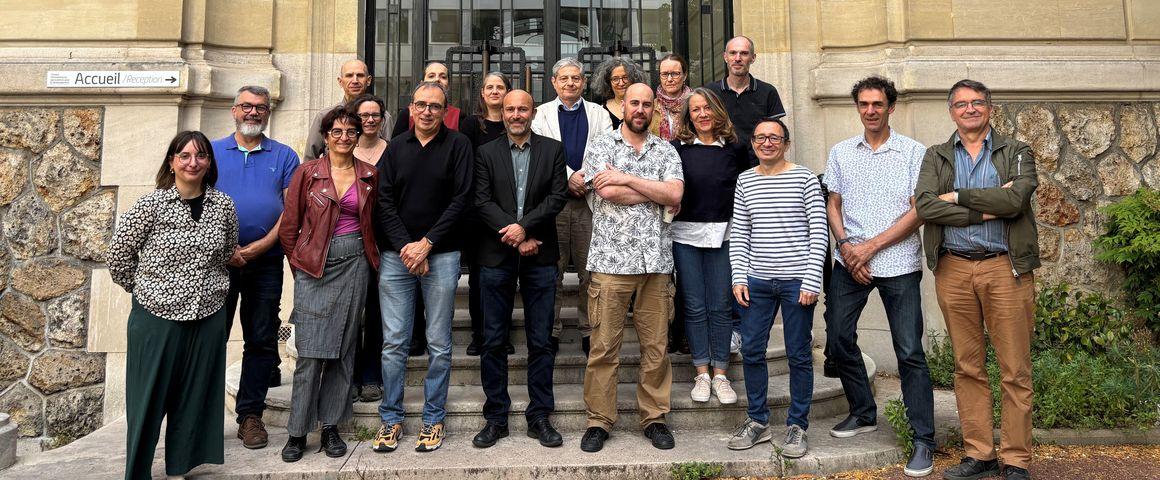
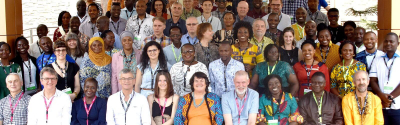
The AIKO project was launched on 4 and 5 June 2026 at CIRAD’s headquarters. © Maguelonne Teisseire, INRAE
With AIKO, we aim to help scientists analyse the huge volume of scientific publications in greater detail, enabling them to build a comprehensive, representative and accurate understanding of their research area.
Mathieu Roche, CIRAD et Laurent Romary, Inria
Coordinators of AIKO
An open science approach based on artificial intelligence
AIKO works to strengthen French initiatives to promote scientific sovereignty through open science approaches.
Four scientific challenges are at the heart of this project:
- Recognition and identification of information in scientific documents, in order to extract and index textual data from publications;
- Content analysis, with the aim of identifying arguments and trends and studying scientific biases;
- Access to content, to simplify complex content and to assist the preparation of state-of-the-art reviews;
- Multimodality, to connect scientific publications with other data sources and to involve different disciplines and partners in the programme.
AIKO will draw on a wide range of models, particularly large language models (LLMs) combined with natural language processing (NLP) techniques, to analyse scientific publications from diverse and broad disciplines. Original data annotated at different scales (documents, segments, terms, etc.), will be produced and published on institutional platforms, in particular Recherche Data Gouv. The original models that will be produced within the AIKO framework will build on these datasets for the training, fine-tuning, retrieval-augmented generation (RAG) and evaluation phases. The most effective AI models may subsequently be integrated into French infrastructures, in particular ISTEX (French initiative for excellency in scientific and technical information), one of the partners of the AIKO programme.
One Health, agriculture, new technologies: AI to address global challenges
To implement its tools and methods, the programme focuses on three priority areas:
- Health, within a One Health context, in connection with the Health Research Programme Agency led by INSERM and to support the commitments made at the One Health Summit held in Lyon in April 2026, particularly with the aim of preventing the emergence of zoonotic diseases.
- Agriculture and environment, in connection with Agralife, the national Programme Agency for “Sustainable agriculture and food, forests, and associated natural resources” coordinated by INRAE.
- New technologies and digital innovation, a focus of INRIA’s role as Programme Agency for the digital sector.
Within this multidisciplinary context, AIKO’s scientific challenges will, for example, enable the identification of techniques used to address plant health, to extract environmental factors for epidemiological surveillance in animal health, or to analyse methods for transforming organic waste in the countries of the global South based on scientific publications.
See also
Institutional news 18 May 2026
Africa Forward: CIRAD strengthens its partnerships in East Africa and worldwide
Institutional news 14 April 2026