


- Home
- Press area
- Press releases
- DigitAg IRC: responsible digital agriculture
Launch of the #DigitAg International Research Community: a new step towards responsible digital agriculture
Event
15 April 2026
The CORDiALL (Convergence of Research in Digital Agriculture Leading Labs) international conference held at Agropolis International in Montpellier from 13 to 17 April 2026 saw the official launch of the #DigitAg International Research Community. This initiative is a major step towards structuring an international research community devoted to digital agriculture, a key part of the agroecological transition and sustainable food systems.
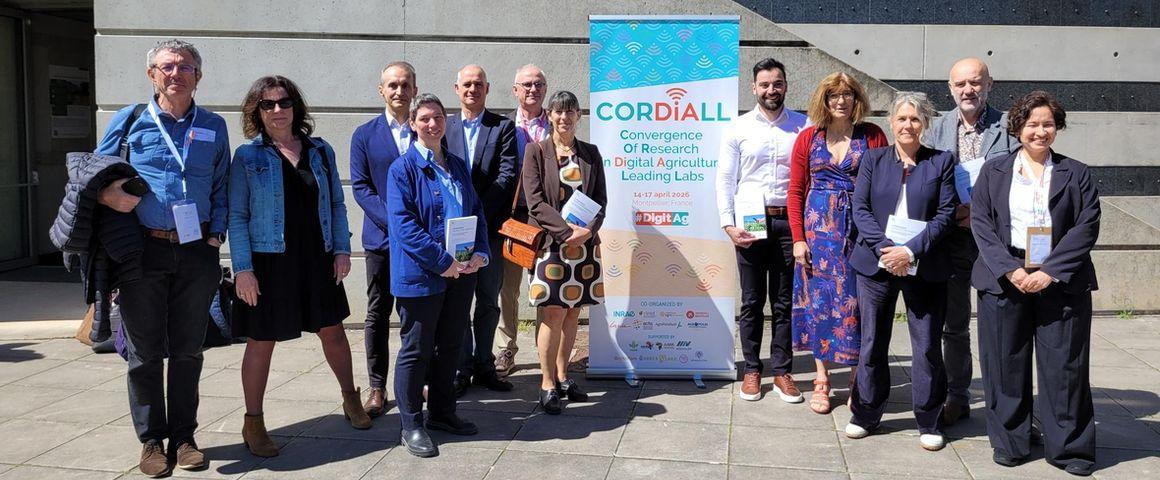
The #Digitag International Research Community is led by six higher education and research establishments: INRAE, AgroParisTech, CIRAD, INRIA, Institut Agro Montpellier and the University of Montpellier © CIRAD
A community working for responsible innovation
The new community, founded after ten years of interdisciplinary research within the Convergences Institute for Digital Agriculture (#DigitAg), aims to federate researchers, teachers, PhD students and socioeconomic players to work towards a shared objective: to promote inclusive, low-environmental-impact digital technology and agricultural artificial intelligence, for more agroecological agriculture. With almost 30% of its research conducted in partnership with countries in the global South, #DigitAg had already proved its international dimension. The #DigitAg International Research Community confirms that choice and the importance of a stronger network for the priorities of its founding members in Europe, Africa and South America.
A heritage and an ambition
The community is headed by six higher education and research establishments—INRAE, AgroParisTech, CIRAD, INRIA, Institut Agro Montpellier and the University of Montpellier—, and will capitalise on the recognition built by #DigitAg, both in France and elsewhere. The Convergences Institute funded more than 115 theses, 28 post-docs and 135 Masters internships, and notably:
- contributed largely to the INRIA-INRAE white paper on digital agriculture (2022), which fuelled the "Agroécologie et Numérique" (Agroecology and Digital Technology) PEPR project led by the two organisations;
- created a HAL collection of 900 articles;
- published a reference work (Editions Quae): "Appréhender l’Agriculture Numérique – 10 ans de recherche interdisciplinaire au sein de l’Institut #DigitAg" (Insight into digital agriculture - 10 years of interdisciplinary research within the #DigitAg Institute).
The community intends to pursue and expand these activities, by fostering scientific leadership, training for junior researchers and knowledge dissemination to the political and economic spheres.
Digital technology in all its forms is clearly a strategic lever—alongside those of agronomy, plant breeding and health, and livestock science and animal health—for allowing agriculture to cope with the main future challenges of the future, particularly the agroecological transition and adapting to climate change. It is also a source of source for use by all farmers, for instance by anticipating health or climate risks, optimising the use of production or management tools, and relieving farmers of certain arduous, repetitive tasks.
Carole Caranta
Deputy Director General of Science and Innovation, INRAE
A research community that benefits from the support of the MEDVALLÉE MONTPELLIER dynamic and in turn fuels the Montpellier One Health ecosystem of excellence
The MEDVALLÉE MONTPELLIER dynamic launched in 2021, at the nexus of three of the region's sectors of excellence—agrifood, health and environment—aims to position Montpellier as an exemplary hub in terms of One Health by creating a unique ecosystem. The launch of the #DigitAg research community, which aims to promote research to benefit responsible digital agriculture, is a new step forward for the MEDVALLÉE community.
By offering a space that is both devoted to international research (30% of #DigitAg's research is conducted with or on countries in the global South) and open to the economic world, the research community fits neatly into the ambition of the MEDVALLÉE dynamic: to federate the whole range of economic, research and higher education players by creating a unique ecosystem that associates our territory's three sectors of excellence. By supporting ecological and digital transition projects, the community will help to boost the visibility of Montpellier and its ecosystem worldwide.
A symbolic launch ceremony
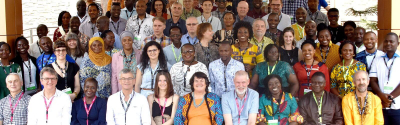
The official launch took place on 15 April 2026 in the presence of 150 international delegates. The ceremony included speeches from Véronique Bellon Maurel, Director of #DigitAg, de Carole Caranta, Deputy Director General of Science and Innovation, INRAE; Henri Bazzi, teacher-researcher, AgroParisTech; Thierry Fourcaud, Deputy Director General in charge of Research and Strategy, CIRAD; Carole Sinfort, Director, Institut Agro-Montpellier; Jacques Sainte-Marie, Head of ICT and Environment Programme, INRIA; Anne Laurent, Head, Executive Vice-President for Open Science and Research Data, University of Montpellier; and Vincent Martin, Director, Innovation Office, FAO. A support charter was signed, reaffirming the partners' commitment to responsible, inclusive digital agriculture to benefit farmers and societies.
Why set up a research community?
Although digital technology and artificial intelligence are profoundly transforming the agricultural sector, there had never been a dedicated structure on either a national or an international scale to federate stakeholders in the field. The #DigitAg International Research Community fills that gap by offering a space for dialogue, sharing and debate, open to all academic and public- and private-sector players.
About #DigitAg
#DigitAg is Convergences Institute set up in 2016, funded by France2030 and headed by INRAE and its partners, to structure interdisciplinary research on digital agriculture. After ten years, it leaves a dynamic scientific community, a body of knowledge and solid international partnerships, on which the new international research community can now build.
Find out more
- #DigitAg website: https://www.hdigitag.fr/eng
- Book: "Appréhender l’agriculture numérique – 10 ans de recherche interdisciplinaire au sein de l’Institut Convergences #DigitAg" https://www.quae.com/produit/1989/9782759242559/apprehender-l-agriculture-numerique
- White paper: "Agriculture et Numérique : Tirer le meilleur du numérique pour contribuer à la transition vers des agricultures et des systèmes alimentaires durables" https://doi.org/10.17180/wmkb-ty56
- INRAE Ressources journal report: https://www.inrae.fr/en/reports/can-ai-make-agriculture-more-sustainable
See also
Event 2 October 2026