



















Results & impact 21 October 2026


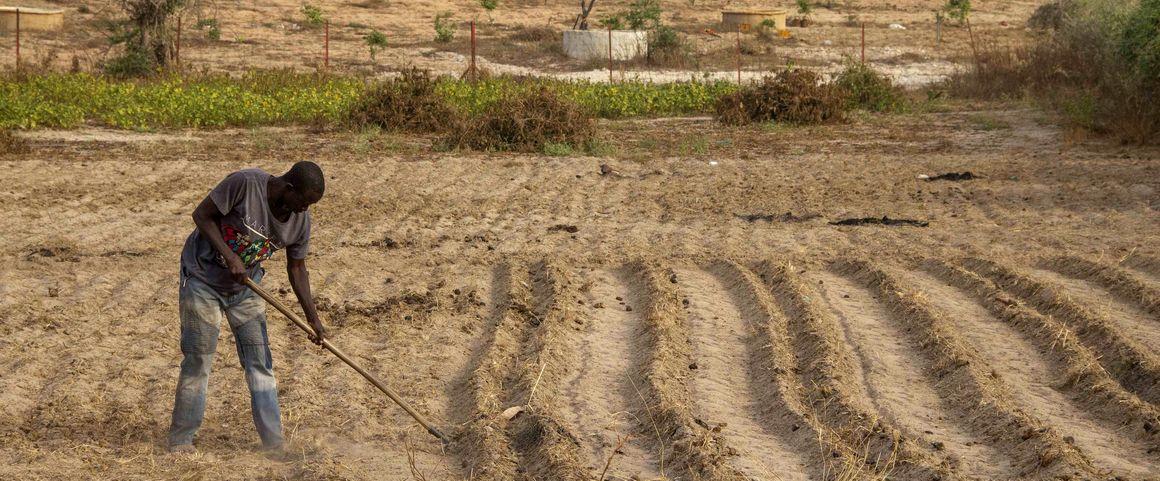
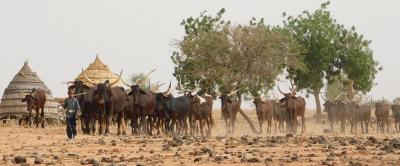
In 2021, agriculture accounted for 39.5% of jobs in Ghana, according to the OECD © R. Belmin, CIRAD
Key points
The first step in drafting fair and effective public policies is inevitably an initial assessment, but for agricultural jobs the challenge is twofold: data are lacking and, in particular, they fail to reveal informal, non-contractual work; preconceived ideas persist regarding, for example, the displacement of jobs once production has been mechanized.
This context complicates decision-making. For Pierre Girard, an economist at CIRAD, the JobAgri project sheds light on the situation in Bono East and helps in assessing the food system’s potential for employment “We surveyed over 900 family farms, but also a fair proportion of the industrial farms in the region. Lastly, we looked at the local maize supply chain to see where the non-agricultural jobs directly dependent on production were located”.
JobAgri made a noteworthy methodological choice: not to count people, but rather measure the volume of work achieved. Pierre Girard continues: “We calculated full‑time equivalents (FTEs), which amounted to counting the total number of days worked. This gave us a clearer picture of both the workload and the labour required to complete the various tasks”. Remuneration was another key indicator.
Family farms in the region differ considerably in their size and their agricultural production systems. According to the project’s data, the land area of the farms varies from under two to over twenty hectares, with an average of 6 ha. Tubers, rice, maize, pulses, market gardening and livestock feature among the very varied activities, and many farms diversify with non-agricultural activities.
“Family farms often fall under the radar in public policies because they are thought to be less efficient than large, specialized agricultural enterprises,” explains Pierre Girard. “What we are showing with JobAgri is that these family farms are nonetheless labour-intensive. In the Bono East region, they provide over 290,000 full-time equivalent jobs. An FTE is considered to amount to 2080 hours of work per year. Family labour amounts to 56% of all these jobs, but the labour of agricultural day workers is also considerable, especially during peak periods.”
As they form a cornerstone of professional activity in rural areas, family farms will have to be taken into account in all future policies covering agricultural employment. These are also the agricultural operations where women are most prevalent.
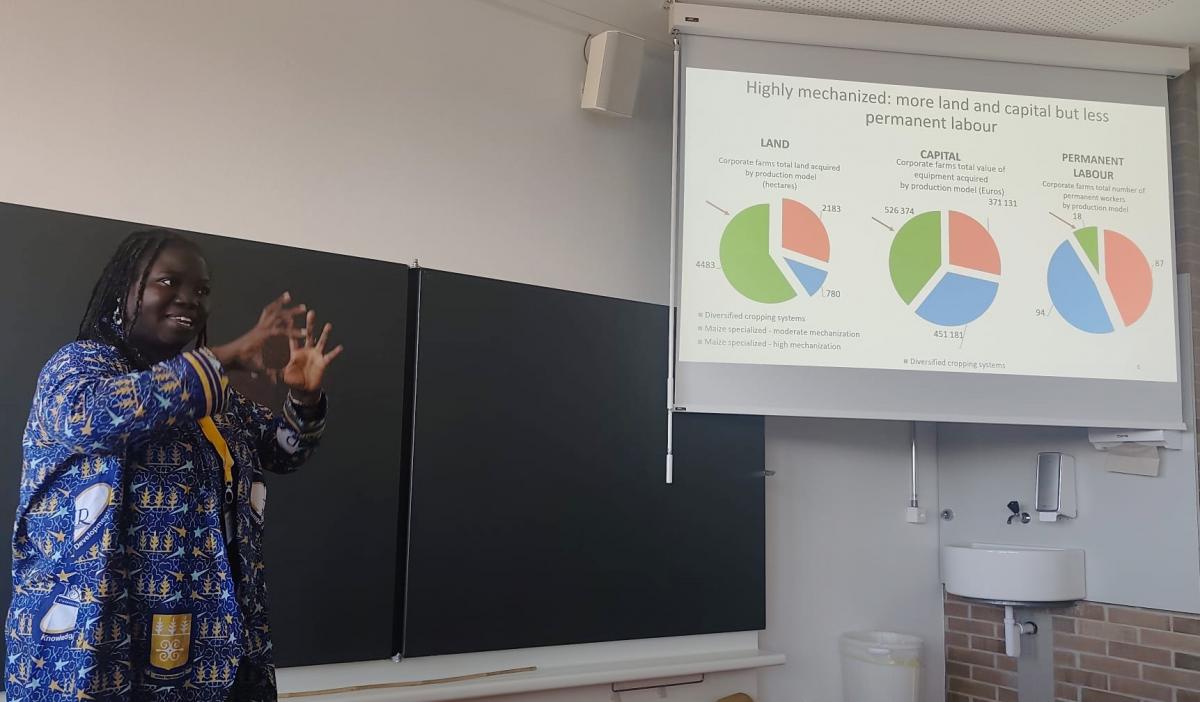
Dzifa Torvikey, a researcher at ISSER, presents JobAgri’s findings on large‑scale farms. Large industrial farms are more mechanized, cover large areas and are more productive, but they do not offer as many permanent jobs © P. Girard, CIRAD
Another major finding from JobAgri is that as long as farm mechanization only affects part of the production chain, it does not necessarily replace or reduce the workforce. Quite the opposite, it is associated, rather, with an increase in the areas under cultivation and tends to create jobs.
Around 55% of farms in the Bono East region are partially mechanized. Scientists refer to “intermediate mechanization”, which mostly involves soil tillage. “This does not necessarily increase productivity per plot but, rather, allows for an increase in cultivated areas”, explains Pierre Girard. “So, these farms need more labour for harvesting and they create more jobs than a smaller non-mechanized farm.”
Only full mechanization of the production chain, which has been seen on a few industrial-scale farms, leads to a drastic reduction in labour requirements: 10 working days per hectare, compared to 68 for a partially mechanized farm.
JobAgri has identified four major business types that drive the agricultural supply chains upstream and downstream of production: agricultural input distributors, traders, processors and transport operators. The surveys focused on maize, with over 650 business managers interviewed.
Initial findings indicate that the great majority of these businesses have the same profile: a small enterprise run by an independent owner investing their own savings to set up the business and then ensure its operation. The different activities are strikingly gendered, with men dominating in processing by up to 90%, while women account for 83% in retail trade. Women are notably absent from transport and logistics, at 0%.
“These businesses tend to expand over time, but their growth does not necessarily go hand-in-hand with improved working conditions”, comments Guillaume Soullier. “Independent entrepreneurs often employ casual workers on a piecework basis, while there are few written contracts in such situations. Verbal and informal agreements entail risks for the workers involved: no insurance for workplace accidents, tough working conditions, lack of social security cover, etc.”
Such growth therefore tends to occur outside formal frameworks, leading to job insecurity, especially for young people.
The rural job market in Bono East is split along gender lines. Women are often concentrated in family-based work and casual employment, while men are over‑represented in permanent salaried jobs. When women do gain access to salaried jobs, wage gaps soon become apparent, with men earning up to twice as much.
Guillaume Soullier explains: “What we quite often find is that the best-paid, most stable, or management-related, salaried jobs are mainly awarded to men. When women occupy salaried posts similar to those of men, they are paid less. However, when they are self-employed, they are able to generate a profit per day’s work similar to that of men. We must therefore support women who set up their own businesses!”
The JobAgri project collected data for more than a year in the Bono East region of Ghana between 2024 and 2025 and only a small part of the overall findings are covered here. Specific analyses will be published throughout the year by project members and plans for scientific dissemination of the findings are already in the pipeline.
The initial findings were presented at the International Symposium on Work in Agriculture in July 2026 in Switzerland. There is a wealth of project data that can be used to analyse the work and job creation capacity of different agricultural systems (varying in agroecological intensity) and value chains (varying in length).
It is hoped that all these findings will provide optimum guidance for Ghanaian public policies on rural employment. The methodology applied by JobAgri, which enabled a clear and somewhat comprehensive assessment of rural labour in the survey region, is applicable in other contexts. The food system offers job opportunities provided worthwhile pay and decent working conditions are guaranteed for young workers.
Results & impact 21 October 2026

Results & impact 18 September 2026
Results & impact 16 September 2026