

















Results & impact 18 September 2026


Meeting of social movements at the pre-COP Juventude das florestas organized by the Guardians of Good Living in May 2025 © Guilherme Firmino, FEFACCION
"Behind the concept of climate justice lies an injustice: the communities that are adapting and seeking solutions to climate change are also the ones suffering the most from it, despite the fact that they barely contribute to it." Emilie Coudel is a socioeconomist with CIRAD who has been supporting smallholder organizations in Brazil for several decades. "There is a gap that is becoming increasingly unsustainable. For some fifteen years, we have pushed rural communities to come up with production systems capable of adapting to climate change. Agroforestry is praised for its resilience, except that climate disruptions are so severe that even agroforestry systems cannot keep up."
The Amazon recently suffered two successive extreme droughts, whereas previously, it saw just one per century. Many trees died. The violence of recent climate shocks tends to put a stop to local people's attempts to adapt, yet they are the very people most likely to conserve forest resources.
In this context, many communities are calling for reparation. However, their demands go beyond that: these movements want to make sure that they have the possibility of developing the lifestyles they want.
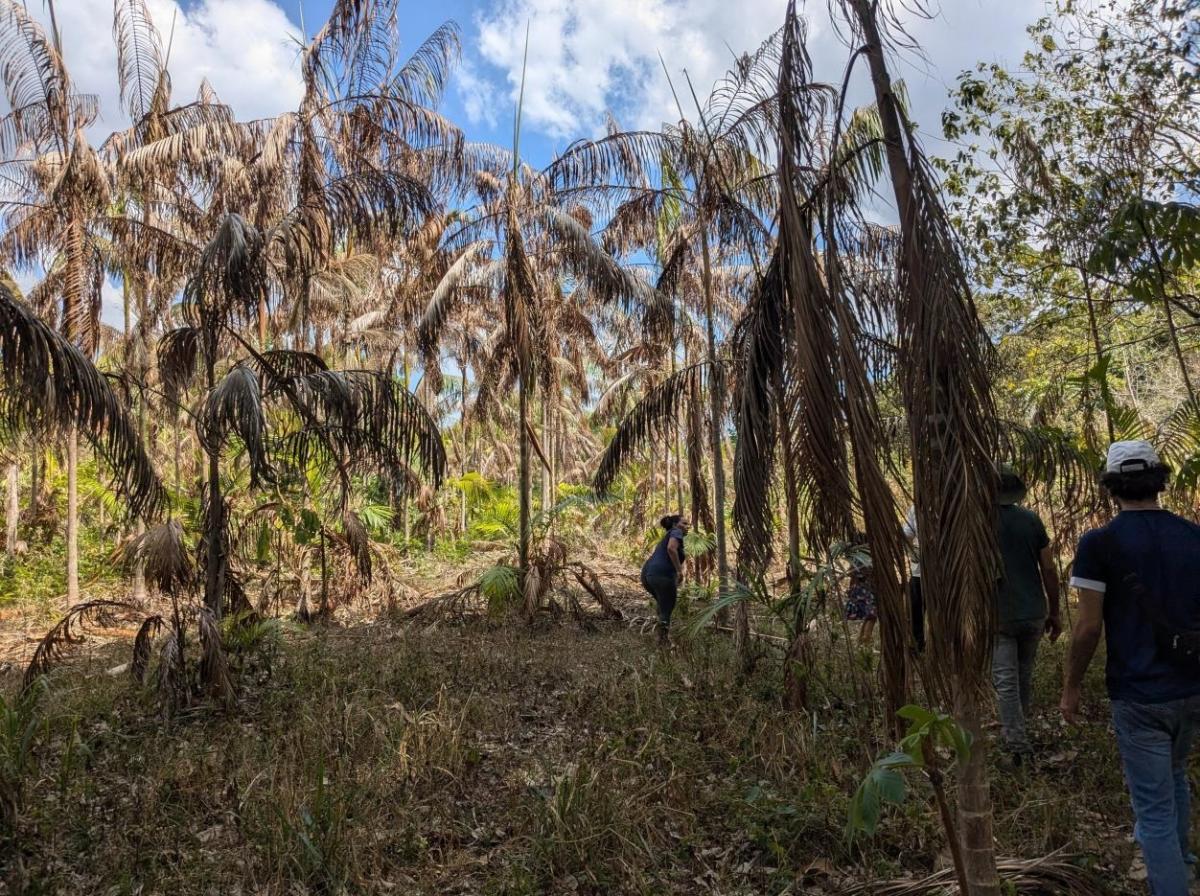
Açai plantation affected by drought despite its proximity to a river. Irituia municipality, Pará state, Brazil © E. Coudel, CIRAD
Through their calls for climate justice, Amazonian communities are now reinventing a framework for action that extends beyond environmental issues and paves the way for a broader debate on social inequalities, land distribution and agrarian reform. This is what a group of young Amazonians called the "Guardians of Good Living" is doing, to defend their way of life and territory of Lago Grande, in the Santarém region, in response to the arrival of mining and logging firms. Since 2019, the group has been raising awareness, training and mobilizing smallholder communities in the territory to defend their vision of climate justice, which they define as "the guarantee of rights historically demanded by peoples that are the real guardians of nature".
At territorial anticipation workshops held as part of the JUNTES project and a PhD thesis by Beatriz Abreu dos Santos, the group came up with a climate justice scenario for their territory and worked together to define the priority actions required to achieve that desired future. "In the scenario, the land belonging to the different local communities is clearly identified and recognized", Beatriz Abreu dos Santos explains. "Family farming guarantees food security, a local University of Good Living will be founded, sustainable tourism will be developed, the River Arapuins is recognized as a subject of law and the installation of players and firms seen as predatory is banned by court order."

Territorial anticipation workshop with the group © Beatriz Abreu dos Santos
The priority actions identified include initiatives aimed at strengthening rural communities and culture, which the group is already doing within its territory, and structural measures that require a strong State presence and public policies. This distinction highlights the limitations of community action in the face of structural challenges. Climate justice implies shared responsibility, in which the state and public funding mechanisms guarantee the continuity and sustainability of the efforts led by communities.
Beatriz Abreu dos Santos' thesis was co-supervised by Stephanie Nasuti from the University of Brasília, and CIRAD's Emilie Coudel and Marc Piraux. In this case, JUNTES means "living youth building know-how". It is a partnership between the "Guardiões do Bem-viver" (Guardians of Good Living) youth group, the University of Brasília, IRD, the Federal University of West Pará (UFOPA), the Getúlio Vargas Foundation (FGV-CES) and the NGO Sapopema.
The COP30 climate conference in Belém in November is expected to see strong participation on the part of civil society, particularly the different Amazonian communities, to call for concrete actions and real climate justice.
It is impossible to guarantee sustainable, inclusive development without creating global funding that can be redistributed to territories. Led by President Lula, Brazil has taken on the role of leader of the countries of the global South in demanding that those countries historically responsible for global warming be forced to make a fair contribution to transition efforts.
One of the mechanisms proposed, which will be launched at COP30, is the Tropical Forests Forever Facility (TFFF), a fund intended to finance tropical forest preservation. The TFFF plans that at least 20% of the funds paid to beneficiary countries should be directly passed on to indigenous peoples and local communities. While Brazil will be paying a billion dollars into fund, President Lula is asking the richest countries to contribute up to the minimum of 25 billion dollars required for its launch.
This initiative illustrates the wish to invent new funding mechanisms based on protecting rather than exploiting commons. To achieve climate justice, we need to rethink the global economy to make solidarity the driver of a sustainable future.

Meeting of the Guardians of Good Living group © Beatriz Abreu dos Santos
Results & impact 18 September 2026
Results & impact 16 September 2026

Results & impact 11 September 2026