











- Home
- Worldwide
- CIRAD worldwide
- Projects
- NAAP Project
Agriculture-food nexus in the Pacific - NAAP
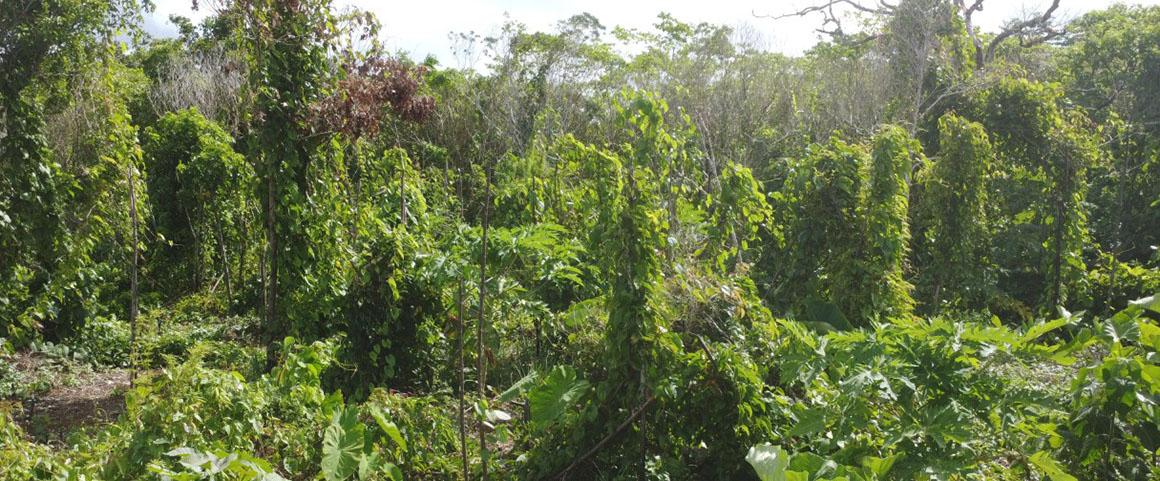
Traditional yam field intercropped with other tubers (taro, cassava) as well as other crops (fruit - papaya; vegetables, tomato, pigeon pea, etc.) © CIRAD
Promoting traditional agriculture to improve food diversity and self-sufficiency in the Pacific
A large proportion of Pacific Island communities still depend on traditional agriculture, which shields farmers from diets that are too high in sugar and salt. However, this agriculture provides little dietary diversity, especially in terms of fresh fruit and vegetables, and could thus play a greater role in supporting balanced diets.
Traditional agriculture can therefore serve as a real, though underused lever for contributing to food diversity in rural communities, through direct access to their own produce. It also provides opportunities for transforming agricultural and food systems towards greater self-sufficiency and healthier diets for the population as a whole. Multidisciplinary and integrated research can help to provide recommendations to improve the performance of food systems.
This project focuses on locations and topics for which we already have established experience, strong partnerships and opportunities for further development.
- New Caledonia, the territory in which the full project will be implemented;
- Wallis and Futuna, the territory in which the work will be implemented partially, with a more exploratory focus;
- Vanuatu, the country in which traditional plant varieties will be proposed based on their agronomic and nutritional performances.
Beyond these three territories, the Pacific region will be more broadly incorporated into literature reviews and into the consultation and processing of available statistics. The recommendations resulting from the programme will also cover prospects for future work in other areas and countries in the coming years.
The project is structured around three broad, interconnected components, each implemented in different ways according to the specific challenges and partnership capacities of the three locations.
Component 1. Characterisation of the main dynamics of food systems
A description of food systems will be produced for the project territories, as well as for other countries with the most reliable statistics. This research aims to identify the coverage rates of local production by product or product group, using customs data (food imports and exports) and local production and processing data. In addition, the structuring of supply (local and imported) and its spatial distribution within these territories will be examined.
Qualitative interviews with key actors and experts in the food systems in question will complement this data analysis, conducted only in New Caledonia and Wallis and Futuna.
Component 2. Surveys of households involved in agricultural activities, documentation of agricultural and food practices
Research conducted by CIRAD and IAC has shown that tribal agriculture contributes significantly to the island’s local production, particularly for tubers. This research has also highlighted the social importance of this activity. More recently, observations in northern New Caledonia indicate that in communities that maintain traditions of gifting and exchange, the risk of excessive consumption of sugary products is reduced.
Consequently, surveys designed to characterise households according to their activity systems, crop and livestock systems, agricultural practices, social practices and dietary behaviours will help to answer the following questions:
- What contribution does traditional agriculture make to food provision, and what is its potential for production?
- Does a high level of agricultural activity reduce consumption of imported, ultra-processed or sugary foods?
- What role do non-market activities play in promoting agricultural production and in food provision?
- Which crop diversification practices are commonly used, and do they contribute to dietary diversity?
- What are the impacts of pests and diseases on crops, and ultimately on access to food?
In New Caledonia, research will include surveys of a sample of more than 1 000 households that are statistically representative of tribal households, conducted by means of questionnaires. The aim is to document the structure of these households and their farms, their activity systems, as well as their crop and livestock systems, the quantities produced and their technical and economic performances. This information will be supplemented with details of their dietary practices. In Wallis and Futuna, the same approach will be applied to around 300 households.
In New Caledonia, specific modules will also be developed to capture the technical aspects of agricultural practices, particularly in relation to agrobiodiversity and the management of crop pests and diseases.
Component 3. Agronomic levers to increase food diversity and security
Food and nutrition security for populations depends on the agrobiodiversity of agricultural systems, as the species and varieties cultivated determine the quality and diversity of diets. However, most food crops in the Pacific are vegetatively propagated. This is the case for bananas, island cabbage, breadfruit, and root and tuber (RT) crops, for which genetic diversity is declining. Their vulnerability to the introduction of exotic pests and diseases is also a concern.
The genetic diversity available for different crops and the presence of pests and diseases thus have a direct impact on dietary diversity and quality. The existing levers for research in these two areas will be explored, linking our work to the findings and outcomes of Component 2 regarding the practices and knowledge of farming households.
Agronomic and nutritional performances of crop diversity
A species and variety inventory of cultivated agrobiodiversity will be conducted, using existing knowledge and recent survey data. In New Caledonia, the diversity of species and varieties produced by traditional agriculture will be assessed through measurements and sampling, complementing Component 2 surveys and focusing on species of interest. Particular attention will be given to analysing the nutritional quality of crops according to the genetic resources available and to agronomic factors. This will serve as a tool to better guide local crop diversification and influence dietary behaviours.
A summary of the varieties used for different traditional crops will be produced for Vanuatu and New Caledonia. Certain crops will be targeted more specifically, in particular breadfruit and island cabbage, for which collections already exist in New Caledonia and Vanuatu. Collaborations will then be developed with the Vanuatu Agricultural Research and Technical Centre, based in Santo. Finally, a demonstration plot set up in partnership with the Loyalty Islands Rural Development Support Centre (CADRL) in Maré, New Caledonia, will be enriched with new crops identified through field surveys.
Agroecological crop protection (ACP) by promoting agrobiodiversity
A synthesis of the different pests and diseases (insects, phytopathogenic bacteria and viruses) affecting traditional crops will be produced. Sampling and trapping at the same study sites will enable better characterisation of population levels and diversity, and thus the impact of these pests and diseases. The target pests and diseases will be prioritised according to initial findings on food systems and survey results.
Traditional control methods (fallow periods, crop rotation, intercropping of varieties and species, use of repellent plants) against the main pests and diseases that limit food diversity will also be characterised. The practices identified in Component 2 will be supplemented by innovative control methods, which will be tested in the demonstration plot and can subsequently be proposed to farmers.
Contract partners :
- IAC : Institut Agronomique néo-Calédonien
- VARTC: Vanuatu Agricultural Research and Technical Centre
Other collaborations :
- IRD : Institut de Recherche pour le Développement
- Lincoln University (Nouvelle-Zélande)