
















Process study / engineering - Food and agrifood technology

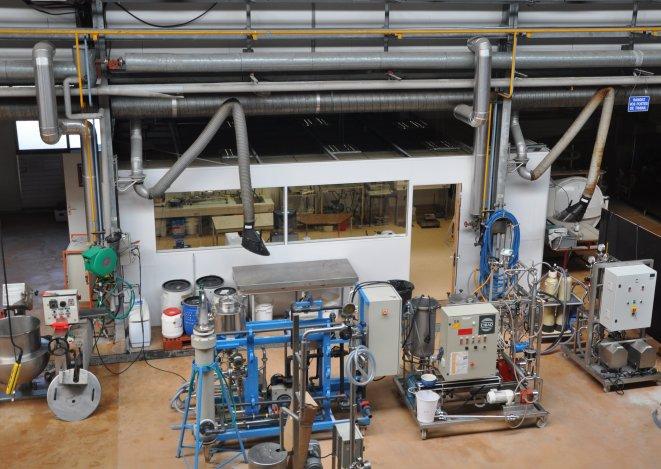
Membrane Separation Platform © Cirad, Dominique Pallet
Agri-food processing often generates effluents, which are a source of pollution and are often considered costly to manage. However, many of these effluents contain molecules with significant biological activity that can be used, particularly for nutritional and cosmetic uses, etc.
Building on the success of various partnerships in the coffee, fruit, and olive sectors, we support projects aimed at recovering value from by-products. Our agri-food technology platform enables us to identify molecules of interest and validate a process combining various extraction, separation, enrichment, concentration, and purification operations. Thanks to our equipment, we define the most suitable steps for recovering by-products in fractions of interest and ensure their stabilization.
Our knowledge of supply chains in tropical regions enables us to identify obstacles and solutions related to supply areas.
We are therefore able to resolve environmental issues, as in the AdCofInov project, or provide technical support for a recovery method, as in the partnership with the Grap'Sud group, which has resulted in a patent application.

Method design and validation
Public-private collaboration can take various forms: joint projects, CIFRE theses, hosting R&D partners (companies, federations and cooperatives, technical centers, etc.) so that they can carry out their own R&D trials with our guidance. We provide our experts to support projects as part of research collaborations or consulting services.
Beyond the technical aspects, our support is implemented more broadly in the context of promoting food sectors that fall squarely within our development mandate. To support projects aimed at developing more nutritional products, we provide expertise to support stakeholders by :
Although extraction is an ancient practice, techniques have evolved considerably and now enable molecules of interest to be extracted and enriched. We focus our expertise on the links between molecule identification (HPLC MS/MS, etc.) and process design.
Currently, there is a great deal of interest among companies specializing in biologically active molecules. However, the experts at the Qualisud research unit are primarily interested in developments in the field of food that can bring nutritional benefits to the most vulnerable populations.
Contact us, Manuel Dornier, Annabelle Prim, to discuss your projects in confidence, and we can explore opportunities for collaboration or refer you to other research organizations that may be able to assist you.
The research team
The QualiSud research unit, which brings together around 100 staff members in France and abroad, works in the field of food processing, from the post-harvest or post-slaughter production process to the assessment of sensory quality, nutritional quality, health benefits, safety, and technological properties. The unit brings together the multidisciplinary skills and technical platforms required to address these issues. The optimization of existing technologies and the design of new food processes are two areas of equal importance within the unit.
An exclusive license agreement has been signed with Grap'Sud for the exploitation of a patent on a process for extracting phenolic compounds from olive vegetation water and preparing extracts titrated in olive and grape polyphenols.
Di Corcia S., Dhuique-Mayer C., Dornier M.. 2020. Innovative Food Science and Emerging Technologies, 66 : 15 p..
DOI: 10.1016/j.ifset.2020.102526
Servent A., Abreu F., Dhuique-Mayer C., Belleville M.P., Dornier M.. 2020. Innovative Food Science and Emerging Technologies, 66 : 9 p..
DOI: 10.1016/j.ifset.2020.102519
Jimenez N., Bassama J., Soto M., Dornier M., Pérez A.M., Vaillant F., Bohuon P.. 2020. International Journal of Food Science and Technology, 55 (6) : p. 2551-2561.
DOI: 10.1111/ijfs.14507
Di Corcia S., Dhuique-Mayer C., Dornier M.. 2020. In : Book of abstracts of International Conference on Carotenoid research and applications in agro-food and health EUROCAROTEN. Lemesos : COST, p. 49-49. International Conference on Carotenoid research and applications in agro-food and health EUROCAROTEN, 2019-11-26/2019-11-28, Lemesos (Chypre).
Santos Da Silveira J., Durand N., Lacour S., Belleville M.P., Perez A., Loiseau G., Dornier M.. 2019. Food and Bioproducts Processing, 115 : p. 175-184.
DOI: 10.1016/j.fbp.2019.04.001
Dornier M., Belleville M.P., Vaillant F.. 2018. In : Rosenthal Amauri (ed.), Deliza Rosires (ed.), Welti-Chanes Jorge (ed.), Barbosa-Canovas Gustavo V. (ed.). Fruit preservation: novel and conventional technologies. Cham : Springer, p. 211-248. (Food Engineering Series).
DOI: 10.1007/978-1-4939-3311-2_8
Acosta O., Vaillant F., Perez A., Dornier M.. 2017. Journal of Food Process Engineering, 40 (1) : 7 p.
DOI: 10.1111/jfpe.12343
Process study / engineering - Food and agrifood technology
Process study / engineering - Food and agrifood technology
Process study / engineering - Food and agrifood technology - Food and agrifood technology