













- Home
- Press area
- Press releases
- Coconut in the light of climate change
Coconut, climate change and ageing plantations: research is working for the future of the value chain
Institutional news
14 April 2026
Coconut water, virgin oil for cooking or cosmetics, sugar, and so on… coconut has many uses, and global demand is growing constantly. However, production has changed little and the value chain faces a range of challenges such as ageing plantations and climate change. CIRAD has substantial research operations on the value chain and has launched a roadmap with three ambitions to support it over the coming decade.
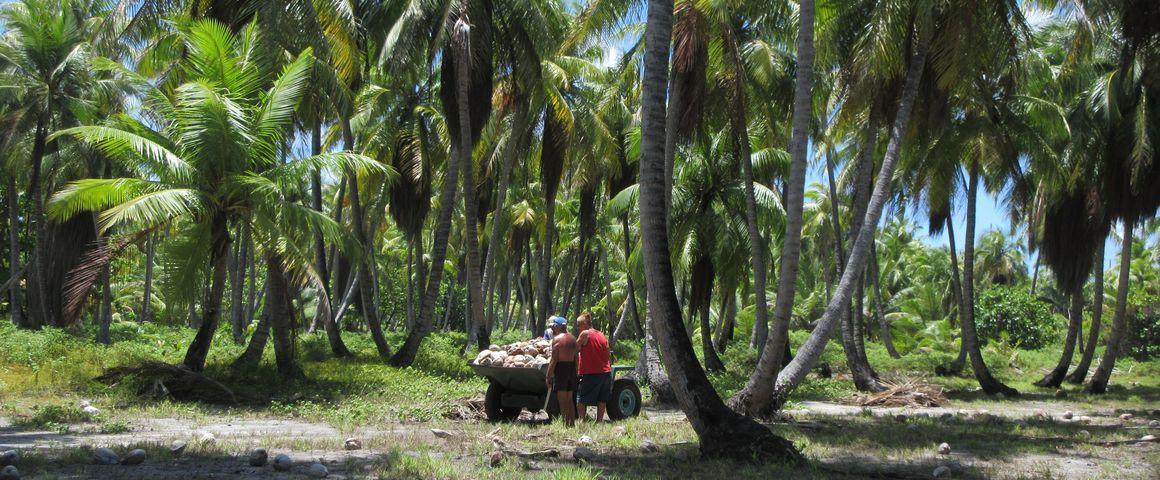
Harvesting ripe coconuts in a plantation in Rangiroa, French Polynesia © A. Garavito-Guyot, CIRAD
Coconut has a wide range of uses, from copra, which is traditionally produced for export, to coconut milk, sugar, coconut water, virgin oil or construction materials, which are initially used by producers on a daily basis.
Global demand is growing rapidly: consumers concerned for their wellbeing love products such as coconut water, virgin oil and sugar. However, average yields from coconut plantings have not changed sufficiently over the past 40 years, from 3.7 to 5.6 tonnes of coconuts/ha/year. If it is to satisfy growing global demand, the value chain, which has reached a turning point, must speed up its transition to a value chain of the future.
Ageing, climate change, diseases and more... coconut faces many challenges
The main challenge facing the value chain is its lack of sustainability, due to ageing plantations and growers. For instance, in Indonesia, 20% of coconut palms are due for renewal.
Climate change has brought new issues for plantations: growing conditions have changed and call for more suitable varieties and pest and disease management methods, particularly to control lethal yellowing disease, which can devastate plantations.
Coconuts are primarily produced on family farms in coastal tropical zones, particularly in Asia (Philippines, Indonesia, India, Sri Lanka, Thailand), but also in Africa, Latin America and Oceania. The livelihood of many rural households depends on the crop. However, the smallholders concerned often lack knowledge of markets and are not sufficiently organised, and it is therefore essential to build equitable markets.
Research is working to invent sustainable coconut growing
To address these many issues, CIRAD presents its three main ambitions in the summary of its roadmap devoted to the value chain:
1 - Produce knowledge for resource management and coconut genetic improvement
Coconut is a plant with remarkable morphological and genetic variability. Understanding that variability better allows us to identify and make use of the most appropriate genetic resources to address the challenges facing the sector. We can work on improving disease resistance, productivity, fruit quality, and so on.
Andrea Garavito Guyot
Coconut geneticist and genomics specialist, CIRAD
2 - Help coconut producers achieve agroecological transition
Among the obstacles currently facing the sector, lethal yellowing is continuing to spread, while dead coconut palms serve as breeding sites for Oryctes spp., a large beetle that causes considerable damage in young plantings. As things stand, there is no satisfactory way of controlling this pest, which is found across the entire coconut distribution zone, apart from chemical control.Informing growers about these threats, providing them with knowledge and training them to address the challenges they face are all part of CIRAD’s mandate.
Laurence Ollivier
Entomologist specialising in coconut pests, CIRAD
3 - Consolidate knowledge and know-how, to design the sector’s future
CIRAD has a long history of research on and expertise and training in coconut, by virtue of its work since the mid-20th century. Its teams are now working to build on the know-how and knowledge acquired, to pass it on by providing training in database management, sustainable production and innovative processing techniques, among other things.
Key figures
- 65.6M tonnes of coconuts produced worldwide in 2024
- 11.3M hectares planted worldwide
- 3908M dollars generated by coconut water exports in 2023
- 5 disciplines, from sociology to genomics, working on coconut at CIRAD
- 490 publication references between 2005 and 2025
- Between 2017 and 2021 CIRAD helped to sequence the coconut genome
See also
Institutional news 8 June 2026
Launch of the AIKO project: Artificial intelligence to process scientific literature

Institutional news 18 May 2026