












- Home
- Press area
- Press releases
- Winners PREZODE zoonotic disease prevention strategies
France 2030 - PREZODE | Prevention strategies to address the emergence of zoonotic diseases
Institutional news
21 January 2026
To boost knowledge and identify prevention solutions to address the emergence or re-emergence of zoonotic diseases, two new interdisciplinary fundamental research projects are due to be funded under the PREZODE research programme. PREZODE, which is supported by the French State under the umbrella of France 2030, is one of two research programmes under the emerging infectious diseases (MIE) and nuclear, radiological, biological and chemical (NRBC) threat acceleration strategy coordinated by the Agence de l’innovation en santé.
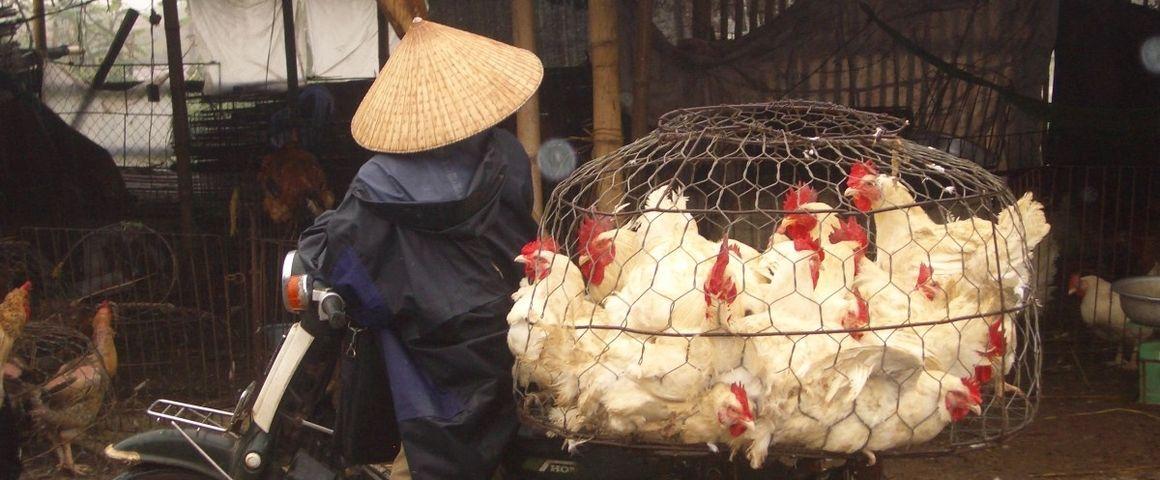
Motorbike carrying poultry from Ha Vi market © M-I. Peyre
The emerging infectious diseases (MIE/EID) and nuclear, radiological, biological and chemical (NRBC) threat acceleration strategy launched four years ago and coordinated by the Agence de l’innovation en santé under the France 2030 plan, is intended to make France more prepared to cope with the risks of a new major health crisis. Under the strategy, the PREZODE research programme, run by the Agence nationale de la recherche (ANR) on behalf of the State, will be funding two new interdisciplinary fundamental research projects aimed at identifying prevention solutions to reduce the risks of zoonotic disease emergence.
Two research programmes to make France more prepared to cope with the risks of a new major health crisis
In line with the priority the French State has given to research and innovation under the France 2030 plan and the corresponding health innovation 2030 plan, the MIE/EID strategy has a substantial research component, with two complementary research programmes:
- The MIE/EID research programme, steered by INSERM by means of ANRS I MIE (national EID scientific research agency), should provide a clearer understanding of how to prevent and control infectious disease emergence phenomena, serve to develop counter-measures to diagnose, protect and treat humans, and enable the establishment of health policies based on scientific evidence and tailored to the specific context of the crisis.
- The PREZODE research programme (Preventing Zoonotic Disease Emergence), led by IRD, CIRAD and INRAE, is intended to boost knowledge production and the development of tools to draft innovative emerging zoonotic disease risk reduction and early detection strategies.
Under the PREZODE research programme, the State has already funded nine research projects, for a total of 16 million euros.
PREZODE research programme, supporting two new research projects to prevent emerging infectious zoonotic diseases
Continuing this dynamic, a third and last call for proposals was issued in 2025 to support interdisciplinary fundamental research projects aimed at identifying prevention solutions to reduce the risk of zoonotic disease emergence, with three main lines of research:
- Identifying risk and resilience factors that could be targeted by zoonosis prevention strategies.
- Co-constructing zoonosis prevention strategies and characterise their epidemiological, sociological, cultural and economic impacts.
- Understanding the sociocultural factors that could bias prevention strategies or make them ineffective, and assessing their acceptability.
Following the assessment of 13 eligible projects by an international panel of experts, two were selected and will receive a total of almost 3.5 million euros from France 2030.
The two chosen projects have suggested different prevention strategies targeting a range of pathogens, and have study sites in Africa and Southeast Asia:
CARE - Coordinator: Katherine Worsley-Tonks (Institut Pasteur)
The CARE project (Community Awareness and Response for Emerging zoonotic outbreaks) aims to improve emerging zoonotic disease prevention by developing and assessing a community-based, integrated participatory approach centring on One Health. Based on the observation that existing prevention strategies are often not sustainable and not sufficiently suited to local situations, CARE proposes working with communities to build flexible risk reduction frameworks, fostering the long-term adoption of prevention measures and improving early case detection. The project will assess the impact of this approach on the associated knowledge of and beliefs surrounding zoonoses, the adoption of preventive behaviour, community monitoring, epidemiological knowledge and cost-benefit ratio. CARE will be rolled out in contrasting ecological, socioeconomic and cultural contexts in Africa (Cameroon, Ivory Coast, Zimbabwe) and France, and will target several pathogens with distinct epidemiological profiles, notably avian influenza, Crimean-Congo haemorrhagic fever and rabies, to test the transferability and robustness of the proposed framework.
France 2030 support budget: € 1 999 177
(Full team list below)
ZOLA - Coordinator: Guillaume FOURNIÉ (INRAE)
This project aims to reduce zoonotic risks in live animal markets, which have been identified as major foci for disease emergence and pathogen transmission, notably avian influenza viruses (AIVs). Moving away from merely adapting standard technical measures, ZOLA suggests an interdisciplinary, participatory approach aimed at co-creating structural interventions that mirror the unique challenges and opportunities of each situation. The project is being rolled out in Bangladesh and Vietnam, and will develop strategies to reduce AIV transmission among the poultry birds on sale and the risks for humans, by combining epidemiology, modelling and social sciences, so as to characterise viral transmission dynamics, commercial networks and the determining factors behind risky behaviour. Lastly, the project will produce an operational roadmap that can be transferred to other market systems and animal-human-environment interfaces, in line with the PREZODE agenda.
France 2030 support budget : € 1 498 726
(Full team list below)
About France 2030
- France 2030 reflects a dual ambition: to transform key sectors of our economy (energy, automotive industry, aeronautics and space) long term through technological innovation, and position France not just as a player but as a leader in the world of the future. From fundamental research through the emergence of ideas to the production of a new product or service, France 2030 supports the entire life cycle of innovations, right up to their industrialisation.
- France 2030 is unprecedented in its scale: €54 billion is being invested so that our businesses, our schools, our universities and our research organizations fully succeed with their transitions in these strategic sectors. The challenge is to enable them to respond in a competitive way to the world’s future ecological and attractiveness challenges, and to showcase the future champions of our sectors of excellence. France 2030 is defined by two overarching objectives, which will see 50% of expenses given over to the decarbonization of the economy, and 50% to emerging key players, those at the forefront of innovation, without neglecting the environment (in the sense of the “Do No Significant Harm” principle).
- France 2030 is being implemented collectively: designed and deployed in consultation with economic, academic, local and European key players to establish strategic guidelines and decisive action. Project holders are invited to submit their entries via the current application process, which is a demanding and selective one, to benefit from state support.
- France 2030 is being led by the French General Secretariat for Investment, in charge of France 2030, on behalf of the Prime Minister, and in partnership with the relevant government ministries.
About IRD
As a French institute for international scientific research, IRD contributes to strengthening the resilience of societies in response to the challenges of global change. It operates in over 50 countries across Africa, Latin America, Asia, the Pacific, as well as in mainland France and the overseas territories.
Its research activities address priority needs in practical ways: mitigating and adapting to climate change, combating poverty and inequality, preserving biodiversity, improving access to healthcare, and understanding social dynamics. Research projects are developed in collaboration with stakeholders on the field and local communities. Teams integrate different perspectives, disciplines, and knowledge through long-term partnerships to build robust, high-impact solutions.
IRD advocates for research that benefits the broadest population possible. It openly shares research results and leverages science for action. In this way, it supports the transformation of societies towards more just and sustainable, social, economic, and ecological models.
About CIRAD
CIRAD is the French agricultural research and international cooperation organization working for the sustainable development of tropical and Mediterranean regions. It works with its partners to build knowledge and solutions for resilient farming systems in a more sustainable, inclusive world. It mobilizes science, innovation and training in order to achieve the Sustainable Development Goals.
Its expertise supports the entire range of stakeholders, from producers to public policymakers, to foster biodiversity protection, agroecological transitions, food system sustainability, health (of plants, animals and ecosystems), sustainable development of rural territories, and their resilience to climate change. CIRAD works in some fifty countries on every continent, thanks to the expertise of its 1800 staff members, including 1240 scientists, backed by a global network of some 200 partners. It also supports French science diplomacy operations.
About INRAE
The French National Research Institute for Agriculture, Food, and Environment (INRAE) is a major player globally in research and innovation. The institute brings together a community of over 10 000 people, including 8000 permanent staff and more than 2500 project-funded contractors each year, working across more than 270 research, service, and experimental units located in 18 centres throughout France.
Internationally, INRAE is among the top research organisations in agricultural and food sciences, plant and animal sciences, as well as in ecology and environmental science. It is the world’s leading research organisation specialising in agriculture, food and the environment.
Faced with a growing world population, climate change, the depletion of resources and declining biodiversity, the institute plays a major role in building sustainable solutions with its research and development partners, helping farmers and all actors in the food and forestry sectors to succeed in these transitions.
About the Agence nationale de la Recherche
The French National Research Agency (ANR) is the funding agency for project-based research in France.
As a public institution under the authority of the French Ministry of Higher Education and Research, the ANR funds and promotes basic and applied research in all disciplines at the national, European, and international level. It also funds technological innovation, technology transfer, and partnerships between research teams from the public and private sectors, in addition to strengthening dialogue between science and society.
The ANR also serves as the main operator of the France 2030 Investment Plan in higher education and research, for which it selects, funds, and monitors projects in connection with national strategies and research programmes.
The ANR is ISO 9001 certified, and was awarded the "professional equality" label.
Full team list
CARE - Coordinator: Katherine Worsley-Tonks (Institut Pasteur)
Consortium: Hervé Bourhy, Tamara Giles-Vernick, Simon Cauchemez, (Institut Pasteur); Anne Conan, Hélène De Nys, Erwan Sachet (CIRAD); Florian Liégois (IRD); Mathurin Tejiokem, Richard Njouom, Rodrigue Poueme, Cameroon Pasteur Centre (CPC); Antoine Socpa, University of Yaoundé I; Jean Marc Feussom, AU-IBAR; Isaac Tiembre, Institut National d'Hygiène Publique, Ivory Coast; Meite Syndou, Institut Pasteur, Ivory Coast; Vessaly Kallo, Direction des Services Vétérinaires, Ivory Coast; Gift Matope, Vupenyu Dzingirai, University of Zimbabwe.
ZOLA - Coordinator: Guillaume FOURNIÉ (INRAE)
Consortium: Alexis Delabouglise, Flavie Goutard, Séverine Thys, Hoa TT Pham, Daan Vink, Tu Tu Zaw Win (CIRAD); Julien Malard (IRD); Claire Guinat (INRAE).
See also
Institutional news 8 June 2026
Launch of the AIKO project: Artificial intelligence to process scientific literature
Institutional news 18 May 2026