












Results & impact 13 March 2026

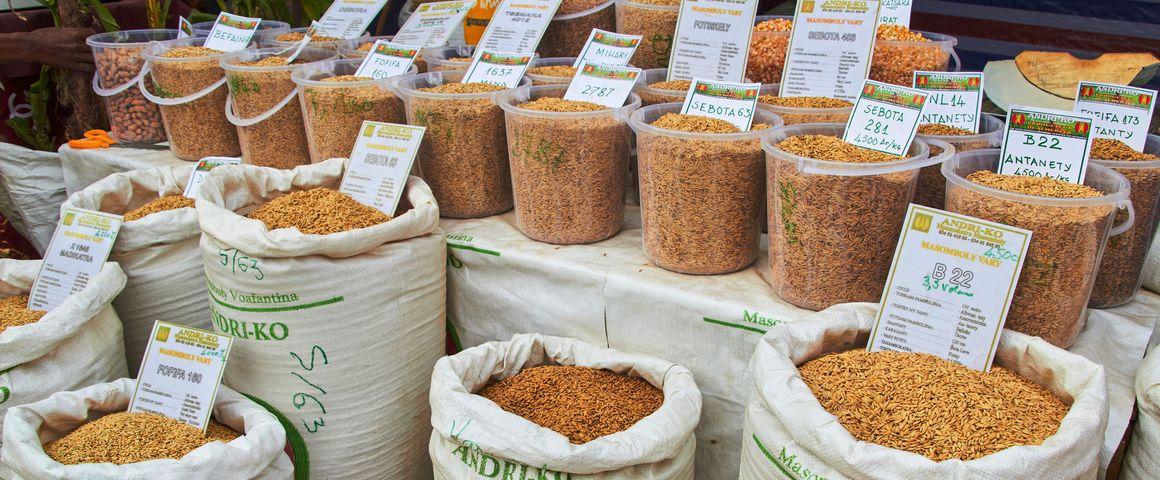
Presentation of improved rice varieties at an agricultural show. The development of upland rice in plain zones is a response to the saturation of bottomland areas and is helping to boost food security in Madagascar © AIM Madagascar
The essentials
Strengthening the region's agricultural value chains is one of the priorities identified with a view to boosting trade between Madagascar, Mayotte, Mauritius and Réunion. On 8 April in Madagascar, following a study of the state of trade within the region, institutional, economic and scientific representatives from all four islands met to discuss operational levers.
Research rapidly emerged as a determining element for developing farming systems. Jean-Marc Bouvet, CIRAD Regional Director for Madagascar, explains: "firstly, research allows us to conceive and test concrete solutions to the issues facing value chain stakeholders. Secondly, thanks to the way we work, we can create and strengthen cooperation networks associating different stakeholders on various levels of value chains, including public- and private-sector players".
According to a recent study, the volume of trade in goods between the islands of the western Indian Ocean remains limited, and is indeed falling, from 2.69% of the global total in 2015 to 2.31% in 2024. This highlights the current limitations of regional economic integration, despite the geographical proximity of the territories in question.
These results are the fruits of an analysis conducted by the EY firm, in partnership with several chambers of commerce (Réunion, Mayotte, France-Madagascar, France-Mauritius) and the Club Export Réunion. The work was supported by the Agence française de développement (AFD), via the Fonds d’expertise technique et d’échanges d’expériences (FEXTE) funded by the Direction générale du Trésor.
Madagascar is often presented as the promised granary of the region. It has vast land resources and human resources and local activities centred on agriculture, which is promising for its development. However, that potential faces constraints: difficult access to land, soil erosion, irrigation issues, crop pests, climate change, etc. Research is working to understand and manage those issues more effectively.
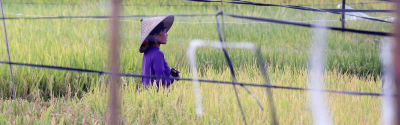
Rice is a good example of the context. It is vital for food supplies in the region, and grows well in many parts of the country. However, the increasing saturation of bottomlands, notably as a result of gradual division of land, is now limiting the possibilities of expansion. Extending crops to plans, or tanety, could be an alternative, but means adapting to more demanding conditions, notably in terms of climate and height above sea level. CIRAD and its partners are therefore working to develop rice varieties suited to such environments, not just to guarantee food security, but to integrate regional markets.
In addition to crops themselves, structuring the agricultural sector is another crucial lever. In Madagascar, family farms account for 75% of food production. Their resilience is therefore vitally important, not just for food sovereignty but for the country's integration into regional markets.
CIRAD's work fits in well with this ambition, in promoting an approach rooted in local realities. The challenge is to improve farm productivity and stability sustainably, to create the conditions for better inclusion in regional trade dynamics. Anne-Sixtine Vialle Guerin, representative of the Agence française de développement, who was able to take part in the discussion workshop, emphasised the pertinence of the approach.
Developing regional value chains necessarily means better connections between innovation, product processing and market access. The question of the link between research and the private sector is therefore central, since to be adopted by a value chain, an innovation has to convince every link in that chain.
CIRAD is working to promote this stance by means of various structures in Réunion and Madagascar, such as research networks (dP OH-OI, dP BIOCONTRÔLE, etc), or intersectoral projects like INTERREG ITALIQ, GERMINATION, G-OPTIMIZ, DeSIRA+OI, and so on. It is also supporting initiatives capable of transforming scientific progress into concrete economic opportunities, by participating in public-private research platforms such as PréRAD-OI.

Representatives of French Tech, CCIFM, GOTICOM, Malakass, AFD and CIRAD at the workshop to launch the strategy to boost trade within the western Indian Ocean © M, Rananja, CIRAD
The initiatives under way bear witness to the growing awareness of the economic potential of effective regional integration within the western Indian Ocean. Strengthening agricultural value chains, scientific innovation and cooperation between public and private players are further levers for boosting the new dynamic. In the medium term, the challenge will be to transform intentions into concrete, coordinated action. It is the ability to do this that will govern the construction of a more integrated regional economic area that will also be more resilient and competitive in the face of future challenges.
Results & impact 13 March 2026

Results & impact 28 October 2025
Results & impact 16 October 2025