








- Home
- Worldwide
- Our regional offices
- West Africa - Forest and Humid Savannah
- Actualités : Afrique de l’Ouest – Forêt et savane humide
- SafeVeg: Vegetable farming in West Africa
SafeVeg: five years of research and partnerships to sustainably transform vegetable farming in West Africa
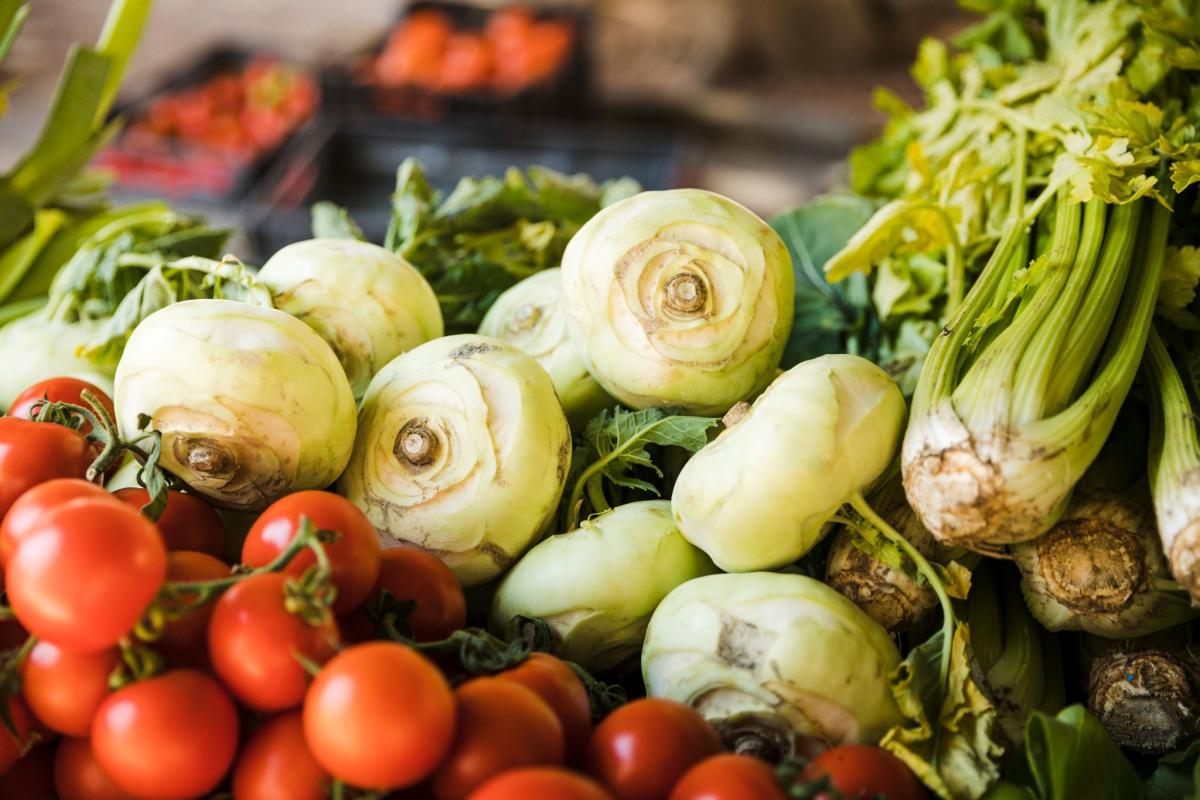
Fresh vegetables at a market © Royalty-free photo – magnific.com
Five years to take action across the entire vegetable sector
How can the availability and consumption of healthy vegetables in West Africa be sustainably improved while strengthening producers' capacity to cope with climatic, health, and economic constraints?
This was the central challenge addressed by the SafeVeg project Safe Locally-Produced Vegetables for West Africa’s Consumers implemented in Benin, Burkina Faso, and Mali.
Launched in 2020 for a five-year period, SafeVeg was coordinated by the World Vegetable Center (WorldVeg). It was implemented in partnership with Cirad and Wageningen University & Research (WUR), as well as the leading national agricultural research institutes in the three target countries.
The project received financial support from the European Union and the Ministry of Foreign Affairs of the Kingdom of the Netherlands under the DeSIRA program (Development Smart Innovation through Research in Agriculture).
SafeVeg aimed to intervene simultaneously across several segments of the vegetable value chain: the availability of high-performing seeds, production practices, climate resilience, health risk reduction, vegetable consumption, market access, entrepreneurial development, and the generation of knowledge to inform public policy.
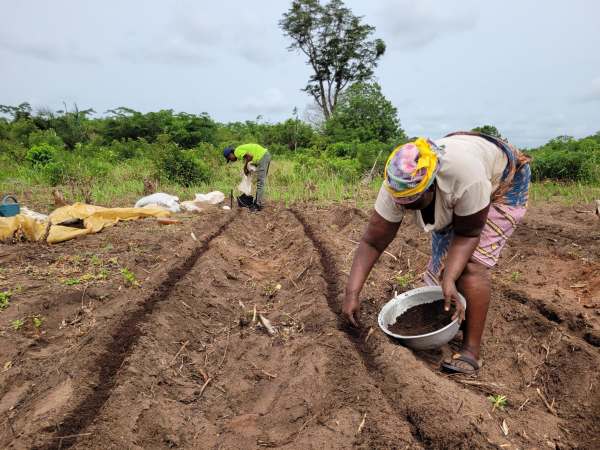
Application of microorganism-enriched compost during an on-farm experiment in Kpomassè, Benin © A. De Troij, Cirad
68 new varieties to diversify the range offered to producers
One of the project’s most significant outcomes is the improvement of the range of varieties available to market gardeners.
By the end of the project, 68 new vegetable varieties had been officially registered in Benin, Burkina Faso, and Mali, marking a major step forward for the vegetable sectors in these three countries.
The species involved include tomatoes, okra, chili peppers, onions, amaranth, roselle (Guinea sorrel), and jute mallow.
These varieties were evaluated based on various agronomic and quality criteria, such as their adaptation to local growing conditions, yield, and resistance to specific diseases and pests.
The number of officially recognized varieties across the three countries rose from approximately 70 to 138, significantly expanding the options available to producers.
Beyond registration, the challenge now lies in multiplying and distributing these seeds so that they are truly accessible to market gardeners. Consequently, the project also focused on strengthening seed companies and the networks of stakeholders capable of supporting their distribution.
CIRAD at the heart of the agroecological transition of market gardening systems
Within the SafeVeg consortium, CIRAD led the component dedicated to the production of healthy, climate-resilient vegetables and to post-harvest practices.
CIRAD’s activities with in the project were coordinated by researcher Djibril Aboubakar Souna, working alongside scientific teams and partners across the three countries.
This component focused specifically on reducing the use of synthetic inputs, implementing agroecological crop protection, adapting vegetable farming systems to climate change, and identifying solutions to minimize production and post-harvest losses.
The chosen approach relied on both experimentation and the direct participation of local stakeholders.
In Benin, for instance, researchers, producers, agricultural advisors, businesses, professional organizations, and development actors were involved in a process to co-design sustainable, agroecological vegetable farming systems.
Following several diagnostic and training phases, an ideotyping workshop held in Abomey-Calavi in June 2025 enabled participants to collectively envision production systems that address the key constraints identified in the field.
This approach ensures that agroecology is viewed not merely as a set of isolated technical solutions, but as a gradual transformation of production systems developed in collaboration with the people who implement them.
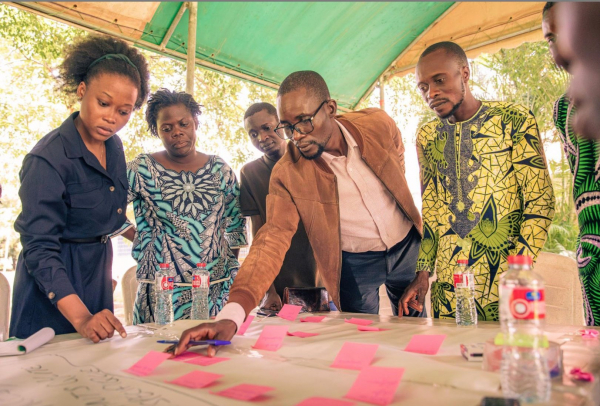
Ideotyping workshop: Co-design of sustainable, agroecological market gardening production systems in Benin © SafeVeg Benin
New practices to reduce reliance on chemical inputs
Crop protection is a key issue in West African market gardening. Faced with pests and diseases, growers can become heavily reliant on synthetic pesticides, with potential consequences for their own health, that of consumers, and the environment.
SafeVeg therefore worked on alternative solutions tailored to local conditions.
Agroecological and climate-smart practices were identified, tested, and adapted in collaboration with pilot growers. Efforts focused notably on the agroecological management of specific pests, the use of organic fertilizers and biopesticides, and biological control methods.
The goal was twofold: to maintain the productivity of market gardening operations while gradually reducing their reliance on chemical inputs. The most promising innovations are intended for wider dissemination among growers, taking into account not only their agronomic effectiveness but also their profitability and feasibility for adoption under real-world farming conditions.
An approach combining production, markets, and consumption
SafeVeg is also distinguished by its holistic approach.
The project went beyond the scope of the individual farm plot, focusing instead on the entire environment in which vegetables are produced, marketed, and consumed.
Activities addressed areas such as demand and dietary habits, market development, the structuring of vegetable business networks, access to quality seeds, and the generation of knowledge to inform public policy.
In particular, Vegetable Business Networks helped bring producers and other economic actors together around shared opportunities. These dynamics help improve market access and create new economic opportunities, especially for women and young people.
This integration of agronomic research, nutrition, economics, and public policy reflects the project's commitment to viewing vegetable farming as a comprehensive system.
A scientific partnership rooted in the three countries
The implementation of SafeVeg relied on an extensive partnership network.
Alongside the World Vegetable Center, CIRAD, and Wageningen University & Research, the three main national agricultural research institutes played a pivotal role:
- the National Agricultural Research Institute of Benin (INRAB) in Benin;
- the Institute of Environment and Agricultural Research (INERA) in Burkina Faso;
- the Institute of Rural Economy (IER) in Mali.
Depending on the specific activities, the project also engaged universities, producer organizations, NGOs, seed companies, advisory support services, private sector actors, and public authorities.
In Benin, for instance, several activities carried out under the CIRAD-led component involved—alongside INRAB and WorldVeg—stakeholders such as the University of Abomey-Calavi, the National University of Agriculture, producer organizations, and private or non-profit entities.
This diversity of stakeholders made it possible to test research-developed innovations against the realities of farming operations and markets.
Sustaining the achievements of SafeVeg
The conclusion of the project does not mark the end of the processes set in motion.
A key challenge now lies in scaling up the dissemination of the innovations developed during the five years of SafeVeg.
For newly approved varieties, this entails, in particular, strengthening seed multiplication and distribution systems to ensure they are truly accessible to growers.
Gradually incorporating these varieties into the regional plant species and variety catalogs of ECOWAS, UEMOA, and CILSS could also help facilitate their movement across national borders and boost their impact at a regional level.
Regarding agroecological practices, the challenge will be to ensure their continued adoption by growers, professional organizations, extension services, and private-sector stakeholders.
The results achieved by SafeVeg demonstrate the value of an approach that combines research, field testing, varietal improvement, agroecology, economic development, and public policy.
Over five years, the project has helped strengthen the scientific and partnership foundations needed for a sustainable transformation of the vegetable sector in Benin, Burkina Faso, and Mali, driven by a shared ambition: to make local vegetables more available, safer, and more accessible, while enhancing the resilience and incomes of the people who grow them.