










- Home
- Worldwide
- Our regional offices
- West Africa - Forest and Humid Savannah
- Actualités : Afrique de l’Ouest – Forêt et savane humide
- Ivorian Agriculture Terri4sol
Ivorian agriculture: what possible futures by 2045?
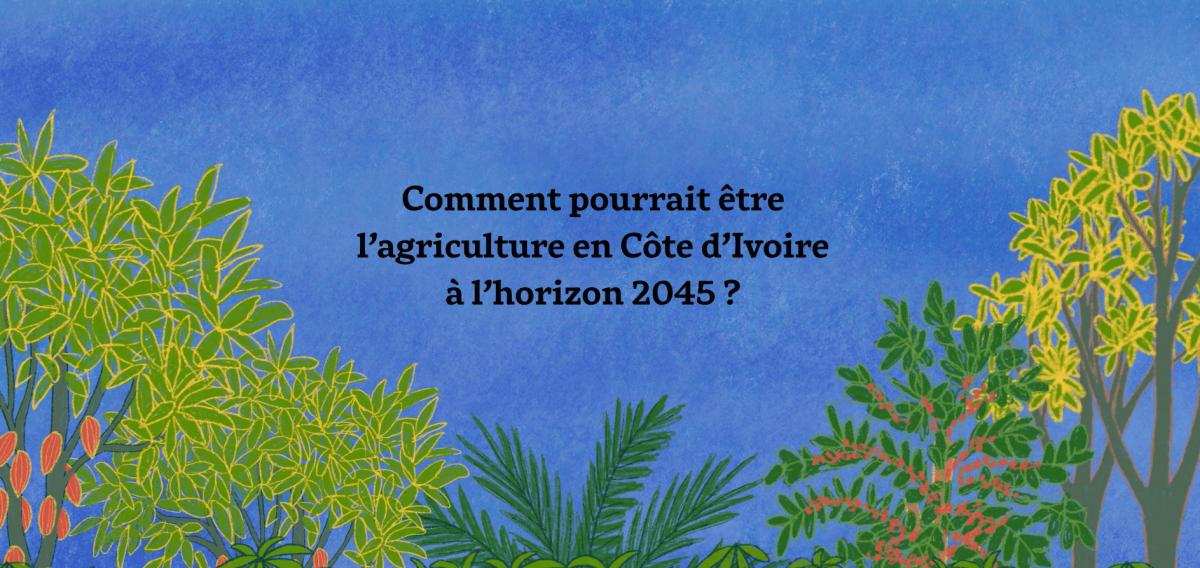
Illustration from the animated video based on the work of the foresight workshop "The Futures of Agriculture in Côte d'Ivoire," Yamoussoukro, June 2024. © Terri4Sol Project, CIRAD
Discovering the possible futures of Ivorian agriculture
Produced as part of the Terri4Sol project, this animated video presents the key takeaways from the foresight workshop "The Future of Agriculture in Côte d’Ivoire", held in Yamoussoukro in June 2024. Through four contrasting scenarios, it provides an accessible resource for understanding future challenges and fostering dialogue among stakeholders regarding the future of Ivorian agricultural and forest territories.
Envisioning the future to act more effectively today
How will Ivorian agriculture evolve by 2045? What will be the consequences of climate change, soil degradation, shifting agricultural markets, and pressures on land?
These are the questions that guided the foresight process undertaken as part of the Terri4Sol project. Unlike forecasting, foresight does not seek to predict what the future will hold. Instead, it enables the exploration of various possible futures to better understand ongoing transformations, identify major uncertainties, and inform decision-making.
This approach is based on a systemic view of agricultural territories, in which environmental, economic, social, and political dimensions constantly interact. It thus serves as a particularly relevant tool for considering the conditions required for a more sustainable and resilient agriculture. The year 2045 was selected as the target horizon representing the span of a generation which is the time needed for today’s decisions to take effect within these territories.
A project dedicated to sustainable soil restoration
The foresight approach presented in this video is part of the Terri4Sol project, which aims to support the transition toward more sustainable agricultural systems in the post-forest areas of Côte d’Ivoire specifically, the regions in the southern half of the country that were once covered by dense forest and have been progressively transformed by agriculture. Faced with growing challenges regarding soil degradation, food security, and pressure on natural resources, the project employs a participatory approach involving researchers, farmers, professional organizations, public institutions, and development stakeholders.
A collective reflection grounded in the realities on the ground
The foresight process initiated by Terri4Sol was developed incrementally. An initial phase, conducted in 2023, involved analyzing historical land-use trajectories in the Ivorian post-forest zone and identifying the key crops involved. This was complemented by interviews with a wide range of stakeholders between February and May 2024, aimed at gathering their perceptions of the issues at stake, their concerns, and their visions for the future.
These efforts informed the foresight workshop held from June 4 to 6, 2024, at the Félix Houphouët-Boigny National Polytechnic Institute (INP-HB) in Yamoussoukro. Over the course of three days, farmers, cooperative representatives, civil society organizations, public institutions, researchers, and academic staff worked together to envision possible futures for agriculture in the Ivorian post-forest zone.
Together, the participants pooled their knowledge and experiences to develop several coherent yet contrasting visions of the future.
The major factors that will shape the territories of tomorrow
The discussions helped identify several key factors likely to influence the evolution of Ivorian agriculture over the coming decades.
External factors include, notably, trends in international prices for cash crops, the distribution of rainfall throughout the year, the country’s political stability, and the prevalence of diseases and pests. Regarding internal factors, participants highlighted the importance of farmers' income, land governance, the development of mining activities, youth interest in agriculture, the quality of agricultural extension services, and the strengthening of public institutions.
Four scenarios for exploring possible futures
Based on these factors, four scenarios were developed collectively. They are neither forecasts nor roadmaps, but rather plausible narratives intended to fuel debate and highlight the consequences of certain current dynamics.
« The land provides a living »
This scenario describes a favorable future in which political stability, strengthened land governance, satisfactory agricultural incomes, and support for producers make it possible to reconcile agricultural development, food security, and the preservation of natural resources.
« Sustainable agriculture in motion »
Despite a more challenging climate context, this trajectory relies on the development of agroecological innovations, sustainable water management, the strengthening of agricultural organizations, and the commitment of public policies to support the transition.
« Socio-economic destabilization of Côte d’Ivoire »
In this scenario, political instability, low agricultural incomes, and weakening institutions undermine family farming. Rural exodus accelerates, young people turn away from the agricultural sector, and food insecurity rises.
« We're in RAMBA !! »
This final scenario the title of which translates from Ivorian slang to “we’re in trouble!” presents a situation characterized by heavy economic and food dependency. Agribusinesses dominate agricultural land, while the effects of climate change, mining expansion, and pressure on natural resources exacerbate the vulnerabilities of these territories.
Scenarios driving action
Beyond constructing future scenarios, participants analyzed the current dynamics that could lead to these various trajectories. This exercise highlighted several key levers for action, including strengthening agricultural advisory services, securing land tenure, supporting small-scale producers, structuring value chains, developing agricultural markets, and combating illegal gold mining.
By bringing these scenarios to life, the video produced as part of the Terri4Sol project aims to make foresight analysis accessible to a wide audience. It serves as a tool for dialogue among development practitioners, policymakers, researchers, and citizens interested in the future of Ivorian agriculture.
More broadly, this initiative illustrates the importance of anticipating future transformations in order to collectively build sustainable, inclusive, and resilient pathways for Côte d’Ivoire’s agricultural and forest territories.