









- Home
- Worldwide
- Our regional offices
- West Africa - Forest and Humid Savannah
- Actualités : Afrique de l’Ouest – Forêt et savane humide
- AMRUGE agricultural transitions in Côte d’Ivoire
AMRUGE: From research to field-level innovations supporting agricultural transitions in Côte d’Ivoire
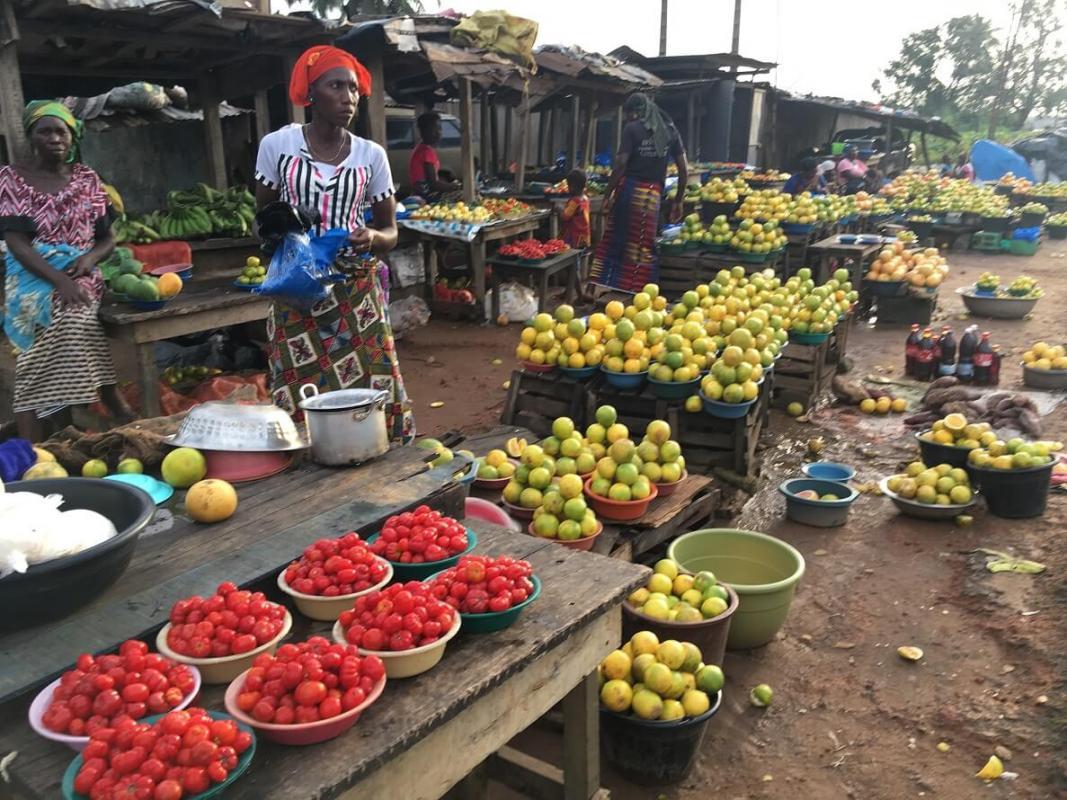
Roadside market, Côte d’Ivoire © C. Cilas, Cirad
AMRUGE in figures
8 years of implementation (2017–2025)
Funding: Agence Française de Développement (AFD), under the framework of the second Debt Reduction and Development Contract (C2D) between France and Côte d'Ivoire.
Over 1.1 billion CFA francs mobilized
6 public universities supported
16 practical work laboratories assessed
1 pilot semi-industrial biopesticide production unit established
8 biopesticides developed
44 F4 lines obtained through cotton breeding work
80 weed species identified in cotton-growing areas
40 trainers trained in organic fertilization techniques
Hundreds of researchers, technicians, livestock farmers, and producers trained
Support for identifying scientific equipment for Côte d’Ivoire’s public universities
As part of Component 3 of the AMRUGE project, and at the request of Côte d’Ivoire’s Ministry of Higher Education and Scientific Research (MESRS), CIRAD conducted a study to identify the scientific equipment needs of Ivorian public universities.
This mission covered six higher education institutions: Félix Houphouët-Boigny University (UFHB), Nangui Abrogoua University (UNA), Alassane Ouattara University (UAO), Péléforo Gon Coulibaly University (UPGC), Jean Lorougnon Guédé University (UJLoG), and the University of Man. In total, sixteen practical work laboratories underwent an in-depth assessment.
Involving around fifteen experts from the fields of health sciences, science and technology, agronomy, and university infrastructure, the study evaluated existing infrastructure, the condition of equipment, the needs of faculty members, and available human resources.
The results led to the creation of detailed equipment lists, complete with technical specifications and budget estimates. This work served as a reference for equipment procurement procedures funded under the C2D framework.
An industrial research unit for developing biopesticides
One of the project’s major achievements is the creation and strengthening of the Industrial Research Unit (URI) at Félix Houphouët-Boigny University.
With the project’s support, the URI now possesses a semi-industrial scale pilot unit for biopesticide production, featuring equipped laboratories, distillation systems, formulation equipment, and packaging facilities.
This infrastructure enables the production of alternatives to chemical pesticides, addressing issues related to public health, environmental protection, and the competitiveness of agricultural value chains.
Plots of aromatic plants were established to ensure a supply of raw materials. Eight biopesticides have been developed, several of which are approved for use on mango, banana, cocoa, and yam crops.
The project also facilitated the creation of a business plan for the NECO biopesticide range, as well as the production of educational kits and the organization of training sessions for producers and users.
Preserving genetic resources and improving livestock farming systems
In the livestock sector, work focused on characterizing animal genetic resources, improving feeding systems, and building the capacity of stakeholders in the value chain.
Monographs were produced on key local ruminant breeds N’Dama, Djallonké, and the NAO goat while livestock farming systems were assessed through field surveys and workshops involving livestock farmers and professional organizations.
A collection of forage plants was established and characterized in Bouaké. Technical production protocols were developed, and Panicum maximum seeds were produced to promote the dissemination of forage resources adapted to local conditions.
The project also enabled the identification, characterization, and monitoring of purebred animals using phenotypic and molecular approaches. Several feeding strategies were subsequently tested at research stations and on farms to sustainably improve livestock performance.
These activities were accompanied by a major capacity-building program, including researcher training, expert missions, the creation of a specialized document repository, and training sessions for livestock farmers and technical service staff.
Supporting the transition of cotton-based systems
The cotton-focused component addressed challenges related to climate change, pests, weed management, and soil fertility.
Work conducted with producers provided a better understanding of their adaptation strategies in the face of changing climatic conditions and helped steer research toward solutions that address realities on the ground.
In the field of variety improvement, cross-breeding efforts yielded 44 F4 lines, thereby enriching the genetic diversity available for future breeding programs.
Significant progress was also made in molecular marker-assisted selection, with the identification of a marker associated with resistance to Fusarium wilt.
At the same time, a digital phytosanitary monitoring system was implemented across some thirty locations to strengthen surveillance and early-warning capabilities.
Research on weeds led to the identification of nearly 80 weed species, six of which were particularly dominant. Alternatives to chemical herbicides based on crop associations and rotations have proven effective in sustainably reducing weed infestation.
Finally, work on soil fertility has led to the development and dissemination of innovative techniques for composting and utilizing organic matter, supported by the training of 40 extension agents from cotton companies.
Innovations for the mango and cashew sectors
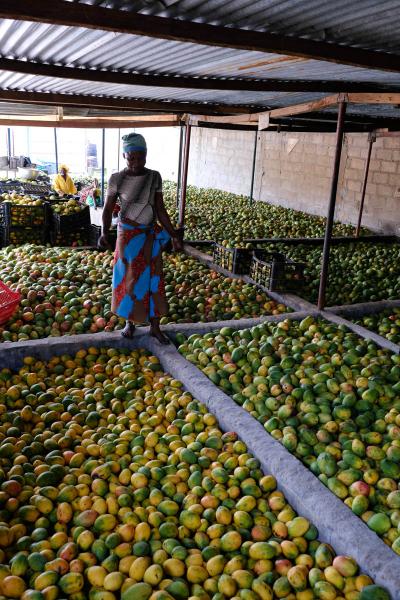
Processing of organic fruits and vegetables, particularly mangoes © biostar, Arnaud Chapuis
The project also helped boost the competitiveness of the mango and cashew sectors through research into crop protection, harvest forecasting, and varietal improvement.
Regarding mangoes, trials confirmed the effectiveness of the biopesticide NECO and Lippia multiflora essential oil against fruit flies, the sector's primary pest in northern Côte d’Ivoire.
Research also identified the host plants that serve as refuges for fruit flies and provided a better understanding of their dynamics within agricultural landscapes.
Significant progress was also made in controlling mango anthracnose and bacterial disease. These diseases were mapped, and several biopesticides proved effective in controlling them.
Furthermore, the project developed a harvest forecasting model based on climate data and field observations. This work helps improve harvest planning, reduce post-harvest losses, and strengthen the competitiveness of Ivorian mango exports.
In the cashew sector, twenty-four genotypes were characterized based on yield, disease susceptibility, and natural defense mechanisms. Fifteen particularly promising genotypes were identified for continued breeding programs.
Supporting the agroecological transition of market gardening systems
In the Gbêkê and Poro regions, activities focused on supporting the agroecological transition of market gardening production systems.
Following a thorough assessment of the farms, several studies evaluated the residual effects of legume crops such as peanuts, cowpeas, and soybeans on the production of eggplants, tomatoes, and okra.
The results confirm the value of these crop rotations for improving soil fertility and reducing reliance on chemical inputs.
Trials involving the use of organo-mineral fertilizers were also conducted, and several tomato hybrids were developed to meet producers' needs.
Finally, the project enabled the training of numerous producers in good agroecological practices and the conduct of socio-economic analyses aimed at better understanding the conditions for the adoption of innovations within the value chains.
An Enduring Scientific Legacy
After eight years of collaboration between the MESRS, the CNRA, Ivorian universities, and CIRAD, the AMRUGE project leaves behind a significant scientific, technical, and human legacy.
Beyond the infrastructure and equipment put in place, the project helped strengthen the skills of research stakeholders, consolidate scientific partnerships, and generate knowledge valuable to the sustainable development of Ivorian agricultural sectors.
These achievements now provide a solid foundation for continuing efforts to modernize higher education, research, and innovation in support of agricultural, food, and environmental transitions in Côte d’Ivoire.