












- Home
- Worldwide
- Our regional offices
- West Africa - Forest and Humid Savannah
- Actualités : Afrique de l’Ouest – Forêt et savane humide
- Agroforestry in Côte d’Ivoire
Agroforestry in Côte d’Ivoire: planting trees, securing rights, and taking action
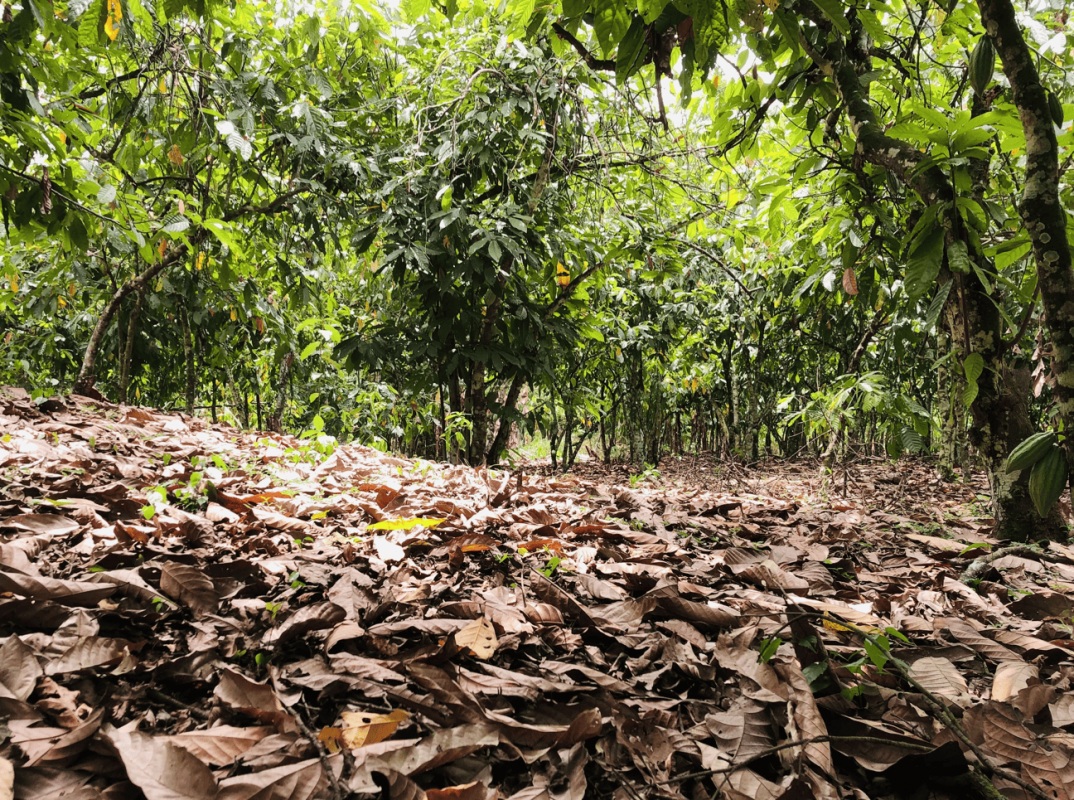
Cocoa plantation – Alloulouakouassikro, February 23, 2023 © Ehouman Evans, Cirad
Faced with forest degradation, soil depletion, and the impacts of climate change, agroforestry has become central to agricultural and forestry transition strategies in Côte d’Ivoire. In the cocoa sector specifically, integrating trees with crops is a key approach to restoring landscapes, boosting farm resilience, and fostering more sustainable production.
However, a gap remains between stated ambitions and their practical implementation on the ground. Research conducted under the TERRI4SOL project demonstrates that the success of this transition hinges on more than just the number of trees planted; it also requires a better understanding of farmers' realities, land tenure security, tree ownership rights, and the practical conditions for implementing agroforestry policies.
Agroforestry at the heart of Ivorian ambitions
In Côte d’Ivoire, agroforestry has increasingly become a feature of public policy, sustainability strategies for the cocoa sector, and landscape restoration initiatives. This shift addresses several challenges: maintaining agricultural productivity in areas where forest resources are dwindling, restoring soil fertility, preserving biodiversity, increasing carbon sequestration, and strengthening farm resilience in the face of climate change.
Consequently, numerous programs in cocoa-growing areas encourage the introduction or retention of trees alongside cocoa plants. Initiatives such as the distribution of forest seedlings, density standards, certification schemes, carbon projects, and landscape restoration programs are proliferating.
However, the existence of technical frameworks and proactive policies does not automatically guarantee their long-term adoption by farmers.
Planting trees is not enough.
One of the key lessons highlighted by TERRI4SOL is the need to move beyond an agroforestry approach based primarily on the distribution and planting of trees.
Factors such as seedling survival, maintenance, species selection, compatibility with crops, and above all the economic value for farmers are all crucial considerations.
Trees already present on farms also represent a resource worth considering; their conservation, management, and regeneration can contribute to the agroforestry transition just as effectively as new plantings.
The challenge, therefore, lies less in viewing the tree merely as an element to be added to a plot than in building agroforestry systems tailored to the agricultural, economic, and social realities of the local areas.
The issue of rights at the heart of the agroforestry transition
In addition to these technical constraints, there is a crucial question: who owns the tree ?
For a producer, planting and maintaining a tree represents a multi-year investment. However, this investment becomes risky when rights to the land or the trees remain uncertain.
Changes in the Ivorian forestry framework have led to progress in recognizing tree ownership. Yet, implementation runs up against the reality of rural land tenure, where a large portion of land is still governed by customary rights and lacks formal certification. This situation can foster reluctance to plant or preserve trees; in particular, some producers fear they will ultimately be unable to reap the economic value of the trees they have protected or planted.
Securing agroforestry practices cannot, therefore, be separated from securing producers' rights.
Securing the land, but also the trees
The work of TERRI4SOL highlights the importance of considering mechanisms to better secure rights over trees, even where land tenure arrangements are not yet fully formalized. This is particularly important for producers who farm land under customary or contractual agreements. It calls for better alignment between forestry, agricultural, and land tenure policies. Indeed, the transition to agroforestry requires producers to have sufficient confidence in the system to make long-term investments. Securing rights, clarifying rules regarding tree utilization, and improving community awareness thus become essential conditions for translating national ambitions into lasting changes at the farm level.
From ambition to implementation
Côte d’Ivoire now has a growing array of policies, standards, and initiatives supporting agroforestry. The challenge lies in enhancing their coherence and ensuring their effective implementation on the ground. This entails, in particular, involving producers more closely in the design of these frameworks, tailoring agroforestry models to local realities, improving technical support, securing investments in trees, and better coordinating stakeholders across the agricultural, forestry, and land sectors.
Agroforestry thus emerges not merely as a planting technique, but as a genuine transformation of agricultural systems and landscapes.
TERRI4SOL: Shedding light on the conditions for a sustainable transition
Implemented in Côte d’Ivoire, the TERRI4SOL project examined transformations in agricultural, forest, and post-forest landscapes, as well as the conditions required to preserve and restore soil organic carbon stocks. By combining analyses of agricultural dynamics and field experiments with an examination of public policies and institutions, the project provides a better understanding of the drivers of and obstacles to the agroecological transition in Ivorian territories.
Its findings highlight, in particular, that when it comes to agroforestry, planting a tree is only the beginning: producers must also be enabled to keep and manage the tree, derive benefits from it, and be assured of their rights over the long term.
It is on this condition that agroforestry ambitions can be translated into lasting changes in Ivorian landscapes.