















Software and digital applications - Territory management solution - Natural resources and territories


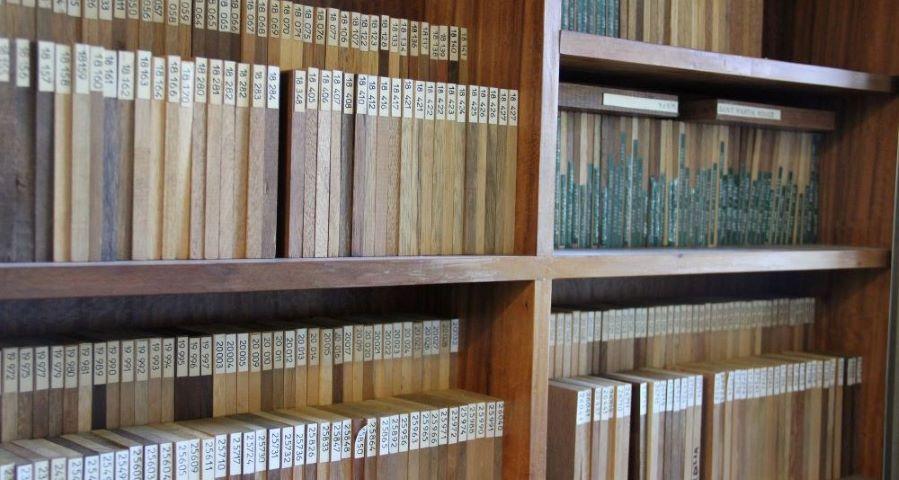
BioWooEB xylotheque, samples, wood chips used for anatomical identification © Patrick Langbour, CIRAD
Our approach is based on many years of scientific and technical study of wood species, with a particular focus on tropical timber. It involves several stages :
The observed characteristics are then compared with reference materials stored in a xylotheque or with data available in specialised literature or on websites.
TLR9 - Technology Readiness Level
Carpenters, cabinetmakers, importers, architects, antique dealers, museum curators and other professionals can rely on the wood identification laboratory of the BioWooEB Research Unit to characterise samples, identify wood species or verify their conformity.
To benefit from our expertise, consult our laboratory identification pricing and contact us to learn about sample submission procedures.
Normand, D. (1972). Manuel d’identification des bois commerciaux .Tome 1 : Généralités, Centre Technique Forestier Tropical. Nogent sur Marne (France).
Normand, D. et Paquis, J. (1976). Manuel d’identification des bois commerciaux. Tome 2 : Afrique guinéo- congolaise. Centre Technique Forestier Tropical. Nogent sur Marne (France).
Détienne, P., Jacquet, P., Mariaux, A. (1982). Manuel d’identification des bois commerciaux – Tome 3 : Guyane française. Centre technique Forestier Tropical. Nogent sur Marne (France).
Détienne, P. and Jacquet, P. (1983). Atlas d’identification des bois de l’Amazonie et des régions voisines. Centre technique Forestier Tropical. Nogent sur Marne (France).
Louppe D. 2015. Anatomie des bois. In : Mémento du forestier tropical. Mille Gilles (ed.), Louppe Dominique (ed.). Versailles : Ed. Quae, 859-867. ISBN 978-2-7592-2340-4
Gérard, J. (coord éd), Guibal, D.(auteur), Cerre, J.C. (auteur), Paradis, S. (auteur) avec 40 Auteurs. (2016) Atlas des bois tropicaux Caractéristiques technologiques et utilisations - Éditions Quæ Collection Guide pratique 1000 pages ISBN 978-2-7592-2550-7, référence 02558
Langbour, P. ; Paradis, S. ; Thibaut, B. Description de la xylothèque du Cirad à Montpellier, France, regroupant huit mille espèces identifiées. BOIS & FORETS DES TROPIQUES, [S.l.], v. 339, p. 7-16, avr. 2019. ISSN 1777-5760.
Langbour, P. ; Paradis, S. ; Thibaut, B., 2018, "CIRAD wood collection - Dataset", doi:10.18167/DVN1/CDHU51, CIRAD Dataverse, V3
Schmitz Nele & al. 2020. Overview of current practices in data analysis for wood identification - A guide for the different timber tracking methods. Joensuu : GTTN-European Forest Institute, 143 p.
Software and digital applications - Territory management solution - Natural resources and territories

Analysis-diagnosis service - Sustainable agriculture - Food and agrifood technology - Natural resources and territories - Animal production and health
Analysis-diagnosis service - Natural resources and territories