LCA : Expert in Life Cycle Assessment of Tropical and Mediterranean Products
Analysis-diagnosis serviceSustainable agricultureFood and agrifood technologyNatural resources and territoriesAnimal production and health
CIRAD researchers are experts in tropical and Mediterranean agricultural supply chains and forestry. For more than 10 years, they have been conducting Life Cycle Assessments (LCA) by developing and applying the best international methodological standards.
Environmental assessment of tropical and Mediterranean value chains
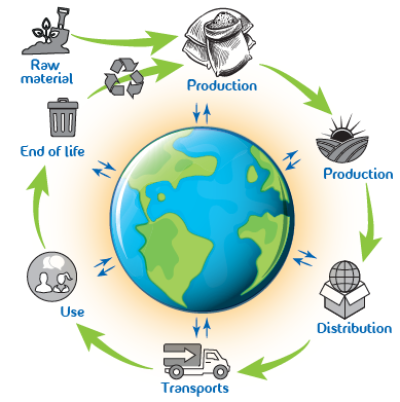
LCA is the internationally recognised method for evaluating the environmental impacts of products and services, in a context of global environmental challenges and the need for more sustainable production systems. LCA makes it possible to quantify all environmental impacts across the entire life cycle, from raw material extraction to end-of-life, and can be applied to products, services, value chains, supply chains, food systems, diets and territories.
The application of LCA to agri-food systems in emerging contexts is recent and presents numerous scientific, partnership and operational challenges. The variability and limited availability of data on tropical value chains require a high level of expertise and in-depth knowledge of both production systems and stakeholders in order to produce robust and reliable results.
LCA is the reference method used by the European Commission to calculate the Product Environmental Footprint (PEF), as well as by international organisations such as the United Nations Environment Programme (UNEP). CIRAD researchers have contributed to the development of global consensus on environmental impact characterisation within international expert groups of the Life Cycle Initiative.
LCA is also the method used to support environmental labelling frameworks introduced under regulations on waste reduction and the circular economy, particularly in priority sectors such as textiles and food.
Figure 1. L'analyse du cycle de vie évalue les impacts sur l'environnement d'une filière « du berceau à la tombe »
Quantifying and reducing the environmental footprint of your processes or products
LCA expert group at CIRAD relies on the best methodological standards for modelling emissions and environmental impacts, combined with extensive expertise in tropical and Mediterranean agricultural, aquaculture, fisheries and forestry value chains. Applied to your product or service, LCA offers a wide range of possibilities, including :
quantifying all potential environmental impacts and identifying key impact hotspots of a product or service;
exploring pathways to reduce environmental impacts through eco-design approaches;
analysing production costs and optimising processes;
identifying the most environmentally efficient alternatives through comparative studies;
assessing the effectiveness of climate change mitigation and adaptation strategies;
identifying relevant performance indicators to monitor impact reduction;
providing robust and quantified evidence to support marketing claims;
implementing Environmental Product Declarations (EPD, e.g. ISO 14025, EU Product Environmental Footprint);
accessing new high-value markets and partnerships;
adapting field-based emission models to tropical conditions.
The multiple beneficiaries of LCA
Within a given value chain, all stakeholders can benefit from this analytical approach :
Agro-industrial companies (food, cosmetics, textiles, etc.) and forestry sector actors
Supporting environmental labelling using a proven and validated methodology
Improving sustainability approaches across the entire value chain
Public institutions and support organisations
Supporting value chains and economic actors in achieving sustainable development objectives.
Technical institutes and consulting firms
Identifying constraints related to sourcing and supply of products from tropical and Mediterranean regions.
Producer organisations and NGOs
Providing tailored support to socio-economic actors on the ground, ensuring alignment between environmental impacts and social and economic realities.
Our partnership offer
This offer is structured around three types of services :
LCA expertise for tropical systems
Comparative Life Cycle Assessment of tropical products
Products eco-design
Sustainable sourcing analysis and support
Critical review of LCA studies (following ISO standards)
Environmental analysis of value chains
LCA tools
A reference database for Life Cycle Inventory (LCI) of tropical products
The MEANS multi-criteria assessment platform and associated datasets available in the dataverse
Training
This offer is currently being developed in collaboration with the ELSA platform (Environmental Life Cycle and Sustainability Assessment) :
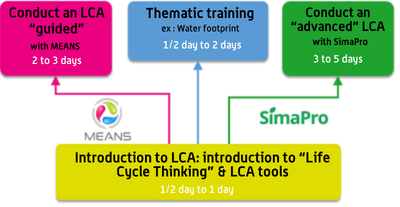
Introduction to life cycle thinking and LCA
Training in conducting LCA for tropical and Mediterranean products using SimaPro and/or the MEANS platform
Training in water foot printing using LCA (ISO 14046 standard)
Figure 2. Training offer in Life Cycle Assessment at CIRAD
The research team With more than 10 years of experience in environmental impact assessment and tool development for tropical and Mediterranean agricultural and forestry products, our team is the leading LCA research group in France in this field. The team is made of agronomists specialised in supply chains of the Global South. In order to disseminate this expertise, the team has recently published an open-access operational guide : for conducting LCA of agri-food production systems in emerging and developing economies.
References
Publications
BassetMens, C., Avadí, A., Bessou, C., Acosta-Alba, I., Biard, Y., Payen, S., 2022. Life Cycle Assessment of agrifood systems. An operational guide dedicated to emerging and developing economies, Quae. ed. éditions Quae. https://doi.org/10.35690/9782-7592-3467-7
Biard, Y. (Cirad), Helias, A., Van der Werf, H. (INRAE), 2021. Loi Climat : « Une méthode qui permet de mieux évaluer les impacts environnementaux des systèmes d’élevage, intensifs ou extensifs ». Le Monde 29/12/2021, 24. https://agritrop.cirad.fr/599943/1/Article%20YB%20Le%20Monde%20Vpapier.pdf
Gentil C, Fantke P, Mottes C, Basset-Mens C, 2020. Challenges and ways forward in pesticide emission and toxicity characterization modelling for tropical conditions. Int J Life Cycle Assess 25(7), 1290-1306. https://doi.org/10.35690/978-2-7592-3467-7
Avadí, A. Marcin, M., Biard, Y., Renou, A., Gourlot, J-P., Basset-Mens, C., 2020. Life cycle assessment of organic and conventional non-Bt cotton products from Mali. Int J LCA 25: 678-697. https://doi.org/10.1007/s11367-020-01731-x
Basset-Mens, C., Rhino, B., Ndereyimana, A., Kleih, U., Biard, Y., 2019. Eco-efficiency of tomato from Rwamagana district in Rwanda: from field constraints to statistical significance. Journal of Cleaner Production 229, 420 - 430.
Basset-Mens C, Payen S, Vanniere H, Braun A, Biard Y,2018. Life cycle assessment of mango systems. In : Achieving sustainable cultivation of mangoes. Galan Sauco Victor (ed.), Lu Ping (ed.). Cambridge : Burleigh Dodds Science Publishing, 429-456. (Burleigh Dodds Series in Agricultural Science, 34) ISBN 978-1-78676-132-3
Basset-Mens, C., Vannière, H., Grasselly, D., Heitz, H., Braun, A., Payen, S., Koch, P., Biard, Y., 2016. Environmental impacts of imported and locally-grown fruits for the French market: a cradle-to-farm-gate LCA study. Fruits 71(2): 93-104. http://dx.doi.org/10.1051/fruits/2015050
Payen, S., Basset-Mens, C., Perret, S.R., 2015. LCA of local and imported tomato: an energy and water trade-off. Journal of Cleaner Production January 87(15): 139-148. DOI:10.1016/j.jclepro.2014.10.007
Bessou C., Basset-Mens C., Tran T., Benoist A., 2013. LCA applied to perennial cropping systems: a review focused on the farm stage. Int J LCA 18: 340-361.
See also
Process study / engineering - Food and agrifood technology