
















Just out 6 October 2026
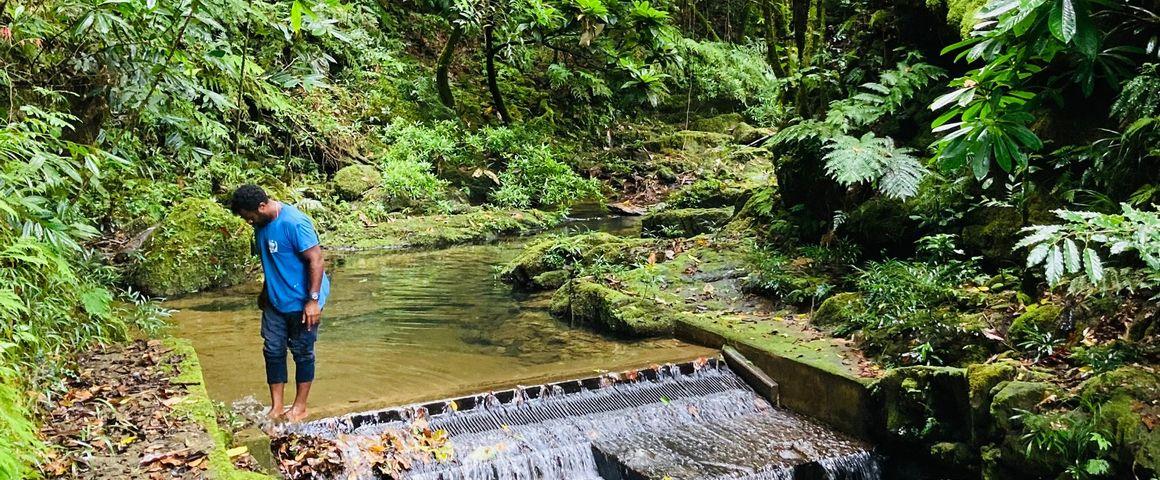
Pombeï reservoir, New Caledonia © Olga Peytavi
The participatory process described in this book, which was launched in early 2018, just before the first referendum in New Caledonia, was supported and piloted by two government representatives from opposing political parties.
Many players from New Caledonia, such as mining companies, farmers and ecologists, were involved in the consultation.
Despite their diverging political and economic interests, all the players involved played an active part in the process and succeeded in completing it.
Water plays a major role in Kanak communities. "Water is a link" between Heaven and Earth, mountains and seas, and between humans and clans.
Clean water, or "good water" supports life and maintains harmony. Conversely, murky water is synonymous with disruption and imbalance. It is not merely a question of a physical alteration in the water: it reflects a profound social or spiritual imbalance. When drought hits and springs dry up, so do social links.
The book shows how these representations of water and traditional water management practices can be integrated into new water management policies and more appropriate management practices that benefit both the environment and the local community.
New Caledonia could serve to inspire policymakers and water managers, particularly in showing how to integrate local know-how, notably that of indigenous communities, when building water governance strategies.
The consultation led to the establishment on the one hand of a policy outline for shared water policy, and on the other to the application of that outline as an operational action plan including more than 700 measures aimed at reconciling and simultaneously addressing three aspects: water for nature, water for health and water for the economy.
The plan hinges on six strategic objectives that were discussed and prioritized during the participatory process:
The book, entitled Water Policy in New Caledonia. Participative Co-building of Water Governance in a Decolonization Process, has four parts:
Caroline Lejars is a researcher at CIRAD (French Agricultural Research Centre for International Development) and currently Deputy Head of the Water Management, Actors, Territories research unit (UMR G-EAU) in Montpellier. Her research focuses on the governance and management of hydrological territories, mainly in North Africa and the Pacific. Most of her research is based on participatory approaches to support the organization of collective action. She has carried out and directed various research projects on groundwater governance, water contracts and arrangements and participatory planning for water policies. She was a lecturer at AgroParistech (2009–2010), and associate professor at the Hassan II National Agronomic Institute in Morocco (2011–2016) and at the New Caledonian Agronomic Institute (2016–2019).
Séverine Bouard is a geographer (PhD). Her research focuses on assessing the extent of agriculture and hunting/fishing among indigenous Pacific communities in the context of the commodification of nature and emerging indigenous discourses on nature and places. She focuses on the trajectories of people and territories, highlighting social change at work. She has taken part in, or led, more than ten research programmes on natural resource management and has developed a research practice deeply rooted in fieldwork. Her aim is to understand and co-design public policies with stakeholders that are based on and respectful of indigenous ontologies and livelihood strategies.
Together with Caroline Lejars, she led the GOUTTE research programme (Water Governance on Customary Lands in New Caledonia), on which this edited volume is based. After twenty years of research at IAC in New Caledonia, she joined the Department of Environmental Management at Lincoln University (NZ) in May 2025.
C. Lejars, S. Bouard (eds.), Water Policy in New Caledonia, Global Issues in Water Policy 32, https://doi.org/10.1007/978-3-031-88196-1
Just out 6 October 2026
Just out 24 June 2026
Just out 12 June 2026