














Results & impact 29 September 2026

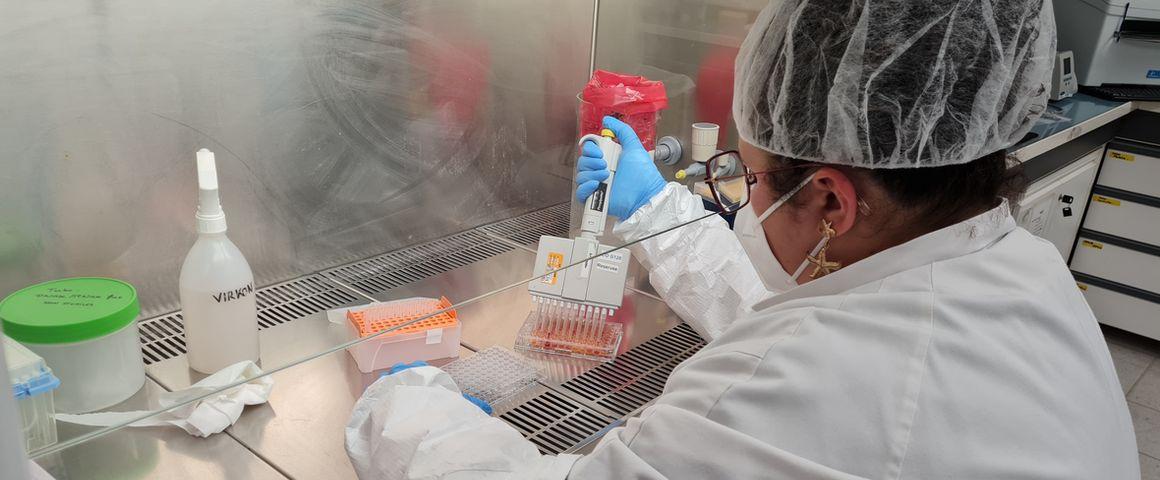
Célia Bernard, eco-epidemiologist and author of the study published in PLOS One, handling blood sera from animals to test for antobodies against the Crimean-Congo haemorrhagic fever virus © C. Dangléant, CIRAD
Since 2015, under an agreement with the Direction générale de l’alimentation (DGAL, the food division of the French Ministry of Agriculture and Food Sovereignty), CIRAD scientists have been studying and monitoring the Hyalomma marginatum tick, one of the known vectors of Crimean-Congo haemorrhagic fever (CCHF). Their work has centred on its distribution area, invasion history in France and hosts, and the infectious agents it carries. In 2023, having detected the virus in Hyalomma marginatum ticks (1), they demonstrated for the first time that the CCHF virus was circulating in the eastern Pyrenees.
In this new study (2), conducted between 2008 and 2022, more than 10 000 blood samples from cattle and wildlife were analysed in southern France. The results showed that 2% of cattle and 2.25% of wild animals (such as deer, roe deer and wild boar) had developed antibodies against the virus, showing that they had probably been in contact with it. The study also highlighted the influence of environmental factors and interactions between wildlife and domestic animals.
The results of the new study suggest that the virus is probably circulating in some of the study zones, although this has not been confirmed.
These results should be taken with a pinch of salt. Only the detection of the virus in ticks, as in the eastern Pyrenees in 2023, can confirm virus circulation in zones where an immune response in animals has been observed.
To date, there have not any cases of CCHF in humans in France. The contaminated animals, whether domestic or wild, have not shown any symptoms. They only carry the virus for a few days and are not a reservoir for it. No specific sanitary steps are required for either domestic animals or wildlife.
The scientists involved are calling for increased monitoring, particularly in at-risk zones, and for integrated approaches to understand and reduce the risks associated with this emerging disease. Several research projects are under way, including the PEPR PREZODE ARCHE project, which is working to understand how the CCHF virus is circulating and emerging in France.
(1) Bernard Célia, Joly Kukla Charlotte , Rakotoarivony Ignace, Duhayon Maxime, Stachurski Frédéric, Huber Karine, Giupponi Carla, Zortman Iyonna, Holzmuller Philippe, Pollet Thomas, Jeanneau Mélanie, Mercey Alice, Vachiery Nathalie, Lefrançois Thierry, Garros Claire, Michaud Vincent, Comtet Loic, Despois Léa, Pourquier Philippe, Picard Caroline, Journeaux Alexandra, Thomas Damien, Godard Sabine, Moissonnier Elodie, Mely Stéphane, Sega Manon, Pannetier Delphine, Baize Sylvain, Vial Laurence. Detection of Crimean–Congo haemorrhagic fever virus in Hyalomma marginatum ticks, southern France, May 2022 and April 2023. Euro Surveill. 2024;29(6):pii=2400023. https://doi.org/10.2807/1560-7917.ES.2024.29.6.2400023
(2) Bernard C, Apolloni A, Grosbois V, Peyraud A, Saengram P, Jori F, et al. (2025) First detection of Crimean Congo Hemorrhagic Fever antibodies in cattle and wildlife of southern continental France: Investigation of explanatory factors. PLoS One 20(9): e0331875. https://doi.org/10.1371/journal.pone.0331875
Results & impact 29 September 2026

Results & impact 21 September 2026
Results & impact 3 September 2026