














- Home
- Worldwide
- Our regional offices
- West Africa - Forest and Humid Savannah
- Actualités : Afrique de l’Ouest – Forêt et savane humide
- B2A more sustainable banana export industry
The B2A project paves the way for a more sustainable banana export industry
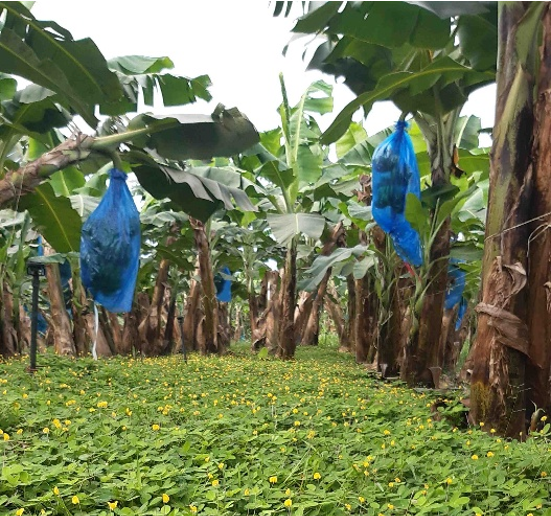
Plant cover in a banana plantation with Arachis repens © Luc De lapeyre, Cirad
Collaborative research to accelerate the agroecological transition of banana plantations
Launched in 2017 and running until 2025, the B2A (Agroecological Banana for Africa) project is the result of a partnership between CIRAD and Compagnie Fruitière, through its subsidiaries in Côte d'Ivoire, Cameroon and Ghana.
Faced with evolving regulations on plant protection products and growing expectations for sustainability, the project explored several ways to reduce reliance on chemical inputs in export banana production systems.
This collaborative research enabled the experimentation, validation, and transfer of innovations that are now being implemented in plantations.
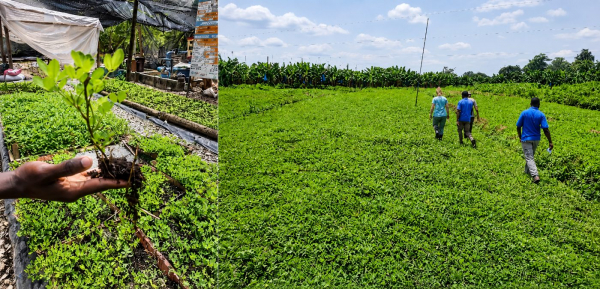
Establishment of nurseries for scaling up the introduction of Arachis repens © Luc De lapeyre, Cirad
Reducing fungicides for more sustainable plant health
One of the project's major achievements concerns the fight against cercospora leaf spot in bananas.
This research has led to the development of warning strategies that have made it possible to phase out mancozeb, a long-standing cornerstone of plant protection. This work has been accompanied by a system for monitoring resistance to systemic fungicides and the evaluation of biocontrol product.
These advances have made it possible to reduce the frequency of phytosanitary treatments by more than 50% and the quantities of active ingredients used by 75% where "zero mancozeb" control strategies are deployed.
The “zero mancozeb” strategy is now deployed on 1,500 hectares of plantations in Ivory Coast, representing 30% of conventional production areas.
Rethinking pest management to reduce pesticides
The project also strengthened the management of nematodes and the banana weevil.
Improved fallow land management, the shredding of contaminated plant residues, the use of trapping with the Cosmolure® pheromone, and the use of healthy plantlets in vitro have all contributed to improved disease prevention.
Two laboratories, in Côte d'Ivoire and Cameroon, were established to monitor plant contamination, with skills transfer and regular audits.
These innovations have led to a 40% reduction in nematicide use and a 97% reduction in insecticide use in Côte d'Ivoire, paving the way for "double zero" strategies (zero nematicides and insecticides).
Optimizing fertilization for systems with lower input requirements
The project also focused on reducing mineral fertilizers.
Evaluating a nitrogen nutrition indicator and better accounting for organic inputs allowed for adjustments to fertilization practices.
Nitrogen inputs were reduced by 20%, while potassium inputs decreased by 30%.
These results confirm that more efficient and input-efficient intensification is possible.
Integrating service plants into the heart of cropping systems
Another lever explored by B2A is the integration of cover crops into cropping systems.
Cover plants during fallow periods, particularly crotalaria, and legumes such as Arachis repens under banana plantations help improve soil biological function and reduce the need for herbicides.
Herbicide’s use has thus been reduced by 40%.
These practices illustrate the potential of agroecological approaches at the cropping system level.
Research innovations already deployed in plantations
Beyond the results obtained, B2A demonstrates that the agroecological transition of export banana sectors is already underway.
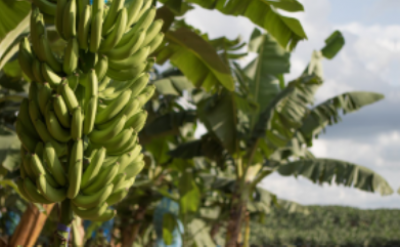
In the heart of tropical banana plantations © B2A, Cirad
By combining research, real-world experimentation, and implementation in plantations, the project opens up possibilities for reconciling competitiveness, reduced inputs, and environmental sustainability.
This work contributes to rethinking banana systems in Africa and shows that credible alternatives to conventional models are already being developed.