
















- Home
- Worldwide
- Our regional offices
- Southern Africa and Madagascar
- News : Southern Africa and Madagascar
- Putting indigenous foods at the heart of healthier and more sustainable African food systems
Putting indigenous foods at the heart of healthier and more sustainable African food systems

Dr Arlène Alpha, CIRAD Senior Researcher and CoE-FS and FAMA Project Lead, outlined FAMA’s multidisciplinary approach. Photo Diaulos Media/CoE-FS.
Across Africa, changing diets are contributing to a growing triple burden of malnutrition, combining undernutrition, micronutrient deficiencies and diet-related non-communicable diseases. At the same time, many indigenous and traditional foods remain underused despite their nutritional, cultural and environmental value.
Can these foods help address some of today's food and nutrition challenges? This was the question at the heart of the Food and Microbiota (FAMA) project. Over two years, researchers worked with communities, farmers, food businesses and policymakers in South Africa and Senegal to investigate the potential of indigenous foods to support gut health and healthier diets—and, importantly, to understand what would be needed for these foods to become more widely produced and consumed.
The project was established within the Transforming Food Systems and Agriculture through Research in Partnership with Africa (TSARA) initiative, with support from the French Embassy in South Africa and CIRAD.
Looking beyond nutrition to understand the whole food system
FAMA brought together expertise spanning consumer research, food processing, microbiology, agriculture and public policy. Rather than considering indigenous foods only as a question of nutrition, the project examined the systems that shape what people can grow, buy, prepare and eat.
Four traditional African plant-based foods, including sorghum-based products such as motoho and amaranth, were investigated across communities. The research combined consumer studies with laboratory analyses of food and gut microbiota, alongside work on production, processing and policy.
This interdisciplinary approach was one of the project's defining features.
FAMA is an example of the interdisciplinary partnerships needed to transform contemporary food systems.
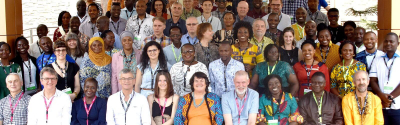
The closing workshop brought these different perspectives together, highlighting a central lesson from the project: improving diets cannot be separated from the wider food systems that make those diets possible.
What consumers think matters as much as what foods contain
The research showed that revitalising indigenous foods will require more than demonstrating their nutritional value.
In the South African communities involved in the project, traditional foods remain associated with health and well-being by many consumers. Yet younger generations are becoming less familiar with them as urbanisation, changing lifestyles and evolving food preferences reshape eating habits.
The situation in Senegal provides a contrasting picture. Traditional dishes are experiencing renewed interest and appear increasingly compatible with contemporary lifestyles. Consumers are increasingly associating them with health and nutrition, alongside their cultural significance.
These differences point to the importance of understanding the social and cultural dimensions of food choice. The future of indigenous foods will depend not only on their nutritional properties, but also on whether they fit the lifestyles, expectations and aspirations of today's consumers.
Exploring the link between traditional foods and gut health
FAMA also investigated how traditional African foods interact with the gut microbiota—the community of microorganisms living in the digestive system and playing an important role in human health.
Laboratory experiments using in-vitro digestion suggested that the foods studied could positively influence gut microbial communities. However, the results varied according to the food tested, the digestion procedure and the individual donor. The findings therefore provide promising indications, rather than definitive evidence of health effects in people.
They nevertheless add to a growing body of research highlighting the potential value of diverse, plant-rich diets.
Like Mediterranean diets — diverse, plant-rich African diets support healthier microbial communities than highly processed Westernised diets.
The project also explored how indigenous crops could be adapted to contemporary food environments. Sorghum, for example, can be developed into convenient food products while retaining nutritional characteristics, including a potentially lower glycaemic impact.
For such products to gain wider acceptance, however, stronger scientific evidence will be needed. Participants at the closing workshop stressed that robust evidence is essential to support future health claims, build consumer confidence and encourage investment in indigenous food products.
From farmers to markets, the value chain is part of the solution
Putting indigenous foods back on people's plates also means ensuring that they are available in the first place. Research in South African communities showed that self-production and wild harvesting remain important ways of accessing traditional foods. This suggests that supporting indigenous foods cannot rely exclusively on conventional markets. At the same time, work with farmers and small businesses explored opportunities to strengthen production, agro-processing and the development of new products. These initiatives demonstrated the potential for indigenous foods to create economic opportunities while contributing to more diverse agricultural systems.
Yet significant barriers remain. Producers and businesses face difficulties accessing quality seed, technical knowledge, appropriate processing technologies, finance and reliable markets.
Strengthening these value chains could therefore deliver benefits well beyond dietary diversity. It could support rural livelihoods, create opportunities for small enterprises and contribute to more climate-resilient agricultural systems.
Creating an enabling policy environment
The closing discussions also highlighted the role of public policy. Despite growing recognition of the nutritional, environmental and cultural value of indigenous foods, support from public institutions remains limited in many contexts. Fragmented governance and policy frameworks that favour commodity-oriented agriculture can make it difficult to develop more diverse local food systems.
Participants called for closer coordination between governments, researchers, industry and civil society. Such collaboration will be needed to translate scientific evidence into policies that support producers while making healthier and more diverse foods more accessible to consumers.
Public procurement could be one avenue for creating demand—for example, by incorporating indigenous foods into school meals and other public food programmes.
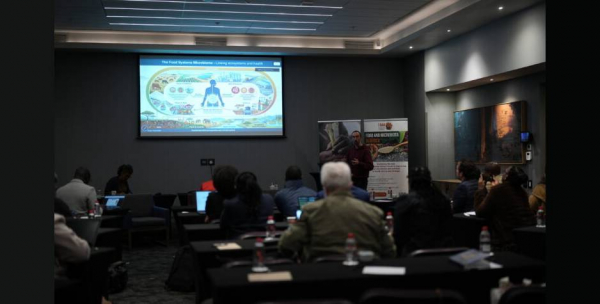
Dr Florian Kroll, CoE-FS Project Lead, served as facilitator for the day. © Diaulos Media/CoE-FS.
What comes after FAMA?
The closing of FAMA, on June 30th, 2026 marks the end of a project, but not the end of the questions it has raised.
Participants identified a number of priorities for the years ahead: expanding community seed banks; supporting small businesses developing indigenous food products; strengthening public procurement; improving coordination between government departments; completing further research on gut microbiota; protecting intellectual property; and building the scientific evidence needed for future health claims.
One message cut across all these priorities: knowledge must circulate beyond the research community.
If indigenous foods are to play a greater role in Africa's future food systems, children and young people will need opportunities to rediscover them. Consumers need accessible information about their nutritional and cultural value. Policymakers and health professionals need evidence that can inform decisions. Farmers and businesses need practical knowledge and support to develop viable value chains.
The FAMA project has shown that the potential of indigenous foods cannot be reduced to a single nutritional property or a single stage of the food chain. Their contribution to healthier and more sustainable diets depends on connecting research, agriculture, food processing, markets, culture, consumer behaviour and public policy.
The next challenge is to turn this knowledge into action—and to ensure that Africa's rich diversity of traditional foods becomes an asset for the food systems of the future.