













- Home
- Worldwide
- Our regional offices
- Southern Africa and Madagascar
- News : Southern Africa and Madagascar
- Mucheni Community Conservancy elects board that will strengthen community-based natural resource management
Mucheni Community Conservancy elects board that will strengthen community-based natural resource management in the region.
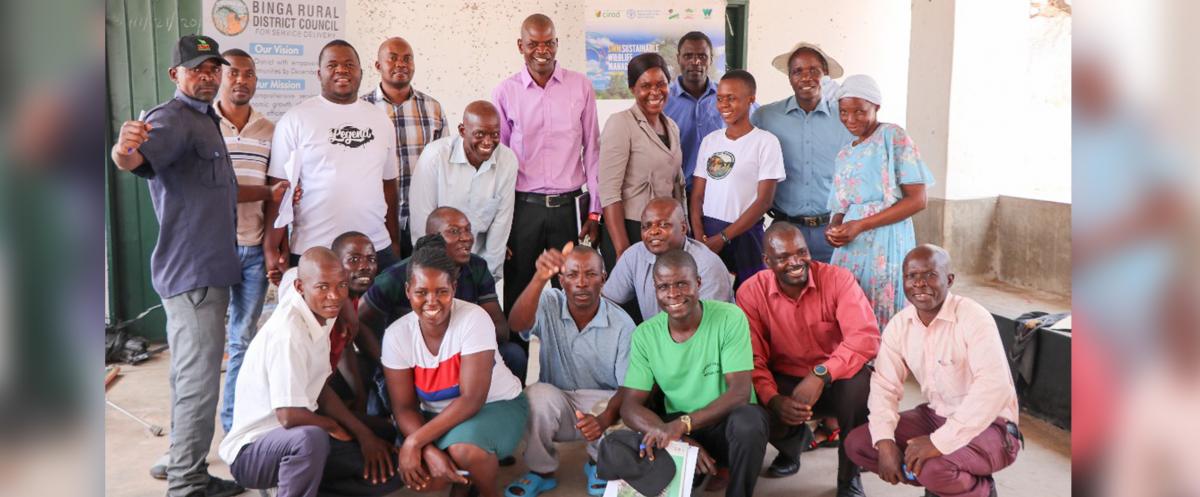
Ward Environment COmmittee Members from Ward 5 - Sinakoma pause for a photo after the successful elections © M.Katsi, Cirad
The elections followed the official adoption of the Mucheni Community Conservancy Constitution by the BRDC, a critical step that provides a clear governance framework for the conservancy’s operations. For the first time, the communities of the Sinakoma, Sinampande, and Sinansengwe chiefdoms have a legally recognized structure to guide their participation in managing the wildlife and natural resources upon which their livelihoods depend.
The adoption of the MCC Constitution and subsequent elections mark a transformative moment for community-based natural resources management in Zimbabwe,...
This is not merely about filling positions; it is about establishing a democratic precedent where communities are the true custodians and beneficiaries of their natural heritage.
A model of inclusive leadership
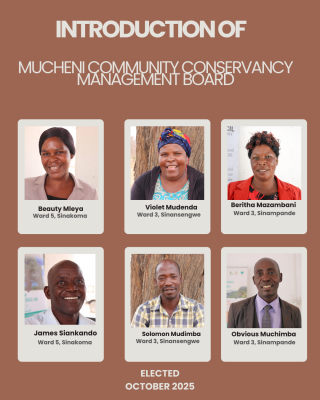
2025 board members
The MCC Constitution mandates gender-balanced and inclusive leadership, ensuring that each of the three chiefdoms is represented by one female and one male representative. Following extensive community awareness and consultation meetings on governance and transparent selection processes, six board members were democratically elected. The members are Beauty Mleya and James Siankando from Sinakoma; Violet Mudenda and Solomon Mudimba from Sinansengwe; and Beritha Mazambani and Obvious Muchimba from Sinampande.
We were taught about what good leadership means and why following the constitution is important for our future...
The process was clear and fair, and we have confidence that our new leaders will genuinely represent our interests in managing the conservancy.
Overcoming historical challenges
This achievement is particularly notable given the historical challenges faced by community-based conservation in Zimbabwe. Programmes like the Communal Areas Management Programme for Indigenous Resources (CAMPFIRE), established by the government in the late 1980s, have often struggled with limited community empowerment, weak governance structures, and conflicts over resource access, and insufficient financial capacity. The establishment of the MCC management board, with its strong constitutional foundation, directly addresses these issues by decentralizing management and building robust, accountable local institutions.
We are proud to see communities in Binga taking ownership of conservation through structured leadership,” said Nqobizitha Ndlovu, SWM Programme Legal Consultant...
These elections demonstrate a fundamental shift—communities now understand that sustainable wildlife management begins with accountable governance. When people have a direct stake and a clear voice, they become the most effective guardians of their environment.
The newly elected board members will assume office upon the completion of mandatory police clearances, a final step to ensure integrity and transparency...
Their mandate will be to steer the conservancy towards sustainable resource management, negotiate equitable benefit-sharing agreements, and ensure that conservation translates into tangible improvements in local livelihoods.
This process demonstrates that with the right tools and knowledge, communities can effectively lead their own conservation efforts,
added Muzamba.
It is a replicable model of empowerment that other conservancies across the region can learn from.
Muzamba emphasized that
for conservation measures to succeed, communities must be at the centre of development activities and be engaged in decision-making processes...
when we talk about empowering rural communities, it’s not just about conservation. It is also about developing local skills and institutions to manage wildlife.
The SWM Programme in Zimbabwe is supporting the Mucheni Community Conservancy to improve community natural resources governance, livelihoods and the sustainable management of wildlife.
About the SWM Programme
The SWM Programme is a major international initiative funded by the European Union with co-funding from the French Facility for Global Environment (FFEM) and the French Development Agency (AFD). It is implemented by a consortium of partners that include the French Agricultural Research Centre for International Development (CIRAD), the Food and Agriculture Organization of the United Nations (FAO), the Center for International Forestry Research and World Agroforestry (CIFOR-ICRAF) and the Wildlife Conservation Society (WCS), and, it pilots community-centric conservation models in 15 countries. In Zimbabwe, CIRAD leads the implementation of the activities in Binga District with support from the BRDC.