















- Home
- Worldwide
- Our regional offices
- Southeast Asian Islands
- News : Southeast Asian Islands
- Second-generation biofuels cannot be improvised
From tropical residues to biorefineries: organizing supply chains before oil shocks
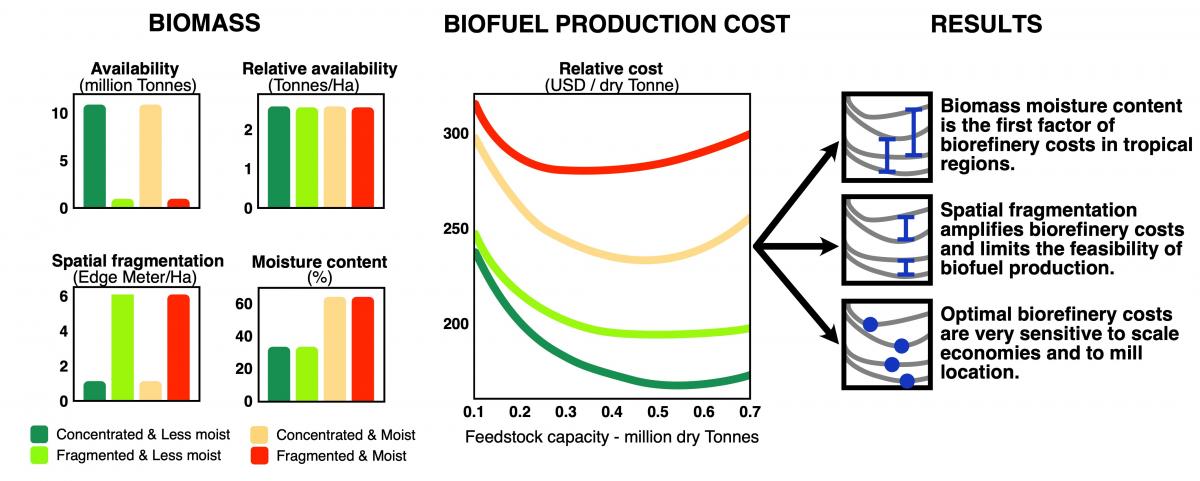
Moisture, spatial fragmentation, relative availability, and economies of scale structure the cost of tropical second-generation biofuels. © CIRAD / C. Ong / J.-M. Roda
Biofuels require strategic preparation: inventories of the biomass resource, supply contracts, logistics, post-harvest and pretreatment, transportation, scaling up to industrial level, and location of facilities. This constraint is particularly strong in tropical countries, where biomass is abundant but heterogeneous, dispersed, and often wet.
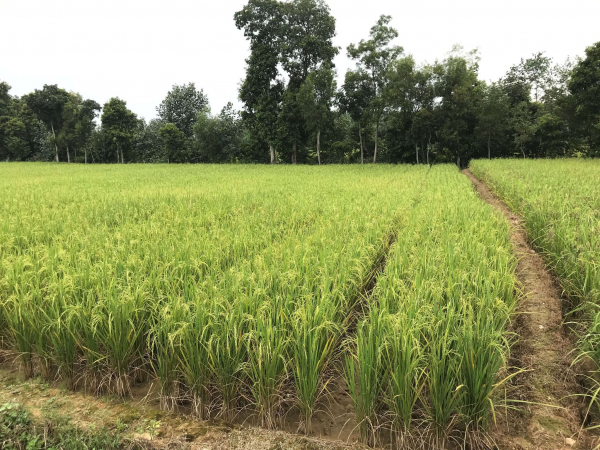
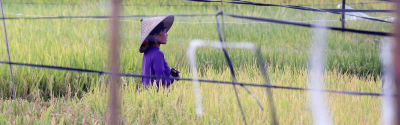
Small rice field in Sumatra (Indonesia), source of rice straw. © JM Roda
Our work focuses on second-generation biofuels. They are not produced from food crops intended for sugar, starch, or vegetable oils. They rely on non-food lignocellulosic biomass: agricultural residues, forest residues, agro-industrial co-products, woody biomass, straw, bagasse, husks, trunks, palms, and other residues. They fall under a circular economy logic: transforming already-produced biological residues into energy carriers, without direct competition with human food.
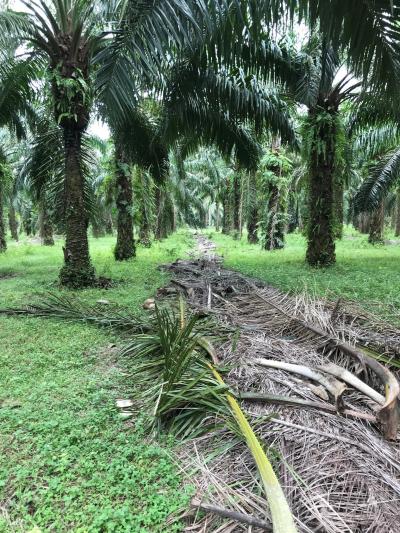
Another type of agricultural residue: palm fronds arranged in lines between the rows of an oil palm plantation in Sumatra (Indonesia). © JM Roda
These results are based on two scientific articles. Ong et al. (2020) show that landscape structure and spatial fragmentation strongly affect the transport costs of agricultural and forest residues in Malaysia. Ong and Roda (2025) then quantify the effect of moisture, relative availability, yield density, supply strategies, and the location of biorefineries on production costs in Peninsular Malaysia. The economic and political meaning is: a residue is not yet a resource. It only becomes a resource if it can be collected, dried, transported, concentrated, and processed at the right scale.
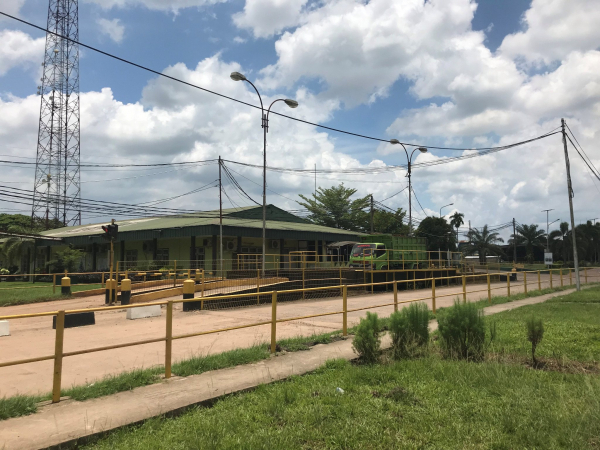
Weighbridge to measure fresh and agricultural biomass at the input and output of an oil palm mill in Sumatra (Indonesia). © JM Roda
For insular Southeast Asia, this work positions CIRAD on a strategic topic linking climate change, circular bioeconomy, tropical biomass, industrial ecology, and energy sovereignty. The region has significant volumes of agricultural and forestry residues. However, their mobilization depends on detailed spatial analyses, robust logistics, and long-term partnerships with public agencies, research institutions, and industrial operators.