







- Home
- Worldwide
- Our regional offices
- Continental Southeast Asia
- News : Continental Southeast Asia
- Workshop national capacity soil health monitoring Laos
Workshop builds national capacity for soil health monitoring in Laos

Dr PHAN Thi Ngan, CIRAD, speaking during the workshop on soil nematodes at the Faculty of Agriculture, National University of Laos.
On 3 September 2025, the Faculty of Agriculture of the National University of Laos hosted a workshop on soil nematodes, led by CIRAD in partnership with IRD and the Department of Land and Agricultural Management under the FEF-SOLAO project. The training focused on building national capacity for soil health monitoring.
Soil health under pressure
In Laos, soil degradation is accelerating under the combined effects of intensive agriculture, mining, hydropower projects, and deforestation. This decline threatens agricultural productivity and also poses health risks, as some soil pathogens, such as geohelminths, can affect human health.
The SOLAO project, funded by the French Embassy in Laos, aims to lay the foundations for a national monitoring plan that integrates both soil and human health dimensions. Activities focus on two main components: pilot data collection at the International Centre for Environmental Research (CIREN) in Nakai, and capacity building for national institutions.
Understanding the hidden role of nematodes

Dr PHAN Thi Ngan during the training session. © SOLAO
The workshop aimed to raise awareness among researchers and students about nematodes, an organism essential to soil health but often overlooked. We focused especially on rice nematodes, combining theoretical knowledge with practical microscopy sessions.
Nematodes are microscopic roundworms, invisible to the naked eye, yet present everywhere in soil. Some are beneficial, feeding on bacteria and fungi, but others are plant parasites that can cause serious yield losses. In Southeast Asia, phytoparasitic nematodes that attack rice can reduce harvests by up to 15%.
Strengthening local laboratory capacities
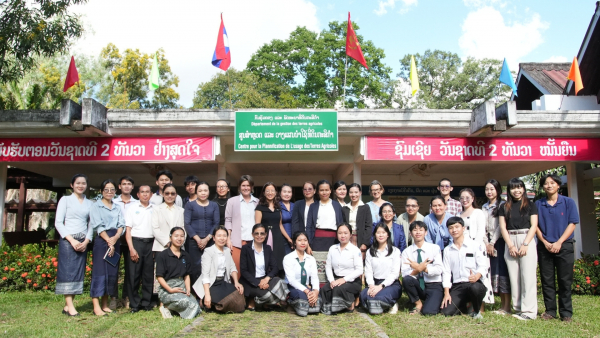
Dr Florine Degrune, Dr PHAN Thi Ngan, along with other project members and participants of the nematode training workshop at the Faculty of Agriculture, National University of Laos. © SOLAO
There is a pressing need to develop methods that go beyond chemical and physical analyses for assessing soil health, and to strengthen staff qualifications, in order to improve the overall quality of data produced by soil laboratories,
The training was organised under the FEF-SOLAO project, as part of its accompaniment to the Department of Land and Agricultural Management (DLAM) in developing a National Soil Health Monitoring Plan for Laos. It focused on strengthening the capacities of the national soil laboratory by introducing new knowledge and methods for detecting and monitoring rice nematodes, as well as applying integrated management strategies such as water and organic matter management, crop rotation with legumes, resistant varieties, and biological control using bacteria and fungi.
The project also promotes the use of biological indicators, such as nematodes, on top of traditional chemical and physical analyses to assess soil health. The nematode training, led by Dr Ngan, CIRAD, marks the start of a series of capacity-building workshops planned under the project, which will continue to reinforce the skills of soil-laboratory staff and expand the range of tools available for soil health monitoring in Laos.
Why training on nematodes matters for Laos

Dr PHAN Thi Ngan during the laboratory session of the workshop. © SOLAO
Rice covers about 80% of cultivated land in Laos and accounts for 42% of the country’s GDP. Ensuring its productivity is a national priority. Nematodes, which attack roots and weaken crops, pose a persistent challenge for rice producers.
According to Dr Florine Degrune and Dr PHAN Thi Ngan, there is a pressing need to build the skills of local technicians and diversify analytical methods so that Laos can gradually conduct its own soil health monitoring without relying solely on external expertise.