






- Home
- Worldwide
- Our regional offices
- Continental Southeast Asia
- News : Continental Southeast Asia
- Vietnam–Senegal Exchange Agroecology Food Security
Vietnam–Senegal Exchange Advances Agroecology and Food Security
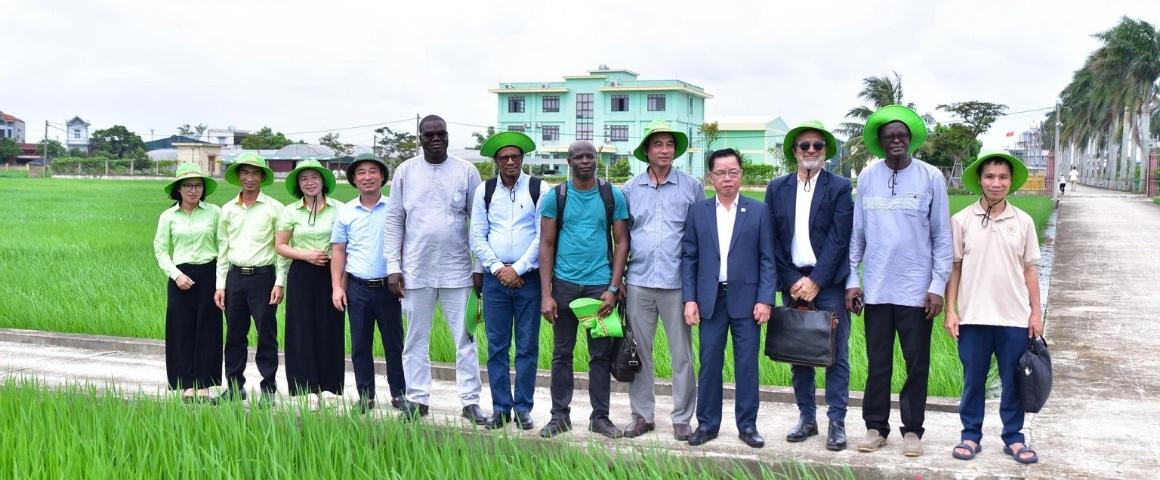
The Senegalese delegation visiting ThaiBinh Seed’s rice breeding facilities in Hưng Yên province. © C. Quan, VAN news
From May to August 2025, Vietnam and Senegal strengthened their scientific and agricultural partnership through a pair of reciprocal study missions under the FEF-R project on "Supporting Vietnam in its cooperation projects with other Southern countries in the fields of agroecology and the development of sustainable practices in rice," coordinated by CIRAD and supported by the French Ministry for Europe and Foreign Affairs. Focused on agroecology and rice systems, the initiative marks a new stage in South–South cooperation between Asia and Africa, with France as a key facilitator.
Two Missions, One Agenda for Agroecology and Food Security
In May 2025, a Vietnamese delegation visited Senegal on a study mission. The program included meetings with government agencies, research institutes, farmer organizations, NGOs, and international partners, to explore farming systems, innovations, and policies, laying the groundwork for the partnership.
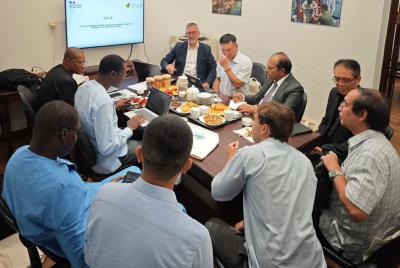
The Senegalese delegation meeting with FAO representatives at the CIRAD office in Hanoi. © L. Vo, CIRAD
In return, from August 18 to 22, 2025, a delegation of high-level Senegalese scientists and policymakers from the Senegalese Institute of Agricultural Research (ISRA), the National Program for Rice Self-Sufficiency (PNAR), and the Senegal River Development Authority (SAED) visited Vietnam, accompanied by a CIRAD researcher based in Senegal. Their program combined high-level policy dialogues in Hanoi, including meetings with the Vietnam Academy of Agricultural Sciences (VAAS), the Institute of Policy and Strategy for Agriculture and Environment (IPSAE), and international partners such as the FAO, the EU, AFD, and IFAD, as well as visits with the private sector.
This project confirmed that Vietnam and Senegal face common challenges: climate change, salinization, and the need for resilient farming systems. But they also bring complementary strengths. Vietnam offers models of rice intensification, irrigation, seed systems, and low-emission farming, while Senegal contributes community-based agroecological innovation and strong political commitment to food sovereignty.

Dr. Kouakou Patrice, CIRAD researcher in Dakar, speaking during the wrap-up session in Hanoi. © C. Quan, VAN news
"The strength of this cooperation lies first in the existence of the FEF-R project, funded by the French Ministry of Foreign Affairs, which made these two missions possible, and the support of CIRAD, whose researchers are present in both West Africa and Southeast Asia. At the political level, there was recently a mission by the President of the National Assembly of Vietnam to Senegal, so the political framework is already in place to facilitate cooperation."
Learning from Vietnam's Transformation
At the Ministry of Agriculture and Environment's International Cooperation Department (ICD) in Hanoi on August 18, the Senegalese delegation emphasized rice as its central priority. Senegal cultivates 200,000 hectares of rice but still relies heavily on imports.

The Senegalese delegation at the Ministry of Agriculture’s International Cooperation Department in Hanoi. © C. Nguyen, VAN news
"Vietnam once went from being food-deficient to one of the world's leading rice exporters," said Dr. Waly Diouf, Coordinator of PNAR, addressing Vietnamese officials. "We are eager to learn from that invaluable experience, not only to achieve national rice self-sufficiency but also to move toward exports."
Discussions focused on Vietnam's journey, from the policy reforms of the 1980s that secured food security to the country's ambitious One Million Hectare Low-Emission Rice Project today. Senegalese experts admired Vietnam's pragmatic and low-cost technologies, as well as its ability to combine policy leadership, research, and private sector participation. Understanding how Vietnam's land and investment policies catalyzed transformation is particularly relevant for Senegal's development.
Observing Agroecology in Practice: ASSET project visit
The delegation visited farms and research sites within the ASSET project (Agroecology and Safe Food System Transitions, coordinated in Vietnam by CIRAD, in collaboration with national partners) to explore agroecological practices in action. At the Northwest Agriculture and Forestry Research and Development Center, they visited a 512 m² greenhouse producing 80,000–100,000 hybrid coffee seedlings annually, alongside thousands of shade-tree seedlings for agroforestry.

La délégation sénégalaise visite les sites du projet ASSET dans la région de Son La, Vietnam. © C. Nguyen, VAN news
During the visit, Dr. Abou Sall, Director of Development and Local Government Support at SAED, remarked: "We saw important agroecological experiments, organic rice fertilized only with compost, agroforestry coffee systems, and simple yet effective technologies. These are experiences from which Senegal can draw inspiration for its food sovereignty program."
The group also discussed Son La's supportive policies, including a 2015 land-use reform that restructured production on sloping land, helping the province become a hub for fruit crops such as mango, longan, and plum, as well as industrial crops like coffee and tea.
Engaging the Private Sector: ThaiBinh Seed
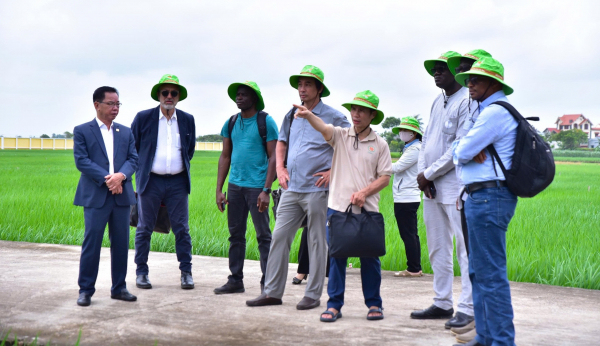
The Senegalese delegation visiting ASSET project sites in Son La province, Vietnam. © C. Nguyen, VAN news
On August 21, in Hung Yen Province, the delegation shifted its focus to the private sector. At Thai Binh Seed, a pioneering Vietnamese seed company, they toured the 140-hectare research institute and modern processing plants, with a combined capacity of 30,000–40,000 tons per year. Thai Binh Seed supplies around one-fifth of Vietnam's seed demand and has developed or licensed dozens of national varieties.
The Senegalese scientists valued this integrated model, which links breeding, testing, approval, intellectual property, and commercialization. "Benchmarking Vietnam's seed system will help Senegal strengthen its own," commented Dr. Madiama Cissé, Scientific Director of ISRA.
Chairman Trần Mạnh Báo underlined the company's readiness: "We are ready to share experience and support Senegal in rice seed research and production."
Building the way forward together
On August 22 at the CIRAD office in Hanoi, the delegation wrapped up their visit with a discussion involving representatives from VAAS, the Ministry of Agriculture and the Environment, AFD, the EU, and the French Embassy, exploring potential areas for future cooperation.

Wrap-up meeting in Hanoi between the Senegalese delegation, CIRAD, and Vietnamese partners to review exchanges and outline the next steps for scientific cooperation in agroecology © C. Quan, VAN news
- Priority crops: Participants discussed focusing on three crops, rice for food security, groundnut for oil and nutrition, and cashew for income and export diversification.
- Capacity building: Both sides expressed interest in student and researcher exchanges, staff training, and on-site learning opportunities.
- Institutional frameworks: Ideas included an MoU between VAAS and ISRA, supported by ministerial-level agreements. CIRAD also emphasized the value of its regional partnership platforms in West Africa and Southeast Asia, which can facilitate sustained inter-regional collaboration.

Dr. Waly Diouf, Coordinator of Senegal’s National Rice Self-Sufficiency Program (PNAR), speaking during the wrap-up meeting in Hanoi. © C. Quan, VAN News
Reflecting at the close of the mission, Dr. Waly Diouf (PNAR) stressed the broader stakes:
"By pooling the strengths of our three countries – Senegal, Vietnam, and France – we have a strong chance to significantly advance agriculture, for the benefit of humanity as a whole."