













- Home
- Worldwide
- Our regional offices
- Continental Southeast Asia
- News : Continental Southeast Asia
- Global experts Viet Nam Bioprotection Sustainable Agriculture
Global Experts gather in Viet Nam on Bioprotection for Sustainable Agriculture

The opening ceremony of the International Conference on Bioprotection for Sustainable Agriculture (ICBPSA25) at Hue University of Agriculture and Forestry, August 2025 © ICBPSA
In August 2025, the University of Agriculture and Forestry, Hue University (HUAF), together with CIRAD, hosted the International Conference on Bioprotection for Sustainable Agriculture (ICBPSA25), welcoming over 100 researchers, practitioners, and students. With 25 scientific papers submitted and participation from at least nine countries and over ten institutions, ICBPSA25 served as a hub for scientific exchange on agroecological practices.
A Global Partnership for Advancing Bioprotection

Dr. François Roger, CIRAD Regional Director for Continental Southeast Asia, delivers the opening remarks at ICBPSA25 © ICBPSA
ICBPSA25 was co-organized by CIRAD and the University of Agriculture and Forestry, Hue University (HUAF), together with leading Vietnamese institutions such as Can Tho University, Nong Lam University, Tay Nguyen University, the Vietnam National University of Agriculture, and the Plant Protection Research Institute. The program also involved international partners, including CABI, the Tokyo University of Agriculture and Technology (Japan), Andalas University (Indonesia), and the International Weed Science Society.
The conference was supported by the France–Vietnam Year of Innovation, the French Embassy in Vietnam, and private sector sponsors such as Ca Mau Fertilizer and Bio-Pro. By bringing together key players across science, policy, and industry, the conference created a complete picture of the challenges and solutions shaping sustainable agriculture.
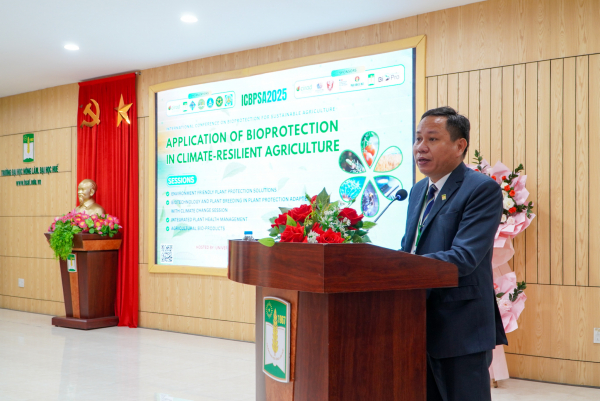
Assoc. Prof. Dr. Trần Thanh Đức, Rector of Hue University of Agriculture and Forestry, delivers the opening remarks at ICBPSA25 © ICBPSA
We hope the conference will bring significant scientific value, inspire new research, and make practical contributions to green and sustainable agriculture in the future
Sustainable methods without sacrificing yields

Dr. Didier Lesueur, CIRAD, presents the Common Microbial Biotechnology Platform (CMBP) during a session at the ICBPSA25 © ICBPSA
The two-day conference centered around four scientific themes that show how bioprotection makes it possible to reduce fertilizers and pesticides without sacrificing yields or quality, challenging the assumption that more inputs are always necessary for higher productivity:
- Developing environment-friendly crop protection: Researchers highlighted solutions that reduce pesticide dependence and support healthier soils and crops.
- Protecting rice in a changing climate: Research on microbial products and resistant varieties showed how Asia’s staple crop can be both productive and more climate-friendly, cutting fertilizer use and greenhouse gas emissions while withstanding major diseases.
- Smarter-crop management for better and safer harvests: Research on fertilization, pest thresholds, and residue behavior showed how integrated plant health strategies can improve productivity while cutting unnecessary inputs.
- Scaling up through innovation: From plant extracts and natural polymers to the mass production of beneficial insects, new bio-based solutions are moving closer to farm use as alternatives to synthetic pesticides.

Ms. Linna Ngang, CIRAD, presents her research on pest and disease dynamics in Cambodian rice systems © ICBPSA
These sessions featured CIRAD researchers sharing advances from their work in the region. Dr. Pierre Lefeuvre shared breakthroughs in high-throughput sequencing for faster detection of plant viruses, while Dr. Didier Lesueur showed how microbial inoculants support coffee and pepper crops. Other contributions included Dr. Frédéric Labbé on citrus disease evolution, Dr. Phan Thị Ngân on nematode management in rice, Mr. Francisco Martinez Martinez on ecological interactions, and Ms. Linna Ngang on pest and disease dynamics in Cambodian rice systems.
Scaling up bioprotection remains challenging
Farmers already have many alternatives to pesticides, from natural enemies and pheromones to resistant varieties and new diagnostics. The real challenge is making these solutions practical and accessible. Adoption depends on the right support system: training, reliable products, and incentives for farmers to move away from heavy pesticide use.
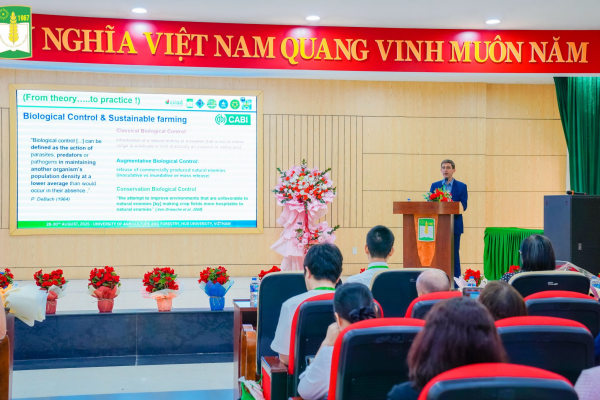
Dr. Arnaud Costa, CABI, presents on biological control and sustainable farming © ICBPSA
Technology is part of the answer, but accessibility remains an obstacle. Dr. Pierre Lefeuvre, CIRAD, showed how high-throughput sequencing can detect plant viruses with unprecedented speed and precision. Yet in developing countries, cost and infrastructure still limit its use.
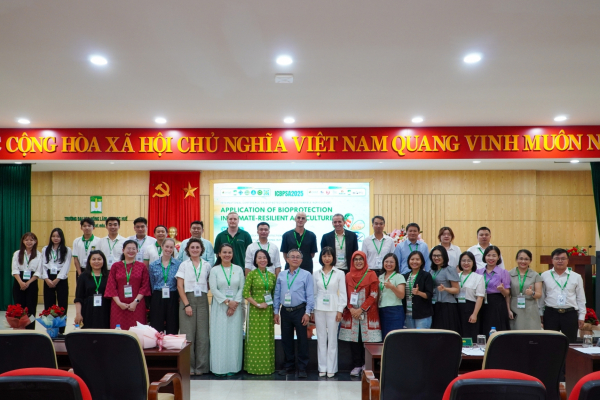
The organizing committee and international speakers from session 1 gather for a group photo © ICBPSA
Despite the challenges in scaling up, the need for IPM is becoming clearer. Dr. Harinder Singh of the Weed Science Society pointed to the spread of herbicide-resistant weeds as a warning that depending on single control methods is risky, and that more diverse crop protection strategies will be required. For Viet Nam, Dr. Hoang Thi Thai Hoa (HUAF) and Dr. Tran Thi Thu Ha (TUAF) added that such strategies also have to be rooted in local conditions, with farmer training and stronger research support playing a central role in making bioprotection viable in practice.
Linking research with farming practice
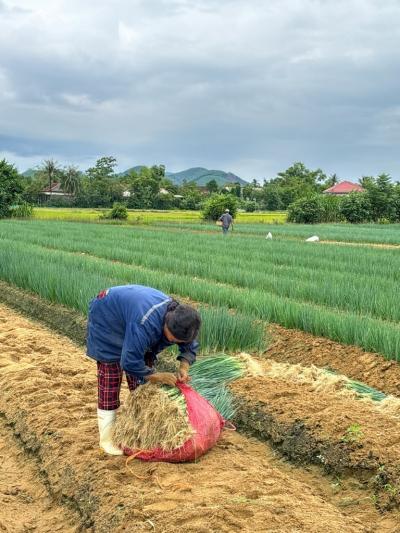
Onion farmers in Huong An share their experiences with adopting bioprotection practices during the field visit. © L. Vo, CIRAD
The field visits highlighted both the difficulties and the opportunities of putting research into practice. In Huong An, onion farmers explained challenges of adoption at the grassroots level: while some use microbiome-based fertilizers, neighboring fields still rely on conventional inputs, making it hard to see clear benefits.
Participants then visited a rau má (Centella asiatica) processing site under Viet Nam’s OCOP (One Commune, One Product) program, a national initiative that supports local cooperatives to develop regional specialties. With support from agricultural and medical universities, the cooperative has learned to turn a fresh, perishable herb into tea powder, adding value and new income streams.
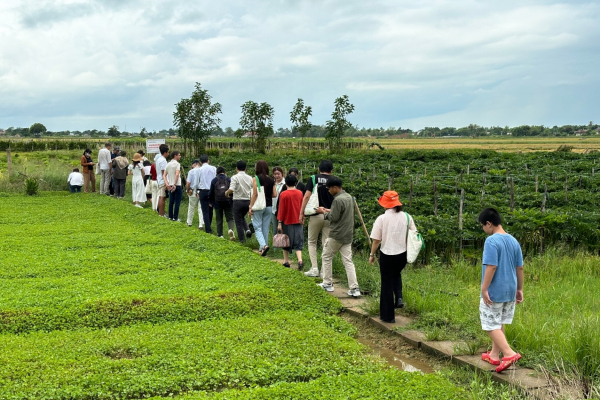
ICBPSA25 participants visit a Centella asiatica (rau má) cooperative in Huế, part of Viet Nam’s OCOP program, during the conference field trip © L. Vo, CIRAD
With plenary discussions, scientific presentations, and field visits, the intensive two-day program showed that bioprotection is advancing on two fronts: in laboratories where new tools are being developed, and in the field where farmers test them under real conditions. ICBPSA25 created a platform for scientists, policymakers, and practitioners to share perspectives, but moving from innovation to adoption will depend on supportive policies and stronger systems that help farmers put sustainable practices into action.