

















- Home
- Worldwide
- Our regional offices
- Continental Southeast Asia
- News : Continental Southeast Asia
- Final Workshop Drought Adaptation Thailand Mun River Basin
Final Workshop Marks a Milestone for Drought Adaptation in Thailand’s Mun River Basin
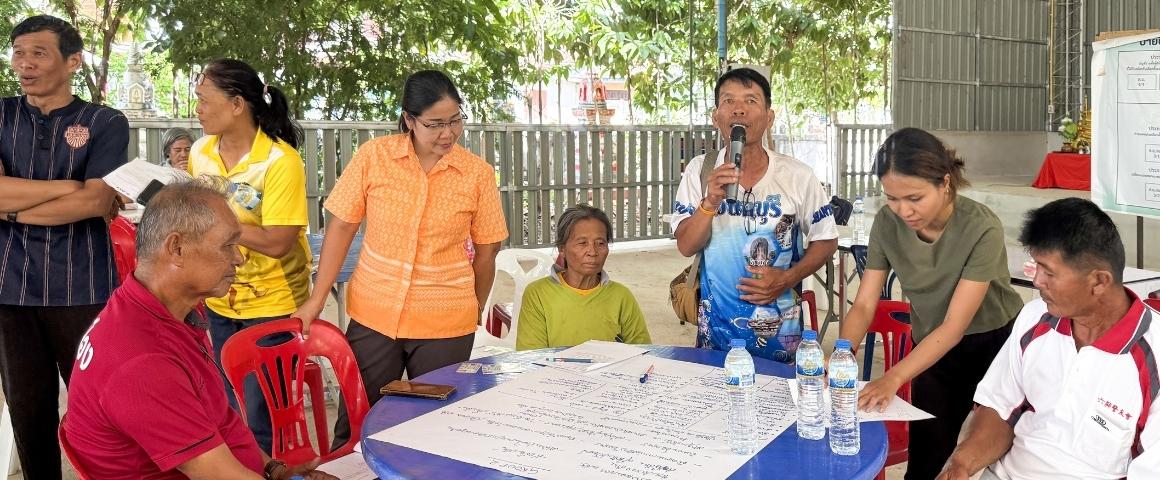
Focus Group Discussion with farmers involved in a project implemented by the Department of Water Resources in June 2025, Buriram Province, Thailand © G Lacombe, CIRAD
On 22 July 2025, the final workshop of the DIWAM project "From Drought Impacts to Water Adaptations in the Upper Mun River Basin" was held at the Asian Institute of Technology (AIT) Conference Centre, Pathum Thani. The event brought together over 60 key stakeholders from Thai government agencies, local communities, and research institutions to reflect on the project's results and explore the possibility of a second phase.
With droughts becoming more frequent and severe in Thailand, particularly in the northeastern region, where agriculture is dominant but highly vulnerable, DIWAM has worked over the past year to assess real-world drought impacts on smallholder farmers, examine existing adaptation measures, and explore ways to make them more effective and scalable.
A Collaborative Approach to Understanding and Adapting to Drought
Launched in August 2024, the DIWAM project was jointly implemented by CIRAD, the Asian Institute of Technology (AIT), and the Stockholm Environment Institute (SEI), with funding from the French Ministry of Europe and Foreign Affairs through the Fonds Équipe France.
The project focused on the Mun River Basin in Northeast Thailand, the country's driest and also most impoverished region. The region is characterized by sandy and saline soils, land dominated by agriculture, and limited rice yields, making it one of the most vulnerable areas to drought.
By working in this challenging landscape, DIWAM sought to:
- Assess how drought actually impacts farming households and rural livelihood
- Compare on-the-ground experiences with model-based drought assessments
- Map the institutions involved in water and drought management
- Identify which adaptation strategies are most effective and how they can be scaled up
- Understand what factors make institution-led projects successful and sustainable
From Fieldwork to Insights
To achieve these objectives, the project carried out research in six sites across Nakhon Ratchasima and Buriram provinces. Each site was tied to projects managed by different Thai government agencies, covering areas such as irrigation, groundwater, land use, reservoirs, and community-based farming.
These sites were selected to capture a diverse range of adaptation approaches: from large collective irrigation systems to small-scale, farm-level models designed for self-reliance. By comparing them, the project could better understand not only the technical and environmental dimensions of drought response, but also how institutions and farmers experience and shape these interventions.

Reservoir on the Mun River Basin integrating wetlands as nature-based water storage for irrigation. © Google Earth
Water storage built by the Department of Water Resources for collective use by riparian communities illustrates one of these adaptation approaches. Communities are expected to define irrigation water-sharing rules and maintenance fees in agreement with local administrations. An attempt to preserve a former wetland in the middle of the reservoir is visible in the photo. This site corresponds to the riverbed of the Mun River, once rich in wetlands. It illustrates ongoing efforts to implement “nature-based solutions,” i.e. improving the natural water storage capacities of wetlands to meet irrigation requirements.
Farmers' Needs at the Heart of Adaptation
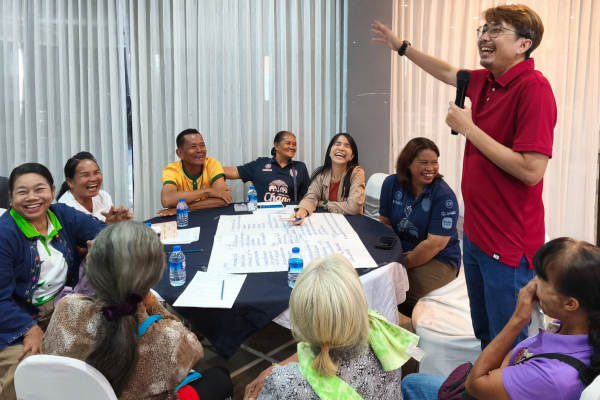
Focus group discussion with farmers involved in the “Khok Nong Na” project implemented by the Community Development Department, Buriram Province, Thailand, June 2025 © G. Lacombe, CIRAD
A large-scale survey effort, supported by local university teams, produced 27,500 data entries covering demographics, crop production, drought experience, institutional engagement, and farmer preferences. This mix of evidence and lived experience provided fresh insight into what makes drought adaptation work and where improvements are needed to make it more sustainable and scalable.
These consultations looked at mandates, activities, and ongoing projects, with the aim of identifying where responsibilities overlapped, where gaps remained, and how different agencies could better complement one another. By combining institutional mapping with field-level evidence, DIWAM highlighted the importance of participatory design. Future drought adaptation projects should be developed in ways that account for site-specific conditions, farmers’ needs, and their existing knowledge and skills
This analysis set the stage for important discussions in the final workshop, where agency representatives and community leaders exchanged perspectives on how national programs and local realities could be better connected to respond to the needs of farmers.
Next steps for the Mun River Basin
At the final workshop, the conversation shifted from diagnosis to action. The knowledge gathered during DIWAM’s first year will feed into a second phase focused on testing concrete solutions in the field: new ways of managing water in rice cultivation, techniques for balancing ponds and recharging groundwater, farm practices like soil compaction that can reduce water loss, etc.
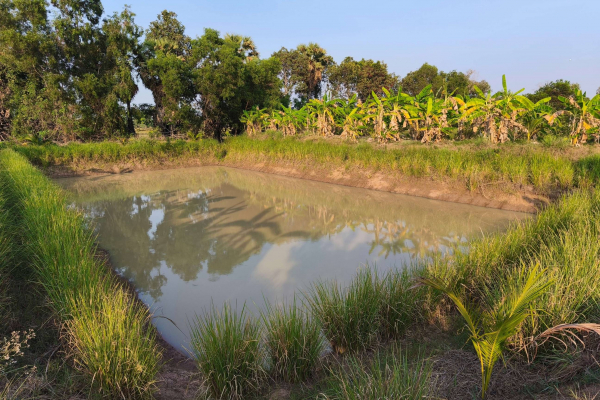
Pond subsidized by the Land Development Department for integrated farming combining irrigation of fruit tree orchards, supplementary irrigation of rice nurseries and aquaculture (fish raising), April 2025, Nakhon Ratchasima Province, Thailand © G. Lacombe, CIRAD
Stakeholders stressed that future projects must be guided not only by technical performance, but also by precise cost–benefit analysis and by approaches that look at the bigger picture: how water use connects with energy needs, food production, and the livelihoods of farming families.
The proposed second phase also places greater emphasis on monitoring and evaluation, so that successful practices can be identified and scaled. And by aligning with international frameworks such as the Rio Conventions, it would connect local adaptation in Northeast Thailand with global efforts to tackle climate change and land degradation.
This analysis set the stage for important discussions in the final workshop, where agency representatives and community leaders exchanged perspectives on how national programs and local realities could be better connected to respond to the needs of farmers.
A Shared Commitment to Resilience
What became clear during the workshop is that resilience cannot be built by farmers alone, nor by institutions working in isolation. By bringing these perspectives together, DIWAM has created a platform where science, policy, and practice meet. The lessons drawn from the Mun River Basin can serve the country’s driest and poorest region and inspire broader actions for a future where droughts will be more frequent and resilience more essential.